
The first time I saw aluminum foil taped behind a radiator, I honestly thought it was a joke. A sort of DIY tinfoil hat, but for the living room. It was at a friend’s flat in an old brick building where the windows rattled every time the bus passed. The heating hissed all day, and yet everyone still kept their sweaters on indoors. Rent was just about manageable. The energy bill, not so much.
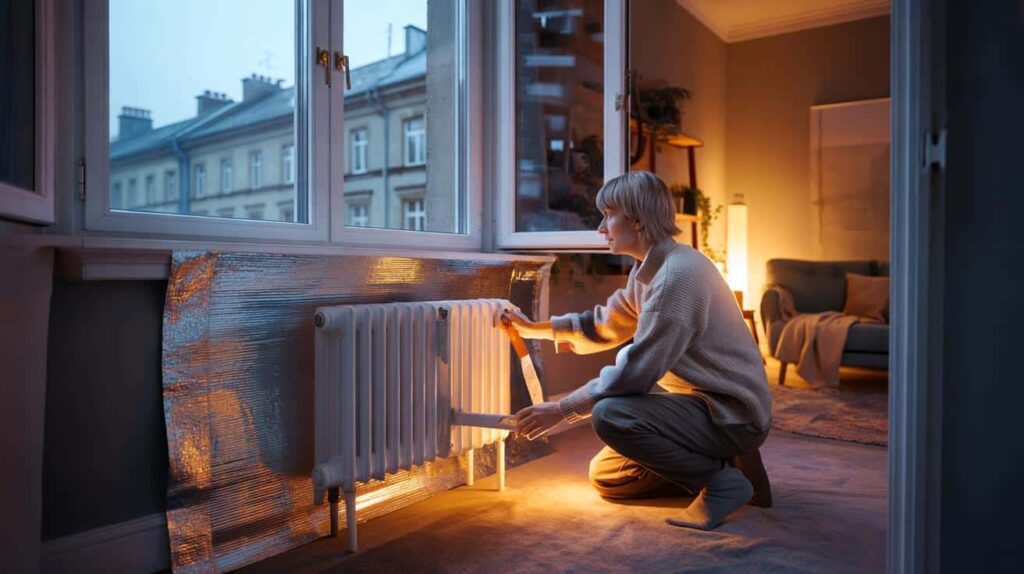
She pointed to the wall behind her radiator. A smooth, bright panel made of cheap foil and a bit of cardboard. “My dad did this in the 80s,” she laughed. “Said the heat shouldn’t go into the wall if I’m the one paying for it.” A few weeks later, her bill arrived. Down. Not by a miracle, but enough to notice. That night, a strange thought stuck with me.
What if one of the cheapest “hacks” for heating has just been hiding behind the radiator the whole time?

Why your radiator quietly heats the street instead of your feet
Spend a winter in any older apartment and you start to feel where the heat escapes. The outside wall feels oddly warm, the window frames sweat with condensation, and the radiator is blazing while your toes are still cold. You can almost picture your money drifting out through the brickwork. A lot of that comes from a simple, annoying fact: radiators don’t only heat the room, they also heat the wall behind them.

That wall, especially on an outside facade, acts like a sponge for warmth. Once it’s hot, it happily shares its heat with the outside air. Brick, stone, poorly insulated concrete — they all leak energy slowly, constantly, silently. So you crank the thermostat up a notch. Then another. The room finally feels cosy, but the meter is spinning. The strange part? A large share of that loss happens just a few centimetres behind your radiator.
Engineers have measured this for decades. A radiator throws out heat in two ways: convection (warming the air that rises) and radiation (like a tiny sun toward whatever surface faces it). Without any reflective layer, a surprising slice of that radiant heat goes straight into the wall. That means you end up warming bricks instead of bodies. The logic behind the aluminum foil trick is brutally simple: if that heat wants to go somewhere, why not bounce it back to you?
The quiet power of a sheet of foil behind the radiator
The basic method sounds almost too simple. You take a thin, heat-resistant backing — cardboard, stiff paperboard, or better, a piece of foam insulation or specialist reflective panel — and cover one side with aluminum foil. Shiny side out. Then you fix this board against the wall behind the radiator, from as low as you can reach to as high as the radiator itself, sometimes a bit more. Nothing touches the hot metal directly, and you leave air to move freely around it.
That shiny surface acts like a mirror for infrared radiation. Instead of being swallowed up by the wall, a good share of the heat is sent back into the room. Tests in British homes have shown that **fuel consumption can drop by around 5–10%** on radiators placed on external walls when proper reflective panels are used. Not a lottery win, but on a full winter’s heating bill, that starts to be real money. Especially if you multiply it by several radiators.
There’s also a very human side to this. You’re not changing your entire heating system. You’re not calling a technician or signing a long contract. You’re standing there with a roll of foil, a pair of scissors, a bit of tape or adhesive strips, doing something very tangible. *You see the panel, you feel the heat change, you see the bill.* For a lot of people, that’s the first time energy efficiency stops sounding like a government brochure and starts looking like a doable Sunday project.
How to do it well (and what people quietly get wrong)
Start with one radiator on an outside wall, ideally in the room you heat the most. Measure the width and height of the back of the radiator or, easier, the area of wall it covers. Cut a piece of cardboard, thin plywood, or rigid foam board to match. Wrap or coat one side with aluminum foil, shiny side facing outward, smoothing it as best you can while accepting a few wrinkles. Those don’t kill the effect.
Fix this reflective board to the wall, not to the radiator. Leave a small gap at the bottom so air can still flow. Use adhesive strips, velcro, or small screws if the wall allows it. The idea is simple: the panel stands flat against the wall, the radiator sits a few centimetres in front of it, and the shiny surface faces the metal. If you want a cleaner look or slightly better performance, you can use ready-made reflective radiator panels from DIY stores, which are just a more polished version of the same idea.
A few things often go wrong, and they’re very human. People push furniture tight against the radiator, blocking airflow. They cover the foil with a curtain or a decorative panel “so it doesn’t look weird”. They forget that dusty panels reflect less, just like a dirty mirror. Let’s be honest: nobody really wipes behind their radiators every single month. Still, once or twice a winter is already a win.
 Pension cuts spark outrage because most people misunderstand how adjustments are calculated
The one emotional frame here is simple: we’ve all been there, that moment when the bill arrives and you feel a mix of guilt and helplessness. This little hack doesn’t fix everything. Yet it feels like reclaiming a bit of control, with tools you already have in the kitchen drawer. One afternoon, one roll of foil, a handful of degrees that suddenly stay inside the room.
Tips, pitfalls and that strange satisfaction of “beating” the bill
If you want real impact, treat it like a mini project, not a half-hearted experiment. Start by listing all the radiators on external walls, then prioritise the ones in the living room and bedrooms where you spend the most time. Use slightly thicker backing material if you can, such as 5 mm foam board or specific radiator foil panels, which add some insulation as well as reflection. Always keep a few centimetres’ distance from the radiator to avoid heat damage.
One smart move is to combine this with a basic thermostat check. Once the reflective panels are up, try lowering the thermostat by just 0.5 to 1°C and see how it feels over a few days. Many people report that **the room feels warmer at the same setting**, simply because less heat is lost. The saving effect grows over weeks, not days, so don’t expect a miracle the first night. It’s the slow, steady kind of win that shows up silently on the quarterly bill.
There are also classic traps. Some people use flammable backing too close to very hot radiators, or tape foil directly onto pipes. Others block the top of radiators with shelves full of plants, stopping hot air from circulating properly. A few hang heavy curtains right in front of everything and then wonder why nothing changed. If your radiators already sit in recessed niches in the wall, you may need custom-cut panels to cover the whole back surface, not just a strip in the middle.
*The plain truth: a foil panel won’t turn a badly insulated house into a passive home, but it can be one of the cheapest “why not?” upgrades you’ll ever try.*
“Once I put reflective panels behind the radiators on my outside walls, my gas usage dropped by roughly 7% over the winter compared to the year before, with similar temperatures,” explains Martin, a 42‑year‑old homeowner in Leeds. “It didn’t feel life-changing day to day. But when I saw the bill, then did the maths on how little it cost me, I realised this is the kind of small habit that quietly pays off every single year.”
- Use shiny aluminum side facing the radiator: this reflects more radiant heat back into the room.
- Cover as much wall area behind the radiator as possible: small strips only give small gains.
- Leave room for air to flow freely: top and bottom of the radiator should stay unobstructed.
- Combine with thick curtains at night and closed doors: each layer keeps more warmth inside.
- Review once a year: check for peeling, dust, and damage, then replace if needed.
When a “grandma trick” suddenly feels like modern common sense
Talk to older generations and many will shrug: “We did that ages ago.” Yet somehow, between glossy ads for smart thermostats and expensive triple glazing, the cheap little sheet of foil behind the radiator slipped off the radar. It doesn’t photograph well. It’s not glamorous. You can’t really brag about it at a dinner party. And still, those who try it rarely go back.
There’s something almost quietly rebellious about using kitchen foil to outsmart rising energy prices. It’s not about being perfect or living a zero‑carbon lifestyle. It’s about taking small, stubborn steps that say: I won’t just absorb every price rise without lifting a finger. When enough people do that, the story of winter changes a bit. Slightly lower bills. Slightly warmer rooms. Slightly less anxiety when the weather forecast turns blue and the thermostat clicks on again.

Maybe that’s the real power of this forgotten trick. Not the percentage on a graph, but the feeling that heating your home doesn’t have to be a mysterious, untouchable thing, controlled only by suppliers and systems. Sometimes the most effective move is also the most humble one — hidden behind the radiator, silent, a thin layer of foil that quietly reflects more warmth back to where you are.

| Key point | Detail | Value for the reader |
|---|---|---|
| Reflective foil limits wall heat loss | Foil behind radiators bounces radiant heat back into the room instead of into external walls | More warmth for the same energy used, especially on outside walls |
| Low-cost, DIY-friendly solution | Requires only foil and simple backing material, can be installed in an afternoon | Immediate, affordable action against high heating bills without professional work |
| Best combined with small habits | Lower thermostat slightly, keep radiators clear, close curtains at night | Stacked savings over the whole winter with minimal lifestyle changes |
FAQ:
- Does regular kitchen aluminum foil really work behind radiators?Yes, kitchen foil does reflect radiant heat and helps reduce heat loss through external walls. Specialist reflective panels perform a bit better and are more durable, but basic foil on a stable backing still gives a noticeable effect.
- Is it safe to put foil directly on the radiator?No, avoid sticking foil directly onto the hot metal. Fix it to the wall using cardboard or insulation board as backing, leaving a gap between the foil and the radiator for air circulation.
- How much money can I realistically save?Independent tests suggest savings around 5–10% on heating energy for radiators on outside walls. The exact number depends on your insulation, fuel type, and how many radiators you equip.
- Will this help in a very well-insulated new home?The gain is smaller in highly insulated, modern buildings because wall losses are already limited. Even then, reflective panels can slightly improve comfort and help you run at a lower thermostat setting.
- Can I remove the foil later without damaging the wall?Yes, if you use removable adhesive strips, velcro pads, or mount the foil on a lightweight board that simply hangs in place, you can take everything down with minimal or no marks on the wall.
