
The Australian state of Victoria is betting big on underground rail, and French companies have quietly secured a central role in one of the most ambitious urban transport projects on the planet.
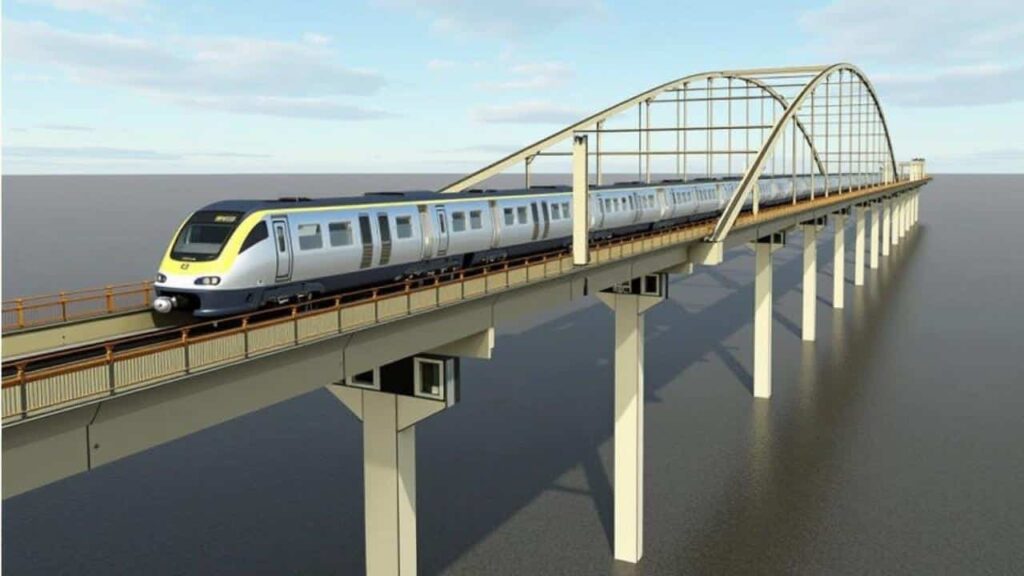
What is Melbourne’s 90km suburban rail loop?
The Suburban Rail Loop (SRL) is a planned 90-kilometre circle line that will run beneath Melbourne’s suburbs, linking major activity centres, universities and hospitals without forcing commuters back through the crowded city centre.
Think of it as an underground ring road, but for trains. The full project is currently priced at more than 125 billion Australian dollars, roughly 75 billion euros at today’s rates, making it the largest infrastructure programme ever attempted in Australia.

Launched as part of Victoria’s “Big Build” agenda, the Suburban Rail Loop aims to reshape Melbourne’s growth for the next 50 to 70 years.

The loop will be built in stages. The first and most advanced segment, SRL East, will run through Melbourne’s southeast and is where French influence is already unmistakable.
SRL East: the first test of a huge bet
SRL East is the pilot stretch that must prove the whole concept works. It includes:
- 26 kilometres of twin tunnels
- Six new underground stations
- A fully automated metro system
- New depots and control centres
This package has been awarded to an alliance called TransitLinX, with a total value of 8.8 billion Australian dollars, about 5 billion euros.
French rail giant Alstom has secured a one‑billion‑euro slice of that contract. Its scope is not just about selling trains; it covers the core of how the system will actually work day after day.
Local politics around SRL are intense. Supporters see a once‑in‑a‑generation upgrade that will unlock housing and jobs along the route. Critics worry about spiralling costs and long construction timelines. Whether SRL East runs smoothly will shape how voters judge the entire loop.
Under Melbourne, a difficult and costly playground
Australia’s biggest city-building project is colliding with geological and economic reality.
Challenging ground conditions
Melbourne’s subsoil is anything but uniform. Engineers must navigate:
- Shifting clay layers at depth
- Significant groundwater and aquifers
- Existing utilities and dense built-up areas
Managing tunnelling machines in that environment requires slow progress, constant monitoring and robust contingency plans. Any misstep risks ground movement at the surface or water ingress underground, both politically explosive in residential suburbs.
Costs under pressure
The SRL is also being built in a tough macroeconomic climate. Material prices have climbed since the pandemic, skilled labour is scarce, and energy bills remain high. Those factors have already pushed budgets upward and forced a revision of the project timeline.
That financial tension makes reliability a political issue. If the first section operates smoothly, arguments for the remaining stages gain strength. Delays or technical failures would hand fresh ammunition to opponents.
Driverless, but not brainless: Melbourne’s future metros
At the centre of the French role is the shift to fully automated trains. Alstom will supply 13 Metropolis metro sets for SRL East, each made up of four cars, running at the highest level of automation used in urban rail: GoA4 (Grade of Automation 4).
In plain terms, that means no drivers. Trains start, stop, open and close their doors and handle incidents through centralised control and on-board systems.
The nerve system is a communication-based train control (CBTC) signalling platform called Urbalis Forward. It continuously calculates the precise position and speed of each train, allowing them to run closer together without sacrificing safety.
CBTC lets operators push more trains through the same tunnel, cutting waiting times while keeping safety margins under strict digital control.
Australia already has experience with this model. Since 2019, Sydney’s Metro North West line – also equipped by Alstom – has run automatically, providing a reference point for Melbourne’s planners.
Made in Victoria: why Dandenong matters
One reason France has become so prominent on the SRL is a conscious effort to “Australianise” the project. The new metro trains will not be imported fully built from Europe.
Instead, assembly will take place at Alstom’s historic facility in Dandenong, about 40 kilometres from central Melbourne. That decision helps secure local jobs, smooths political concerns over foreign contractors and builds up long-term manufacturing capacity in Victoria.
The contract also includes 15 years of maintenance, delivered through Alstom’s FlexCare Perform programme. A new depot in Heatherton will store and service up to 36 trains, creating a long-term base for technicians and operators.

From concrete to control rooms: a French chain of expertise
Alstom is not the only French player embedded in this Australian mega‑project. Two other major groups from France are already locked in.
RATP Dev: the operator’s mindset from day one
RATP Dev, the international arm of Paris’s metro operator, has joined the Linewide Alliance that shapes how SRL East will run. Its involvement starts long before passengers set foot on a platform.
For the next decade, RATP Dev will work alongside designers and builders on station layouts, operating procedures and emergency plans. The goal is simple: ensure that what is being built today can cope with peak-hour crowds and service disruptions tomorrow.
From 2035, a joint venture between RATP Dev and Australian contractor John Holland – under the TransitLinX banner – is expected to operate and maintain the line for 15 years. With 14 GoA4 metro lines already under its belt, from Paris to Riyadh, the company brings lived experience of fully automated networks.
Bouygues Construction and the hard work underground
Bouygues Construction, another French heavyweight, is handling one of the key civil engineering packages for SRL East’s northern tunnels under a contract worth 343 million euros.
That includes preparing massive launch sites for tunnel boring machines and managing excavation in difficult ground. For Bouygues, it extends a long track record in tunnelling projects worldwide, from road tunnels to metros.
Taken together, Alstom, RATP Dev and Bouygues form a continuous French value chain: from tunnelling and station boxes to software, signalling and operations.
A system designed as a single organism
One of the project’s defining choices is to treat the railway as a tightly integrated whole rather than as a series of disconnected contracts.
Alstom’s role spans:
- Rolling stock (the metro trains themselves)
- Signalling and train control
- On-board and trackside communications
- Platform screen doors
- Centralised control and supervision
- Cybersecurity across the network
That integration happens within the TransitLinX alliance, which brings together John Holland, KBR, WSP, Alstom and RATP Dev. The idea is to reduce interface risks, where small incompatibilities between systems can lead to years of delay.
What this means for daily life in Melbourne
If SRL East delivers on its promises, the everyday impact could be significant. Trips that now require a long detour via central Melbourne should become short cross‑suburb hops.
Hospitals, campuses and business districts along the route would gain direct, high‑frequency connections. This could support higher-density housing near stations, more jobs in the suburbs and less reliance on cars for commutes.
| Aspect | Today | With SRL East |
|---|---|---|
| Typical suburb‑to‑suburb trip | Bus + train via city centre | Single direct metro ride |
| Service pattern | Mixed, with driver-operated trains | Fully automated, high-frequency metro |
| Urban development | Car-oriented, dispersed | More dense hubs around stations |
There are risks. Construction will be disruptive for residents along the route. Property markets may heat up around future station locations, creating concerns about affordability. And if cost inflation continues, governments could face tough choices on later stages of the loop.
Key terms and how they play out on the ground
Several technical expressions around the SRL have very concrete consequences.
GoA4 (Grade of Automation 4) is the highest category for automated metros. Trains operate without staff in the cab. Human teams still monitor systems, manage incidents and maintain infrastructure, but not from behind a windscreen at the front of the train.
CBTC (communication-based train control) uses continuous, secure radio links and on‑board computers to manage train spacing. Instead of relying on fixed signals set far apart, the system calculates “moving blocks” around each train, squeezing more capacity out of the same pair of tracks.
System integration sounds abstract, yet it decides whether passengers face frequent breakdowns or smooth journeys. When train software, platform doors, power systems and station alarms share data effectively, recovery from a fault is quick. When they do not, operators must fall back to manual procedures and long delays.
For Melbourne, the cumulative effect of these technologies is powerful: shorter headways, consistent timetables and the ability to scale up services as population grows along the corridor, without entirely rebuilding the system.
If the SRL succeeds, it could shift how other sprawling cities in Australasia and beyond think about suburban transport – and cement France’s position as a go‑to partner for those that choose to go underground on a grand scale.
 France moves to lock in control of a crucial battery material Europe’s carmakers can’t live without
