In northern Canada, a classic Boeing 737 has been reshaped into a strange hybrid: half cargo hauler, half passenger jet, tailored to reach remote Arctic communities that depend on the next flight for food, fuel and medicine.
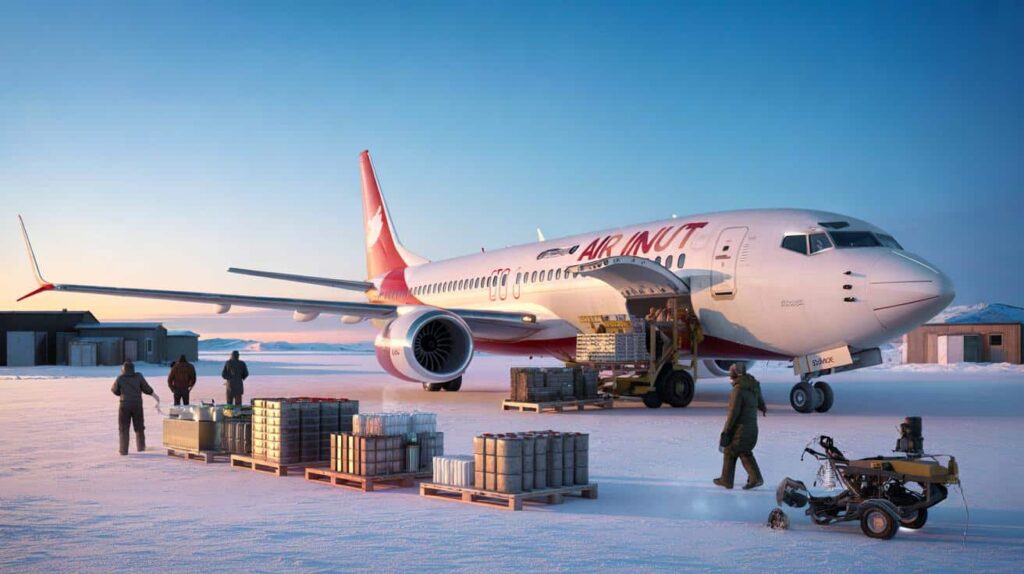
A 737 that works like a flying lifeline
Regional carrier Air Inuit has introduced a heavily modified Boeing 737-800NG “combi” aircraft, certified by Transport Canada to carry passengers and freight on the same deck. It is one of the most unusual uses of the popular single-aisle jet.
The aircraft is already scheduled to operate routes between Montreal and Kuujjuaq in Nunavik, northern Quebec, with flights set up to reflect a basic reality of the Arctic: people traffic changes day by day, but cargo never stops.
This 737-800NG combi can load five full cargo pallets in the forward cabin while seating up to 90 passengers in the rear, giving one flight two missions.

On some days, seats will be full of workers, nurses or local residents heading south. On others, the cabin will be dominated by freight: food containers, medical supplies, spare parts, snowmobile engines or industrial tools that keep remote villages running.
Traditional passenger jets flying half empty on these routes simply do not make economic sense. A combi allows Air Inuit to maintain regular schedules while adjusting the mix of cargo and passengers without adding extra flights.
How a combi layout actually works
On Air Inuit’s aircraft, the forward section of the main deck is converted into a dedicated cargo zone. Pallets are loaded through a large side cargo door, rolled into place on floor tracks and locked down.
- Front cabin: up to five standard cargo pallets
- Rear cabin: up to 90 economy-class seats
- One main deck: freight and passengers share the same level but remain physically separated
- Flexible layout: seats or pallets can be reconfigured between flights
A rigid bulkhead divides the freight area from the passenger cabin. Behind it, the interior looks familiar: rows of seats, overhead bins, galleys and toilets, just like a regular 737 serving big-city routes.
Regulators set the toughest hurdles
Why putting people and pallets together is complicated
The main barrier to this project was not simply cutting metal and rearranging seats. It was satisfying the strict rules that allow passengers to travel within the same pressurised space as stacked freight.
Fire is the nightmare scenario. Pallets can include cardboard boxes, plastic containers and fuel-driven machinery, all of which increase fire risk. Any incident in the forward hold must be detected and contained long before it threatens the passenger cabin.
The 737-800NG combi adds cargo fire detection, halon-based fire suppression, reinforced partitions and adapted structure borrowed from dedicated freighter designs.
Transport Canada’s certification demands multiple layers of protection:
- Automatic smoke and heat sensors throughout the cargo section
- Halon fire suppression systems capable of flooding the freight area
- Sealed, reinforced bulkheads to block smoke and flames
- Structural reinforcements to handle shifting loads during turbulence
- Emergency procedures and crew training tailored to a dual-use cabin
Only once these systems proved reliable under test conditions did regulators give the green light for commercial service.
Canada-led engineering: turning a standard jet into an Arctic workhorse
A heavy industrial conversion on home soil
The transformation was carried out by KF Aerospace, a Canadian maintenance and modification specialist. The company designed and manufactured hundreds of bespoke parts, from cargo floor structures to new doors, ducts and wiring harnesses.
Unlike converting an older freighter, this project tackled a relatively modern 737-800NG with different systems, avionics, and weight-distribution constraints. Engineers had to ensure the new configuration met the aircraft’s original performance and safety standards.
| Feature | Standard 737-800NG | Air Inuit 737-800NG combi |
|---|---|---|
| Main deck layout | All passenger seating | Forward cargo, rear passenger cabin |
| Primary mission | Short/medium-haul passenger flights | Mixed passenger and freight to remote Arctic communities |
| Cargo access | Belly holds only | Large side cargo door to main deck |
| Cabin systems | Standard fire detection | Enhanced detection and halon suppression in cargo area |
Two more aircraft are planned to join the fleet during 2026. For KF Aerospace, this opens a new niche: reimagining mainstream narrow-body jets for specialist roles far from major hubs.
From tired 737-200s to a modern Arctic fleet
Leaving a rugged classic behind
For decades, Air Inuit relied on the older Boeing 737-200, a tough aircraft known for tolerating unpaved or short runways, and for surviving harsh weather. But those strengths came with growing headaches.
Ageing engines burned more fuel. Spare parts became harder to source. Downtime increased as maintenance grew more complex. Performance no longer matched the reliability that northern communities needed.

The 737-800NG combi brings a meaningful step forward: more efficient engines, modern avionics and a cabin closer to what travellers see on major airlines. It also adds features that, while common elsewhere, are a small revolution in the High North.
On board, passengers can connect to Wi‑Fi provided via Starlink, a rare comfort on long flights over empty tundra and frozen bays.
This connectivity helps more than holidaymakers posting photos. It supports medical staff sending patient data, local officials coordinating with southern agencies, and flight crews accessing up-to-date weather or operational information in real time.
An airline shaped by Inuit communities
More than a business plan
Air Inuit, founded in 1978, is fully owned by the Inuit of Nunavik through the Makivvik Corporation. Around 14,000 people live in the region, the vast majority Inuit, scattered across small settlements with no road links to southern Canada.
The airline acts as a logistical backbone, not just a commercial carrier. It moves teachers, nurses, hunters, children, building materials and fresh groceries. It also supports medevac flights and emergency operations when storms, accidents or health crises strike.
The 737-800NG combi fits that identity. It upgrades technology while keeping the flexible “truck of the skies” mentality that lets one aircraft handle vastly different missions in the same week.
The new combi underlines a simple idea: in the Arctic, an aircraft is not just transport; it is public service infrastructure with wings.
Other operators serving sparsely populated territories, from northern Scandinavia to Alaska or Greenland, will likely watch this Canadian project closely. The concept offers a way to maintain vital links without losing money on lightly booked passenger flights.
Why combi aircraft matter in remote regions
Real-life scenarios from the Arctic
Imagine a mid-winter flight north from Montreal. There may be only a few dozen passengers, but the front of the aircraft could be full of food containers intended to restock a village store before the next blizzard closes the airstrip.
On another day, a sudden power station failure in a coastal community might require emergency delivery of generators and spare parts. The same aircraft can be reconfigured with fewer seats and more cargo pallets within a short turnaround, keeping response times low.
During the summer sealift season, when ships can reach some communities, demand patterns shift again. More residents travel south for medical appointments or training, while heavy goods move by sea. The combi arrangement allows Air Inuit to prioritise passengers without sacrificing cargo capacity entirely.
Risks, benefits and trade-offs
Running a mixed cabin is not risk-free. Safety procedures are more complex, and crews must be trained to manage both passengers and freight-related incidents. Loading errors could affect aircraft balance if not rigorously controlled.
Yet the benefits are significant. One flight can cover two roles, cutting fuel burn and emissions compared with operating separate cargo and passenger services. Communities gain more reliable schedules and better odds that urgent goods and people arrive on time.
There is also a financial angle: better aircraft utilisation supports the long-term viability of routes that would not survive on passenger fares alone. That stability matters for public services, local businesses and even mental health, as residents feel less cut off from the rest of the country.
Key terms that shape this project
For readers less familiar with aviation jargon, a few concepts underpin this story:

- Combi aircraft: A plane configured to carry freight and passengers on the same deck, separated by a fixed barrier.
- Halon suppression: A fire-fighting system that releases a gas to interrupt the chemical reaction of a fire, widely used in aviation cargo holds.
- Narrow-body jet: An aircraft with a single aisle, such as the Boeing 737, typically used for short and medium-haul routes.
- Nunavik: The northern third of Quebec, home to Inuit communities spread across Arctic tundra and coastline.
The combination of these elements turns a mainstream Boeing 737-800NG into something far less ordinary: a tailored tool for one of the harshest, most isolated regions on Earth, where every flight can make the difference between scarcity and supply.