That is about to change.
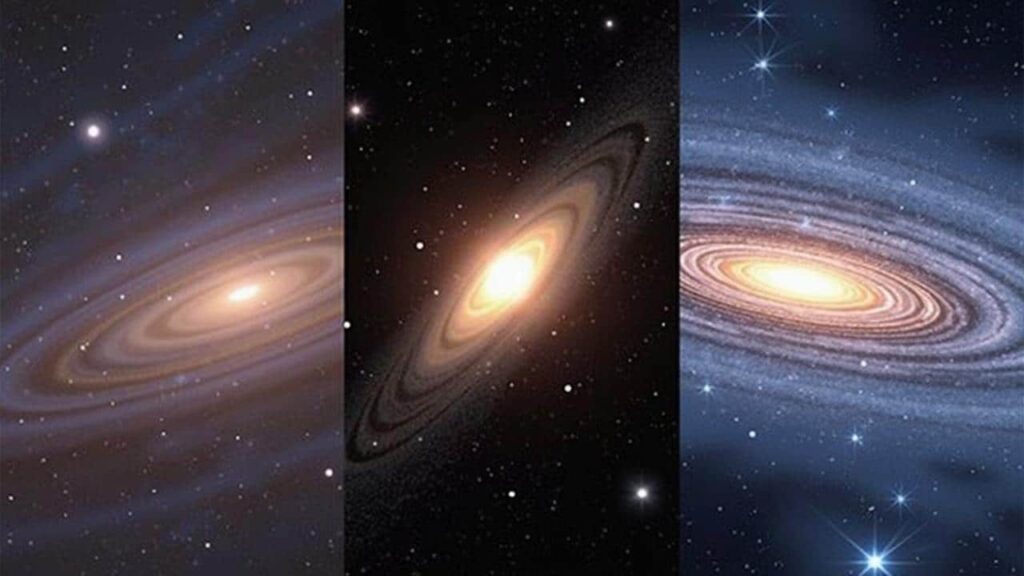
Europe is quietly building one of the boldest astronomy missions of the century: a trio of spacecraft that will listen for ripples in space-time itself, testing a prediction Albert Einstein made in 1916 and reshaping how we track violent events across the Universe.
Europe prepares a space-based ear for the cosmos
The mission is called LISA, short for Laser Interferometer Space Antenna, and it is run by the European Space Agency (ESA). Instead of taking pictures of stars and galaxies, LISA will measure how space stretches and squeezes as gravitational waves pass through it.

Terrestrial observatories like LIGO and Virgo have already detected these waves from colliding black holes and neutron stars. Yet they are stuck on Earth, where seismic noise, human activity and the planet’s own gravity mask a vast part of the signal. LISA moves the experiment into space, far from these disturbances.

LISA aims to tune in to low-frequency gravitational waves that never reach ground-based detectors, opening a fresh channel on the Universe.
The project has now passed a key industrial milestone. Thales Alenia Space has signed a €16.5 million contract with German company OHB System AG to provide the propulsion subsystem for the mission, with later phases pushing the total contract value close to €90 million. That propulsion work sounds mundane, yet for LISA it becomes almost as delicate as the physics it wants to probe.
The strange signal Einstein predicted
Einstein’s general theory of relativity describes gravity as the curvature of space-time. When extremely massive bodies accelerate — think black holes spiralling together or dense white dwarfs orbiting in tight pairs — they do not just pull on their surroundings. They send out waves in the fabric of space-time.
These gravitational waves do not carry light or particles. They encode pure information about motion and mass. They pass through stars, planets and entire galaxies almost without interaction. That makes them frustratingly hard to detect yet scientifically gold.
So far, Earth-based detectors have caught only the shortest, fastest ripples, generated by relatively small black holes or neutron stars late in their death spirals. LISA targets a different regime: slow, drawn-out oscillations lasting minutes, hours or even years, produced by much heavier systems.
Listening to that deeper register may tell astronomers when and how giant black holes formed in galactic centres, how compact binary stars evolve, and whether the newborn Universe left behind an echo in gravitational radiation.
A cosmic triangle 2.5 million kilometres wide
The idea behind LISA is deceptively simple. Three identical satellites will fly in a roughly equilateral triangle, each side about 2.5 million kilometres long. The formation will trail or lead Earth around the Sun, maintaining its geometry as the entire system orbits.
Inside each spacecraft sit ultra-stable test masses — small blocks of metal, isolated from all external forces except gravity. Laser beams bounce between the satellites, turning the triangle into a colossal interferometer. When a gravitational wave passes, the distances between the test masses shift by less than a trillionth of a metre.
Catching that tiny change requires extraordinary stability. Solar radiation, tiny gas leaks, thermal expansion and electromagnetic forces all try to jostle the spacecraft. On top of that, the triangle must hold its precise shape over at least six and a half years of operation, with a possible extension to nearly a decade.
Why propulsion becomes a scientific instrument
For most missions, thrusters just move spacecraft from A to B. For LISA, propulsion helps make the satellite almost vanish around the test mass. The central objective is “drag-free flight”, where the satellite constantly adjusts its position so the test mass stays in nearly perfect free fall.
Thales Alenia Space will design and build this propulsion subsystem, mainly from its UK facilities. The system must gently counteract solar pressure and other non-gravitational forces without disturbing the test masses. That means thrust levels so small and controlled they look more like whispers than rocket burns.
LISA’s micropropulsion must deliver exquisitely tiny, continuous pushes, allowing the test masses to follow the natural curvature of space-time.
Advanced microthrusters from Leonardo and other suppliers form part of a broader control architecture known as DFACS — the Drag-Free and Attitude Control System. DFACS measures how the spacecraft drifts relative to the test mass, then commands the thrusters to nudge it back into place while keeping the laser links aligned across millions of kilometres.
DFACS: making the spacecraft “disappear”
The DFACS sits at the heart of LISA’s strategy. Sensors read the position of the test masses down to picometre scales. On-board computers calculate how the spacecraft must move to keep those masses undisturbed. Thrusters then perform minute corrections.
This loop runs continuously. It compensates solar photons hitting the spacecraft, torques from antennas, even the feeble push from radiating heat. At the same time, it holds the spacecraft in the correct orientation, keeping the long laser arms pointed with astonishing precision.
- Measure the test mass position at ultra-high precision
- Compute necessary corrections in near real time
- Fire microthrusters with finely tuned impulses
- Maintain laser alignment between all three satellites
The result, if everything works, is that the test masses effectively float in undisturbed free fall, tracing out pure gravitational motion. The spacecraft become mere shells, obediently following along.
A finely meshed European industrial network
LISA also functions as a showcase for Europe’s space industry. The hardware and software spread across several countries, each contributing specific expertise.
| Country / site | Main contribution |
|---|---|
| United Kingdom | Propulsion subsystem design, integration and testing |
| Italy (Turin) | Mission architecture and heritage from early study phases |
| Italy (Gorgonzola) | On-board computer and mass memory as an integrated unit |
| Switzerland | Electronics for the instrument and constellation acquisition |
| France | Data processing centre and scientific coordination through CNES |
Thales Alenia Space also handles avionics, control software and telecommunications, while ensuring the payload sits in a carefully managed electromagnetic and radiation environment. The European Space Agency coordinates the overall mission, drawing on decades of experience from flagship observatories.

CNES and the nervous system of LISA
On the ground, France’s CNES space agency plays a central role. It leads the Distributed Data Processing Center, the digital hub where LISA’s raw measurements arrive, are cleaned, cross-checked and turned into gravitational wave signals.
Data from the three satellites will feed into a main computing centre in France, linked to national centres across partner countries. That network must handle subtle correlations between signals, filter out instrumental noise and separate overlapping sources in the gravitational sky.
Behind each tiny change in distance lies a complex data pipeline, where European teams reconstruct the events that shook distant regions of the cosmos.
To prepare, CNES coordinates a broad community of French laboratories. In Toulouse, two instrument prototypes test interferometer performance and tackle a nasty problem: stray light. Even a faint reflection can swamp the picometre-level measurements LISA needs, so teams study how light scatters, bounces and leaks through the system.
Standing on the shoulders of pathfinders
LISA does not start from scratch. In 2015, ESA launched LISA Pathfinder, a small mission that tested key technologies for drag-free flight and high-precision interferometry. That spacecraft placed two test masses in almost perfect free fall and exceeded its performance goals by a wide margin.
Other ESA missions, such as Gaia and Euclid, add heritage in ultra-stable pointing and precision propulsion at the Lagrange points. Their experience reduces technical risk for LISA, even if the challenge now scales up to much larger distances and longer durations.
Taken together, these projects show that Europe can build instruments that balance on the edge of physical limits, where every vibration and temperature change counts.
What LISA could reveal about the Universe
LISA will target a frequency band between roughly 0.1 millihertz and 1 hertz — a range completely out of reach for Earth-based detectors. That opens several scientific frontiers.
- Mergers of supermassive black holes at galactic centres
- Compact binaries of white dwarfs and neutron stars in our own galaxy
- Intermediate-mass black holes, still largely hypothetical today
- Possible relic signals from very early cosmic phases
When two supermassive black holes spiral together after a galaxy merger, they should emit strong, slow gravitational waves that LISA can track over months. That offers a new handle on how galaxies grow and how quickly their central monsters form.
Closer to home, thousands of compact stellar pairs will act as an unavoidable background hum. Modelling that hum will teach astronomers about the population of tight binary systems in the Milky Way.
Key concepts that will shape the mission
Several technical and scientific terms will crop up repeatedly as LISA approaches launch, currently targeted for 2035 on an Ariane 6 rocket.
Gravitational wave “frequency”: Just like sound, gravitational waves have frequencies. LIGO hears high pitches from smaller, faster mergers. LISA listens to the bass notes from heavier or more widely separated systems.
Geodesic motion: In general relativity, an object in free fall follows a geodesic, the straightest possible path in curved space-time. LISA’s test masses aim to follow those paths, undisturbed by anything except gravity.
Noise sources: Unwanted signals — from spacecraft motion, thermal shifts or even outgassing molecules — can mask gravitational waves. Designing LISA is largely a game of chasing down and minimising each of these noise contributions.
Risks, challenges and what could go wrong
A mission that depends on picometre precision faces a long list of potential issues. Thrusters could drift out of calibration. Lasers might age differently across the three spacecraft. Radiation could slowly degrade sensors or electronics.
Engineers counter these risks with redundancy, careful testing and long lead times. Ground facilities simulate aspects of the mission, though no laboratory can fully mimic a 2.5-million-kilometre interferometer in deep space. That gap between simulation and reality will keep teams busy throughout the 2030s.
There is also a scientific risk of the most intriguing kind: the Universe might not behave as expected. If LISA sees fewer signals than predicted, theorists will need to revisit models of black hole growth and cosmic history. If it sees unexpected patterns, new physics could be hiding in the data.
How this changes our view of astronomy
LISA extends a trend that began with the first direct detection of gravitational waves in 2015: astronomy is no longer just about light. By combining gravitational-wave observations with traditional telescopes, researchers can build a more complete picture of extreme events.
Imagine a supermassive black hole merger that LISA tracks for months. Astronomers can point optical, X-ray and radio instruments at the same region, watching how gas, stars and jets respond before and after the final collision. That kind of coordinated campaign turns a distant merger into a well-characterised physical process.

Over decades, such multi-messenger studies may help explain why some galaxies host quiet black holes, while others fling out powerful jets and shape their environments. LISA’s role is to provide the timing and mass measurements for those central players.