
The message popped up at 22:47.
“URGENT DOG ADOPTION – family leaving the country TOMORROW, dog will be PUT DOWN. Need a home NOW. Small adoption fee.”
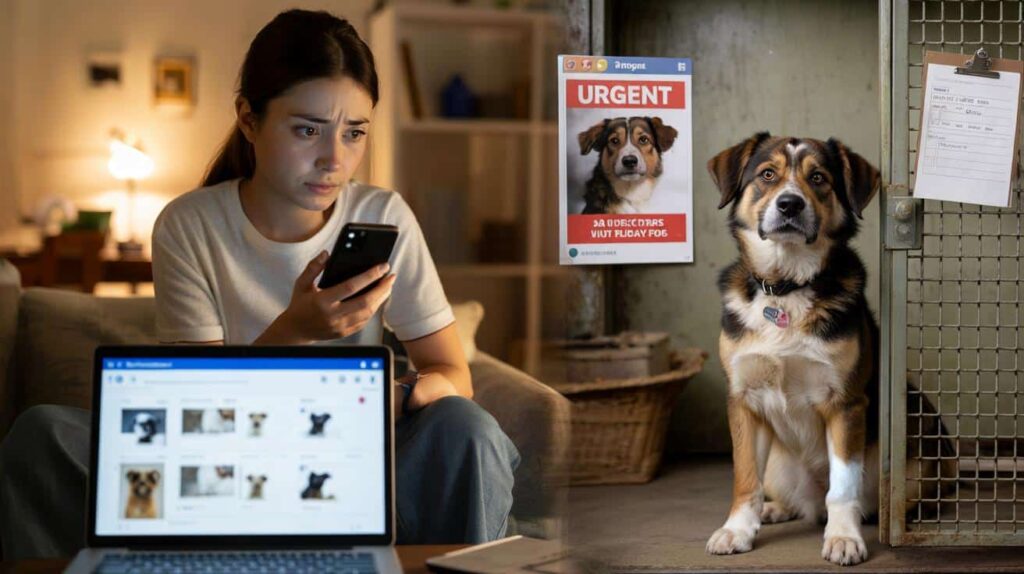
No bed, no toys, just eyes that looked like they knew they were being used. Underneath, a flood of comments: “I’ll take him”, “I’ll donate”, “Where are you based??”
By the time I checked again in the morning, the post had vanished. So had the profile. And the dog, if it even existed, was nowhere to be found.

That’s when the penny drops: urgency is not always about saving a life. Sometimes it’s about emptying your wallet.

When “urgent” is a siren, not a signal
Urgent dog adoption posts hit us right in the gut.
They’re built to. A shaky photo, a heartbreaking caption, a deadline that feels like a ticking clock over a real animal’s head.
Your brain doesn’t go to “Is this real?”.
It goes straight to “How do I help before it’s too late?”. That split second between emotion and action is exactly where scammers live.
They know most of us scroll tired, late in the evening, phone in one hand, conscience in the other. That’s when the traps work best.
Across Facebook groups, Gumtree, Craigslist and even WhatsApp chains, the pattern repeats.
Always a rush. Always a backstory that sounds just true enough.
“Owner died suddenly.”
“Landlord kicking us out.”
“Shelter full, dog due to be euthanised tomorrow.”
Then the hook: a “rehoming fee” that must be bank transferred “right now to reserve the dog”. One woman from Birmingham told me she sent £200 for a Labrador she never met. The profile blocked her after payment. No address. No dog. Just that familiar, sour mix of shame and anger.
Real rescues know desperation. They also know process.
There’s paperwork, checks, conversations that last more than three frantic DMs. Urgent scam posts cut all of that out. They offer purity: instant saviour status, at the swipe of a card.
From a distance, a lot of these posts look like grassroots rescue.
Up close, the cracks start to show.
The language is oddly copy-pasted across cities and countries.
The photos look like they’ve been lifted from Google Images or old breeder adverts. Sometimes the same “urgent dog” appears in Leeds, then in Glasgow, then in Dublin, all within a week.
And the emotion is oddly one-note too: all drama, no detail.
No vet history, no behaviour notes, no neutering status, just a big red emotional button: “HELP OR HE DIES.”
Genuine adoption posts tend to be messier.
They mention quirks, fears, past trauma. They come with too much information, not too little. Scams are neat. Real dogs rarely are.
How to pull the brake before your heart hits “send”
The most powerful move is brutally simple: slow the whole thing down.
Even thirty seconds makes a difference.
Read the entire post twice, out loud if you have to.
Ask yourself: what do I actually know about this dog beyond a sob story? Where is it? Who is legally responsible for it? If those answers are fuzzy, that’s your first red flag.
Then look away from your phone for a minute. Literally.
Let your nervous system settle before you offer money or personal info. Urgency thrives on tunnel vision.
Next step: flip from emotional mode to detective mode.
Click on the profile that shared the post. How long has it existed? What else do they post about?

A profile created last week with only animal “emergencies” and no real-life traces is a huge warning sign.
Same for accounts that refuse to share a phone number, a rescue registration, or even a rough location.
Legit rescues may be overwhelmed, but they’re not ghosts. They list addresses, charity numbers, vet partners. They have adoption forms and home checks. If someone wants cash via PayPal “friends and family” or bank transfer before you’ve even met the dog, that’s not rescue. That’s a sales funnel.
Also, take screenshots.
If the post disappears or changes details suddenly, you’ll have proof to show group admins or report to platforms. Scammers count on things being ephemeral. Make them permanent.
“If an ‘urgent’ post makes you feel like you’re the only person who can save this dog right this second, breathe and step back. Real rescue is a team sport, not a hostage situation.”
- Reverse image search the dog photo on Google or TinEye to see if it’s been used elsewhere.
- Ask for vet details and call the practice directly to confirm the dog exists.
- Request a brief video call with the dog visible and the person speaking live.
- Check for a charity number or registered rescue status in your country.
- *If they push harder when you ask questions, that’s your answer right there.*
The quiet checks that separate real rescues from red flags
There’s a small set of questions that cut through almost any fake.
Think of them as your personal lie detector for urgent dog posts.
Ask: “Which vet is this dog registered with?” and “Can I speak to them?”
Ask: “Can you send me a video of the dog with today’s date on a piece of paper?”
Ask: “Who did the behaviour assessment and can I see it?”
None of these are aggressive. They’re standard in the rescue world. Anyone who reacts with outrage, guilt-tripping or silence is giving you their answer, even without words.
Of course, real people in crisis can be chaotic, clumsy, even a bit defensive.
A family genuinely losing their home might not have tidy paperwork or know the right rescue vocabulary. This is where your empathy has to walk alongside your scepticism.
You can be kind and still ask for proof.
You can care deeply about animals and still say, “I’ll only send money through a registered rescue or once I’ve met the dog.” Human drama doesn’t erase the need for basic safeguards.
Soyons honnêtes : personne ne fait vraiment ça tous les jours.
We don’t all run background checks before every act of kindness. The trick is to build two or three habits you can actually keep, even on a tired Tuesday night with your phone half falling out of your hand.
The big picture is brutal.
Scammers don’t just take money. They clog up genuine rescue channels, they flood Facebook groups, they sow doubt. Each fake “urgent” case makes people slightly less likely to believe the next real one.
That’s the collateral damage: the dog who really is on a deadline, stuck in a council pound or a backyard crate, while decent people scroll past thinking, “Hmm, probably a scam.”
On a more practical level, fake “rehoming” posts often feed shady breeding or puppy farming networks.
The same operators can pose as desperate owners one week, then as “small family breeders” the next, shuffling animals like stock.
Real rescues keep records. They microchip under their name first. They do follow-ups.
Scammers do none of that, because for them the “urgent dog” was never an animal with a future. Just a story that expired as soon as your money arrived.
We’ve all had that moment where a post hits so hard we feel it in our chest. That’s not something to shut down. That’s something to guard.
Talking openly about scams doesn’t make you cold.
It makes you the kind of person who protects both the dogs and the communities trying to help them. Share the red flags. Ask awkward questions in the comments. Message group admins when something feels off.

Some urgent posts will still be real, raw, and messy. Some will lead you to a dog that changes your life. The trick is learning to tell who’s actually holding the leash at the other end of the screen.

| Point clé | Détail | Intérêt pour le lecteur |
|---|---|---|
| Vérifier le profil | Regarder l’historique, la date de création, la présence d’infos réelles | Repérer rapidement les comptes jetables utilisés par les arnaqueurs |
| Exiger des preuves concrètes | Vidéo datée, coordonnées du vétérinaire, documents de refuge | Passer de l’émotion pure à la vérification sans perdre son empathie |
| Payer via des canaux sécurisés | Privilégier refuges enregistrés, paiements traçables, reçus | Protéger son argent tout en soutenant les vrais sauvetages |
FAQ :
- How can I tell if an urgent dog adoption post is fake?Look for missing details (no location, no vet info), a brand-new profile, refusal to video call, and pressure to send money immediately via bank transfer or “friends and family”. One or two red flags invite questions; several mean walk away.
- Is it safe to pay a “rehoming fee” online?Only if it goes through a registered rescue or a transparent platform, and only after you’ve verified the dog exists and is in their care. Avoid sending money to private individuals you haven’t met, especially under time pressure.
- What should I ask a genuine rescue before adopting urgently?Ask about medical history, behaviour, why the dog is urgent, what support they offer after adoption, and whether there’s a trial period. A good rescue will welcome these questions, not dodge them.
- What can I do if I realise I’ve been scammed?Gather screenshots, payment proof, and profile links. Report to the platform, your bank or payment provider, and local authorities where relevant. Inform the admins of any groups where the post appeared so they can warn others.
- How can I still help real urgent dogs without risking scams?Follow established local rescues, sign up as a foster, donate directly via their official websites, and share verified appeals. You can also support councils and shelters that publish clear, trackable lists of dogs on deadlines.
