Walkers snapped photos, puzzled by the strange contrast: ice solid enough for birds at the shore, open water swaying in the middle. What looks like a simple winter scene actually reveals some of the strangest physics of water.
From snowy stroll to science question
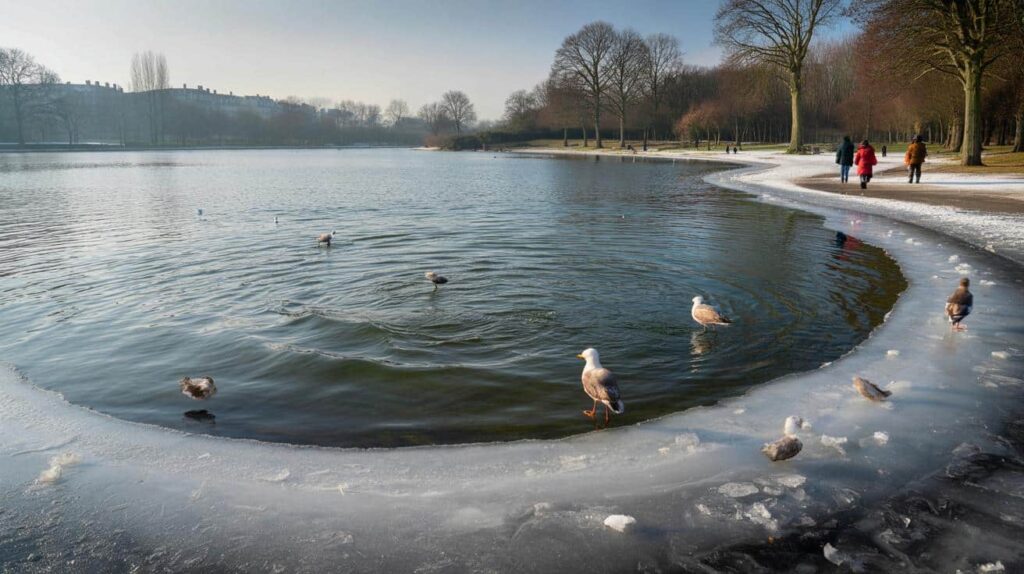
Across France, a brief cold spell turned parks white, filled streets with snowball fights and sent families hunting for the nearest lake. Around Lake Créteil, on the south-eastern edge of Paris, the view looked almost Canadian: a grey sky, frosted paths, and a ring of ice gripping the shoreline.
Yet the picture didn’t quite fit the mental image of a “frozen lake”. The outer rim formed a solid sheet. Gulls could stand on it. Closer to the centre, waves were still moving, dark and liquid. That contrast prompts a simple question that opens the door to some deep physics: why does a lake freeze the way it does?
 Storks and gulls carry hundreds of kilos of plastic from landfills to Andalusia’s wetlands
The fact that Lake Créteil froze at the edges and stayed liquid in the middle is not random; it follows strict rules of water physics.

Why lakes freeze from the top, not from the bottom
Start with a slightly counter‑intuitive property of water. Most substances get denser as they solidify. Water almost follows that rule, but not quite. Liquid water becomes denser as it cools – until it hits about 4 °C. Below that, it starts getting lighter again. Then at 0 °C, it turns to ice, which is roughly 10% less dense than liquid water.
Because it’s lighter, ice floats. That is why ice cubes rise to the top of your glass and why sea ice and icebergs sit on the surface instead of sinking.
In a lake, that single quirk governs everything. As the surface cools, the cold water usually sinks if it is denser than what lies below. Once the surface layer gets colder than 4 °C, the trend reverses: it is now lighter than the rest, so it stays near the top. When it finally reaches 0 °C, it can freeze and form a lid of ice.
If ice sank, many lakes would freeze from the bottom up, and winter would be disastrous for fish, plants and aquatic insects.
The invisible layering inside a winter lake
How water sorts itself by temperature
Although it looks uniform from the path, a lake in winter is layered. The water is stratified into zones of slightly different temperature and density.
- In summer, warm water sits at the top, cooler water stays at the bottom.
- In autumn, winds stir the lake and mix the layers.
- In winter, the pattern flips: the coldest water hugs the surface, with a stable 4 °C zone deeper down.
That stable 4 °C layer acts like a heat reservoir. Even when the air plunges below freezing, water near the bottom stays a few degrees above 0 °C and slowly feeds heat upwards.
The thermal conveyor belt
Picture the lake as a quiet conveyor belt of heat. At the surface, cold air pulls energy out of the water. Slightly warmer water from below rises to replace it, cools, and the cycle repeats. As long as the air remains below freezing for days at a time, the top layer can finally reach 0 °C and solidify.
Once that ice skin is in place, it slows the escape of heat. The ice and a thin layer of trapped air act as insulation, protecting the deeper water and everything living there.
Why the edges freeze first
Shallow water cools faster
The key to the Lake Créteil puzzle lies in depth. Near the banks, the water is shallow. In the middle, the depth increases sharply. Cold air cools the surface of both areas, but the same square metre of surface sits above very different volumes of water.
| Location | Water depth | Cooling behaviour |
|---|---|---|
| Near the shore | Shallow | Cools quickly, freezes early, ice persists |
| Lake centre | Deep | Large heat reservoir, takes longer to freeze and thaws sooner |
Because the volume is small near the edge, the cold can remove the necessary energy much faster. Those near‑shore sections hit 0 °C earlier, form ice sooner, and often build a thicker, tougher fringe.
The icy ring around Lake Créteil is the visible result of shallow zones giving up their heat far faster than the deep central basin.

Why the centre thaws first
When temperatures start to rise, the process plays out in reverse. The deeper central part still hides water at around 4 °C. That relatively warm layer slowly feeds heat upwards, weakening the ice above. Weak sunshine and wind then break it apart.
Near the banks, you do not have that same buffer. The shallow water has cooled more thoroughly. There’s simply less stored heat beneath the ice, so the sheet survives longer. That is why, on a cold January afternoon, you can see open water in the centre and a stubborn crust at the edge, exactly as at Lake Créteil.
Freezing a lake takes a staggering amount of energy
The thin plate of ice at the margin looks fragile, but forming it is energy‑intensive. Cooling water is one thing; changing its state from liquid to solid is another.
To cool 1 gram of water by 1 °C, you need about 4.18 joules of energy to leave the water. Turning that same gram at 0 °C into ice needs roughly 334 joules. The phase change alone is dozens of times more demanding than a single degree of cooling.
Scale that up to a large lake and the numbers become enormous. Cooling a very big lake from late‑summer temperatures down to near 4 °C can require energy comparable to a country’s annual electricity use. Adding a 10‑centimetre sheet of ice over the whole surface adds another huge chunk of energy that must be extracted by the winter air, day after day.
Puddles, ponds and lakes: why small freezes first
Seen through this lens, a frozen puddle and Lake Créteil obey the same rules. A small puddle has a lot of surface compared with its tiny volume of water. The heat has a short path to the atmosphere and escapes quickly. One clear, frosty night can be enough.
A deep lake is the opposite case. Its surface area is relatively modest compared with the huge volume of water underneath. That huge volume acts as a thermal battery. Unless the cold spell is long and intense, only the shallows and edges will freeze, leaving the middle open or only thinly iced.
Key terms behind a “simple” winter scene
Density anomaly
Scientists talk about the “density anomaly” of water. That phrase simply means water behaves oddly around 4 °C: it reaches its maximum density there, not at its freezing point. This oddity is what allows lakes to keep liquid water beneath ice, even during harsh winters.
Thermal stratification
“Thermal stratification” describes the layering of different water temperatures in a lake. In summer, that layering can trap cold, oxygen‑poor water at depth. In winter, it helps preserve a stable, relatively warm bottom layer that allows fish and invertebrates to survive despite ice on the surface.
Safety, wildlife and what a frozen shore really means
The next time a cold snap hits a city like Créteil, the ring of ice at the lake’s edge might look tempting for a quick photo or a risky step. From a safety point of view, that patchwork of frozen banks and liquid middle is a warning sign. It means the ice thickness varies sharply over just a few metres. What can support a gull or a thin layer of snow will not necessarily hold a person.
For wildlife, though, this partial freezing can be a good compromise. Birds can rest on the ice while still having access to open water for feeding. Aquatic plants and fish benefit from the insulated, liquid layer below. In heavily urbanised regions, these winter conditions also influence when and how lakes mix in spring, affecting oxygen levels and water quality later in the year.

So that quiet afternoon at Lake Créteil, with its icy fringe and liquid heart, is more than just a pretty winter postcard. It’s a live demonstration of how unusual water really is – and how that strangeness quietly shapes the survival of life each time temperatures plunge.