In the Moselle basin, part of France’s Grand Est region, researchers have stumbled onto vast deposits of naturally occurring hydrogen, triggering a high-stakes scientific campaign that may soon reveal whether the country sits on the largest “white hydrogen” reserve ever identified.
From coal gas to a potential hydrogen bonanza
The story starts in a place better known for coal than cutting-edge energy. For decades, Lorraine’s mining basin symbolised the end of heavy industry in France. Now it might anchor a new chapter built on natural hydrogen.
Back in 2018, the REGALOR project was launched with a very different target: methane trapped in former coal seams. The aim was to confirm estimates suggesting the region could hold hundreds of billions of cubic metres of gas, equivalent to several years of French consumption.

While chasing that fossil fuel, field teams noticed something unexpected in samples taken from deep aquifers: hydrogen, and not just trace amounts.

Natural hydrogen in Lorraine was first identified “almost by accident” during a project that was originally focused on coalbed methane.
Those preliminary observations were enough to shift priorities. By 2025, the follow-up programme, REGALOR II, dropped methane entirely and pivoted to one question: how much hydrogen lies under Moselle, and can it be used safely?
Pontpierre: a 4,000-metre bet on the subsoil
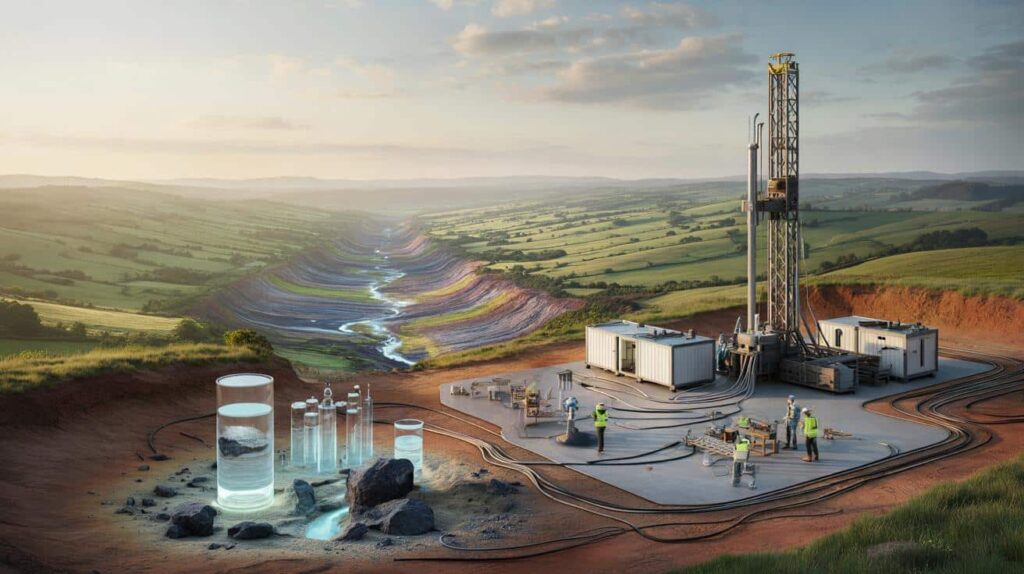
The most visible sign of this pivot stands in Pontpierre, a small commune now hosting an exploratory well that aims to reach 4,000 metres below the surface. The well is not designed as a production site. It is essentially a giant scientific instrument.
Each metre drilled delivers new rock cores, water samples and gas readings. On site, specialists measure the concentration of hydrogen dissolved in deep water and logged in microscopic pore spaces in the rock.
So far, the figures have challenged expectations. At shallow depths around 200 metres, hydrogen barely registers, staying near 0.1 percent. Deeper down, the picture changes quickly.
- Between 600 and 800 metres: concentrations climb from about 1 to 6 percent.
- Around 1,100 metres: levels exceed 15 percent, a record for a continental setting.
- Simulations for 3,000 metres: models suggest levels could go beyond 90 percent.
If confirmed by the Pontpierre well, those values would place the Lorraine basin in a different league compared with other known natural hydrogen occurrences, such as those found in Mali or Russia.
How white hydrogen forms beneath Lorraine
A giant underground “kitchen”
To understand whether this is a one-off curiosity or a long-lived resource, scientists first need to explain how the hydrogen forms. The GeoRessources lab at the University of Lorraine, backed by CNRS researchers, leads this work.
They describe the subsurface like a vast “kitchen” with a small number of ingredients: water, iron-rich rocks, remnants of ancient coal and reactive minerals. The recipe depends on temperature, pressure and how fluids circulate through fractures and pores.
In simple terms, hot water reacts with iron-bearing minerals in the rock. Through oxidation–reduction reactions, part of the iron changes chemical state and hydrogen is released. If geological structures favour trapping and concentration, that hydrogen can accumulate in deep aquifers.
Early data suggest an active production system, where reactions between hot water and iron-rich rocks continuously generate hydrogen at depth.
REGALOR II aims to put numbers on each step: reaction rates, migration pathways, storage capacity and how rapidly the system might replenish itself if extraction ever starts.
Hydrogen not in pockets, but in water
Unlike conventional gas fields, Lorraine’s hydrogen does not appear as large, discrete gas bubbles. Most of it seems to be dissolved in very salty, deep waters or trapped at microscopic scale.
This difference matters. Techniques developed for natural gas extraction cannot simply be reused. Engineers will need tools that can pump water, separate dissolved gases efficiently, and re-inject fluids without disrupting key aquifers closer to the surface.
How big could the reserve be?
Based on current models and limited measurements, the regional hydrogen stock under Lorraine is tentatively estimated at around 46 million tonnes.
For comparison, global production of “grey” hydrogen – made from natural gas with substantial CO₂ emissions – was roughly twice that in 2023. If those estimates hold, Lorraine alone could one day cover a sizeable fraction of current world demand, at least on paper.
The economic stakes are obvious. Analysts expect the hydrogen market, dominated today by fossil-based production, to be worth close to 200 billion euros a year by the late 2030s. A domestic, naturally formed source would give France and the EU new strategic options.
If Lorraine’s figures hold, the Grand Est region could become a cornerstone of Europe’s low-carbon hydrogen supply chain.
The basin also benefits from geography. It sits near major industrial corridors in France, Germany and Luxembourg, where pipeline projects such as mosaHYc aim to transport hydrogen to steelworks, chemical plants and refineries.

Regulation, water and the memory of past mistakes
A region still scarred by gas controversies
Local communities in Moselle know what a boom-and-bust resource cycle looks like. Coal mining left subsidence, pollution and social upheaval. More recently, projects to exploit coalbed methane faced fierce opposition.
In December 2025, France’s highest administrative court cancelled a coal gas permit in the area, citing risks to water resources. That decision set a clear tone: any new subsurface activity will face intense scrutiny.
REGALOR II has been shaped in this context. Researchers are under pressure to show that potential hydrogen extraction can be assessed and designed before industry moves in, not after damage has occurred.
Protecting aquifers comes first
One of the thorniest questions concerns water. Because hydrogen is dissolved in deep aquifers, extracting it might require pumping large volumes of brine and sending it back underground once stripped of gas.
Scientists are testing sensors and sampling tools that can operate at several kilometres depth, measuring dissolved gases without causing major disturbance. Originally built for pure research, these instruments are gradually being adapted toward pilot-scale extraction concepts.
Any future industrial phase would need to show that freshwater layers closer to the surface remain untouched, and that pressure changes at depth do not trigger seismic or subsidence issues. Those topics already feature prominently in the project’s social sciences component.
A test case for Europe’s climate strategy
Beyond Moselle, REGALOR II slots neatly into European and French climate frameworks. France’s National Low-Carbon Strategy aims for net-zero emissions by 2050. The EU’s “Fit for 55” legislative package targets a 55 percent cut in greenhouse gases by 2030 compared with 1990 levels.
Hydrogen is central to those plans, especially for sectors that struggle to decarbonise, such as steel, fertilisers and heavy transport. Yet building massive electrolysers and the renewable power needed to run them poses its own challenges.
Here lies the appeal of white hydrogen: it is already formed in the ground and produces virtually no CO₂ during its natural creation. If recoverable at scale and at reasonable cost, it could reduce pressure on wind and solar capacities, and give Europe a domestic alternative to imported gas-based hydrogen.
White hydrogen does not replace green hydrogen, but it could ease the transition by adding a new, low-carbon supply option.
Who is steering the project and who pays?
Industrial coordination for REGALOR II falls to La Française de l’Énergie, a company already active in gas operations in the region. Scientific leadership comes from the GeoRessources lab.
Several specialised partners contribute:
- BRGM, France’s geological survey, for subsurface mapping and risk assessment.
- SOLEXPERTS France, for borehole instrumentation and drilling engineering.
- The GRéSTOCK research team, which models the physical, chemical and hydrological behaviour of the reservoir.
The budget stands at just over €13.3 million. A large share comes from the EU’s Just Transition Fund and from the Grand Est regional authorities. About €1.5 million is specifically allocated to the University of Lorraine for core scientific tasks and for social sciences research into local impacts and governance.
Making sense of hydrogen “colours”
Public debate often uses a colour code to describe hydrogen, depending on how it is produced. The Lorraine case adds a relatively new shade to that palette: white hydrogen, meaning naturally occurring hydrogen found in the subsurface.
| Type | How it is formed | Typical CO₂ emissions | Stage of development | Key point |
| White hydrogen | Naturally generated underground, often dissolved in deep aquifers | None during formation | Exploration phase | Primary resource, no industrial process needed to create it |
| Green hydrogen | Electrolysis of water using renewable electricity | Very low, linked to equipment | Scaling up | Depends on abundant, cheap renewable power |
| Grey hydrogen | Reforming of natural gas | High | Dominant today | Accounts for most current global production |
| Blue hydrogen | Grey hydrogen with carbon capture and storage | Lower, but not zero | Pilot and early commercial projects | Climate benefit hinges on real capture rates |
What happens if Lorraine’s hydrogen is confirmed?
Several scenarios are now on the table. One is that the resource turns out smaller than early estimates, valuable mainly as a research case. Even that outcome would sharpen global understanding of natural hydrogen systems and guide exploration efforts elsewhere.
A second scenario is that Lorraine hosts a large, technically recoverable reserve. In that case, France would face a strategic choice: how fast to move from science to commercial pilots, and under what regulatory guardrails. The memory of shale gas disputes and coalbed methane battles suggests a cautious, transparent approach will be needed to secure public trust.
A third, more complex scenario is that the hydrogen system is dynamic, with continuous generation at depth. If replenishment rates are high enough, extraction might resemble tapping a deep, slow but renewable source, rather than draining a finite tank. Measuring those rates accurately will be one of the toughest scientific challenges of the next few years.
Risks, benefits and what to watch next
The upside is obvious: large volumes of low-carbon hydrogen, produced close to major industrial hubs, could cut Europe’s dependence on imported gas and speed up decarbonisation of heavy industry. It might also bring long-term jobs to a region scarred by industrial decline.
The risks are more subtle. Deep drilling always carries environmental and seismic issues. Handling very salty, mineral-rich waters at high pressure is technically demanding. Governance and benefit-sharing questions will arise if commercial production becomes realistic, especially in communities that still live with mining legacies.

For now, all eyes are on Pontpierre. Over the next three years, data from that 4,000-metre hole in the ground will tell France whether Moselle is simply an intriguing geological lab, or the starting point of a major shift in Europe’s energy landscape.