
The first splash always looks innocent. A dot of tomato sauce on a white cabinet, a coffee arc near the handle, a greasy fingerprint nobody admits to. You wipe it “quickly” with the corner of a dishcloth, already thinking of the next thing on your list. Then one day the afternoon sun comes in at just the right angle and your kitchen doors suddenly look like a modern art project in orange, brown, and vague oily shadows. You feel a little betrayed by your own cupboards. You thought you were on top of things. Yet here they are, quietly recording every pan of bolognese and every late-night snack. You open a door and your fingers stick just a little. That’s the moment you know you’ve left it too long. You close the door softly, take a breath, and think: there has to be an easier way to erase all this.
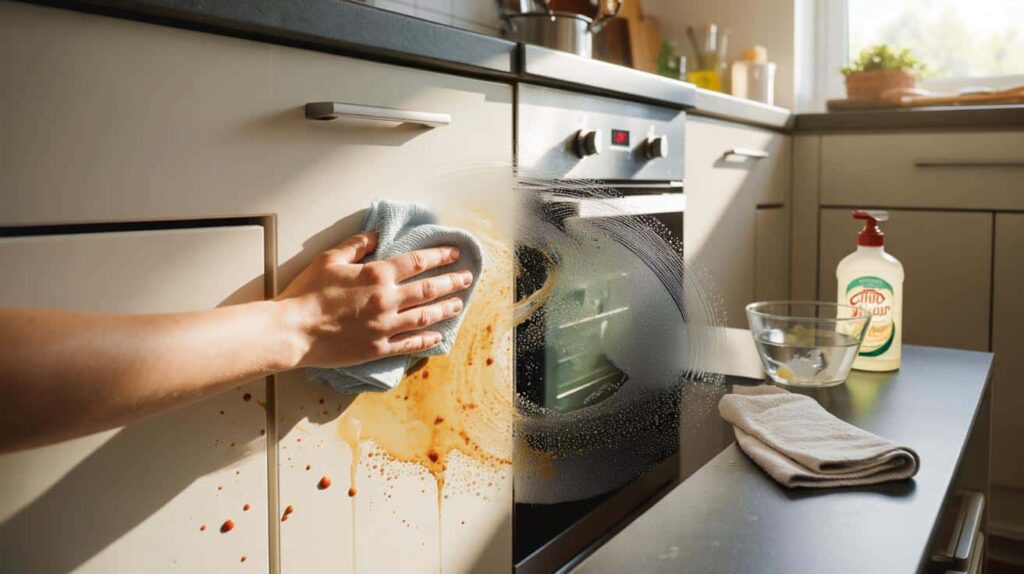
Why food splashes stick to cabinet doors so stubbornly
Stand in front of your kitchen cabinets and look closely, really closely. Those pale halos around the handles, the tiny dots of oil near the stove, the faint shadow where steam hits the door every night. They don’t arrive all at once. They build up slowly, like layers of memory you didn’t ask for. One splash of curry, one puff of frying oil, one impatient hand dipped in flour then on the handle. At first, a damp sponge does the job. Then the splashes start to resist. That’s when we realise we’re not just fighting visible stains, but a thin, sticky film that has quietly settled into every micro-scratch of the surface.
Picture a weeknight: pasta boiling over, sauce bubbling, kids shouting questions from the next room, your phone buzzing on the counter. You turn the heat down with one hand, grab a spoon with the other, nudge the cabinet door closed with your elbow. A tiny arc of tomato flies across and lands right on the panel. You see it. You think, “I’ll get that after dinner.” Of course, after dinner turns into loading the dishwasher, answering an email, folding laundry. That little red dot dries, mixes with steam, then with dust. Repeat this scene twenty times and your cabinet doors stop looking “lived in” and start looking tired. The mess isn’t dramatic. It’s just… persistent.

There’s a reason these splashes cling so much: kitchen grime is a cocktail. Fat from frying, sugar from sauces, pigment from spices, plus steam that carries tiny droplets to the doors. On wood or MDF, the surface often has tiny pores, perfect for trapping oily residues. On glossy laminate, grease acts like glue for dust and crumbs. Wiping with just water spreads the film rather than lifting it. Over time, every lazy wipe draws little halos around the original stain. *That’s how you end up with a door that looks clean from far away, but up close feels slightly tacky, no matter how often you swipe it.*

The easy routine that actually removes splashes (without ruining your cabinets)
Start with the gentlest mix: warm water and a drop or two of mild dish soap in a bowl. That’s your base. Dip a soft microfiber cloth, wring it so it’s damp, not dripping. Then treat each cabinet door like a small project. Begin at the handle area, where fingers and splashes meet. Wipe in small circles, not harsh scrubbing. You’re dissolving the grease film, not sanding it off. For older, dried stains, press the damp cloth against the spot for 10–15 seconds before you start wiping. That mini “compress” lets the heat and soap loosen the grime. Rinse the cloth often, change the water when it turns cloudy, and finish each door with a quick pass of a dry towel to avoid streaks.

There’s one common scene that quietly damages more cabinet doors than anything else. Someone notices a yellowish ring of oil next to the stove. They grab the rough side of a sponge, add a bit of undiluted degreaser, and attack the stain with the determination of a superhero in a final fight. The ring disappears. So does a bit of the finish. Two months later, a dull, slightly rough patch appears exactly where they scrubbed. We’ve all been there, that moment when you just want the dirt gone now. The trick is to let the product work instead of your arm muscles. A mild solution, a little soak time, and patience often erase a stain more efficiently than ten seconds of furious scrubbing.
“The goal isn’t a show-home kitchen,” says one professional cleaner I spoke with. “It’s doors that feel pleasant when you touch them and don’t stick to your fingers at 10 p.m. That’s when you know they’re really clean.”

- For painted wood: Use only mild soap and a very soft cloth. Test any new cleaner on a hidden corner first.
- For laminate or melamine: A mix of warm water, dish soap, and a splash of white vinegar cuts grease without leaving a heavy film.
- For glossy finishes: Wipe in straight lines, then buff gently with a dry microfiber to avoid swirl marks.
- For stubborn, dried splashes: Lay a damp soapy cloth or paper towel on the spot for a few minutes instead of scraping it with your nail.
- For daily life: A quick 30-second wipe of the doors nearest the stove after cooking saves you from one exhausting “deep clean” later.
Living with real kitchens, not showroom cabinets
There’s a quiet relief that comes the day you accept your cabinet doors will never stay spotless for more than 24 hours. Kitchens are places where things bubble, spit, explode a little, and occasionally overflow. That faint trace of curry, that shadow where the toaster lives, they’re signs of a room that actually feeds people. The goal isn’t to erase every story your kitchen tells. It’s to stop the stories from turning into a sticky film you feel every time you grab a handle. Once you’ve done one good, patient reset of your doors, you start to see maintenance differently. A quick swipe becomes less of a chore and more of a small favor to your future self. Let’s be honest: nobody really does this every single day. But once a week? After the messiest meal? That feels strangely manageable. And slowly, without you obsessing about it, your cabinets go from slightly shameful to quietly satisfying again.

| Key point | Detail | Value for the reader |
|---|---|---|
| Gentle products first | Warm water + mild dish soap dissolves most splashes without damaging finishes | Protects cabinets while still removing everyday grime |
| Let time do the work | Short “soak” with a damp cloth on dried stains beats harsh scrubbing | Fewer scratches, better results with less effort |
| Target high-splash zones | Focus quick wipes around the stove and handles once or twice a week | Prevents heavy build-up and long cleaning sessions |
FAQ:
- How do I remove old, yellow grease stains from white cabinets?Use warm water, a drop of dish soap, and a splash of white vinegar on a microfiber cloth. Press on the stain for 20–30 seconds, then wipe gently. Repeat rather than scrubbing hard. If the yellowing remains, it may be discoloration of the paint, not just grease.
- Can I use baking soda on cabinet doors?Yes, very carefully. Make a soft paste with water, dab it on with your fingertip or cloth, and wipe in tiny, light circles. Rinse right away. Avoid this on high-gloss or delicate painted finishes, where even mild abrasives can dull the surface.
- What’s the best way to clean greasy cabinet handles?Remove sticky buildup with a cloth dipped in warm, soapy water. For heavy grease, use a soft toothbrush around screws and edges. Dry thoroughly so metal parts don’t tarnish or rust.
- How often should I clean my cabinet doors?A full wipe-down once a month is usually enough for most kitchens, with quick spot-cleaning around the stove and handles after messy cooking sessions. Busy households that cook daily may want a light wipe every week.
- Are commercial degreasers safe for kitchen cabinets?Some are, if diluted properly and tested on a hidden area first. Spray onto a cloth rather than directly on the door, and never use products labeled as heavy-duty oven or grill cleaners on cabinet finishes.
