
It usually starts with good intentions and an armful of plastic bins.
You stand in the middle of the living room, lids scattered around like giant Tupperware, swearing this will finally be the day your home “gets organized.” You toss in Christmas decorations, half-forgotten cables, baby clothes you’re not ready to let go of. The boxes fill up fast, the lids snap shut with a satisfying click. Neat towers appear along the wall or disappear into the closet.
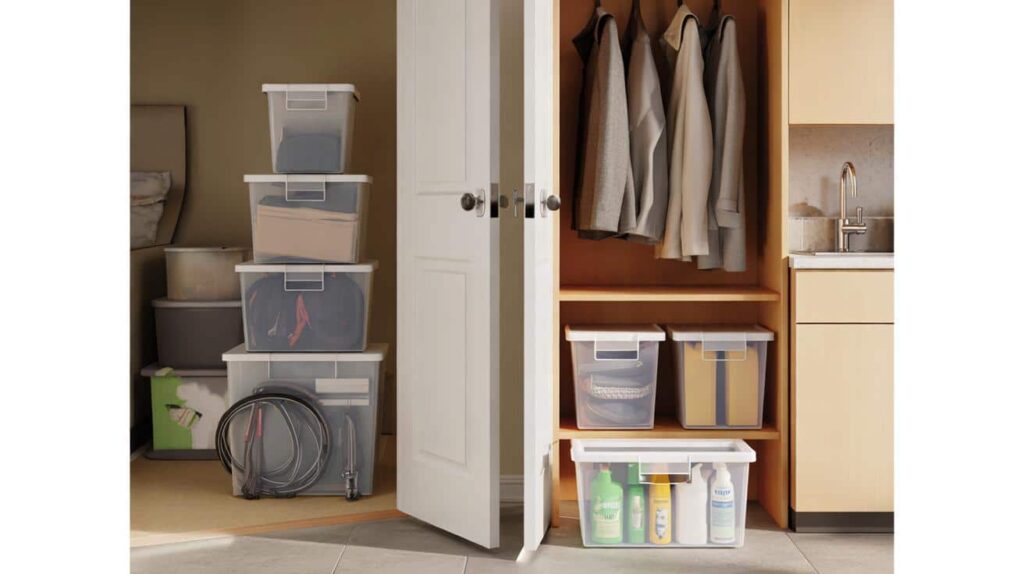
Then, three months later, you’re on your knees, opening every single one, hunting for a single charger or that blue scarf you swear you kept.
The boxes worked.
You didn’t.
The hidden problem with our beloved storage boxes
We treat storage boxes like a magic trick.
You throw chaos into a transparent cube, close the lid, stack it somewhere, and the visual mess disappears. For a few days, your brain sighs with relief whenever you glance at that clear floor or that tidy shelf. It feels like progress.

Yet deep down, you know something’s off.
You didn’t organize anything. You just upgraded from a visible mess to a hidden one. The boxes become time capsules of “stuff I’ll deal with later,” and later never comes.

Take a real, very common scene.
A reader told me she had twelve identical clear bins in her attic, all labelled “Misc.” At first, that label felt clever and flexible. Years later, “Misc” had become a curse word. She needed a passport cover before a trip. It was “definitely in a box.” She spent an entire Sunday opening and closing twelve lids, climbing up and down the attic ladder, sweating, swearing, and finding everything except the passport cover.
By the end she knew where every Christmas ornament, childhood drawing, and broken toy was.
But not the one object she actually needed that day.
The real issue isn’t the box.
It’s the way we think about it. Storage boxes are tools for access, not just containers for hiding. The correct use is less about “Where can I put this?” and more about “How fast will Future Me find this?” That shift sounds small, but it changes everything: what you keep, where you keep it, and how you relate to your things.
*Without that shift, you’re just spending money to stack frustration in nicer shapes.*
The box is either a shortcut to find what you love, or a plastic tomb for objects you’ll never see again.
The method almost no one uses: reverse from retrieval, not from space
Here’s the method almost nobody applies: you start from the moment you’ll need the thing, not from the place where you have space.
Instead of asking “Where does this fit?”, you ask “In what real situation will I look for this, and how?” That means you organize by future action, not present location. Cables go where you’ll be desperately plugging things in. Gift wrap goes where you actually wrap gifts, not where there’s a random empty shelf.
When you use boxes with that mindset, they stop being generic containers.
They become physical bookmarks in your daily life.
Think of your winter clothes.
Most people stuff everything cold-weather-related into one or two big bins labelled “Winter.” It sounds logical, until that first chilly October morning when you just want your favourite sweater, not your ski helmet and thickest scarf. So you drag down a huge box, rummage, disturb all the neat folding, and shove it back half-open.
Now imagine a different scene. One medium box labelled “Everyday winter clothes – bedroom.” Another box: “Ski + extreme cold – top shelf.” The first one lives near your wardrobe, the second can hibernate somewhere more remote. On the first cold day, you reach for exactly one box, pull out exactly what you need, and walk away in under a minute.
Same number of boxes. Completely different life.

This works because the organizing unit is no longer the object, it’s the scenario.
Your brain doesn’t think “Where is my scarf, spatially?” It thinks “I’m going out, it’s cold, what do I grab?” That’s a situation, not a GPS coordinate. When storage follows real situations – “late-night fever kid,” “last-minute guest,” “quick repair,” “holiday decorating” – you cut the time and stress every time the box comes off the shelf.
Let’s be honest: nobody really does this every single day.
Yet even applying this mindset to a few key categories can turn your most annoying searches into two-second moves.
From random bins to smart stations: a practical way to use your boxes
Start with just one “pain point” area.
Maybe it’s kids’ toys, seasonal decor, or that avalanche of cables and chargers. Take everything out of the existing boxes and sort by situation, not by type. Instead of “all toys here,” think “quiet-play box for sick days,” “outdoor toys box near the door,” “quick clean-up box for the living room.” Instead of “all cables,” think “travel tech kit,” “home office essentials,” “emergency power outage set.”
Once you have these scenarios, you give each its own box, place it where that situation actually happens, and label it like you’re talking to a slightly tired future version of yourself.
A common mistake is to treat the label as a formality.
We scribble “Stuff” or “Office” and call it done. Then six months later, the box is a mystery again. A good label is almost a sentence: clear, human, specific. “Birthday party kit – candles, balloons, banner” beats “Party.” “Kitchen tools I use rarely – waffle iron, raclette, fondue” beats “Small appliances.”
Also, don’t turn your boxes into black holes.
If you can’t see inside, take a picture of the contents and tape it to the front. That small, almost childish gesture saves an absurd number of minutes and sighs on a busy day.
We’re not trying to become professional organizers. We just want to stop losing twenty minutes of life every time we need one simple thing.
- Name the scenario before you touch a single box. “Sunday cleaning,” “holiday decorating,” “guest room reset.”
- Pick the smallest box that works, not the biggest you can find. Big bins invite dumping and forgetting.
- Add a short, human label on two sides: “Everyday craft box – table use,” not “CRAFT.”
- Place the box where the action starts, not where there’s empty space.
- Give yourself one “wild card” bin only for truly random items, and reset it every three months.
Living with your boxes, not just storing with them
Once you start using storage boxes this way, something subtle shifts.
You stop dragging them around like heavy, silent guilt and start treating them like little assistants parked in the right place. A box near the door turns into a stable home for bike lights, dog leash, umbrella. One under the sink quietly holds the exact products you use in one single weekly clean. Your attic stops being a plastic graveyard and becomes a seasonal library you can actually read.
 Meteorologists warn February could begin under an Arctic regime never observed in recent history
Your things don’t change.
Your relationship with them does. The question becomes less “Where can I stuff this?” and more “Will Future Me thank me or swear at me when they open this lid?”
 If you feel emotionally unsettled after positive events, psychology explains the inner adjustment
| Key point | Detail | Value for the reader |
|---|---|---|
| Organize by scenario | Sort items according to real-life situations, not just by category | Find what you need at the exact moment you need it |
| Label like a human | Use clear, specific, conversational labels and photos when boxes aren’t transparent | Reduce searching, guessing, and reopening multiple boxes |
| Place boxes where actions happen | Store each box near the spot where you’ll actually use its contents | Turn storage into effortless routines instead of stressful treasure hunts |
FAQ:
- Question 1How many storage boxes is “too many” for a normal home?
- Answer 1When you can’t remember what’s in at least a third of them without opening, you’ve crossed the line. That’s usually a sign that you’re storing out of fear of deciding, not out of intent to use.
- Question 2Should I use clear or opaque boxes?
- Answer 2Clear boxes are best for frequently used items or shared spaces. Opaque boxes work for visual calm in bedrooms or living rooms, but they need strong labels and, ideally, a small photo of what’s inside.
- Question 3What do I do with stuff that doesn’t fit any scenario?
- Answer 3If you can’t name a realistic situation in which you’d reach for it, that’s your sign to donate, recycle, or let it go. A “just in case” that never comes is quietly charging rent in your home.
- Question 4How often should I re-organize my boxes?
- Answer 4Once or twice a year is enough. A quick 15-minute review by category—decor, clothes, tools—is better than a heroic all-day session you’ll avoid for five years.
- Question 5Is it worth buying expensive organizing systems?
- Answer 5The real game-changer isn’t the price of the box, it’s the clarity of the system. A cheap, well-thought-out box labeled and placed by scenario will beat a designer bin filled at random every single time.
