
The first warm morning of spring, I pulled up the blinds like I always do, coffee in hand, ready to feel smug about my “pretty clean” apartment. Sunlight flooded the living room in that soft, almost cinematic way. For three glorious seconds I felt like I lived in a lifestyle magazine. Then I saw it.
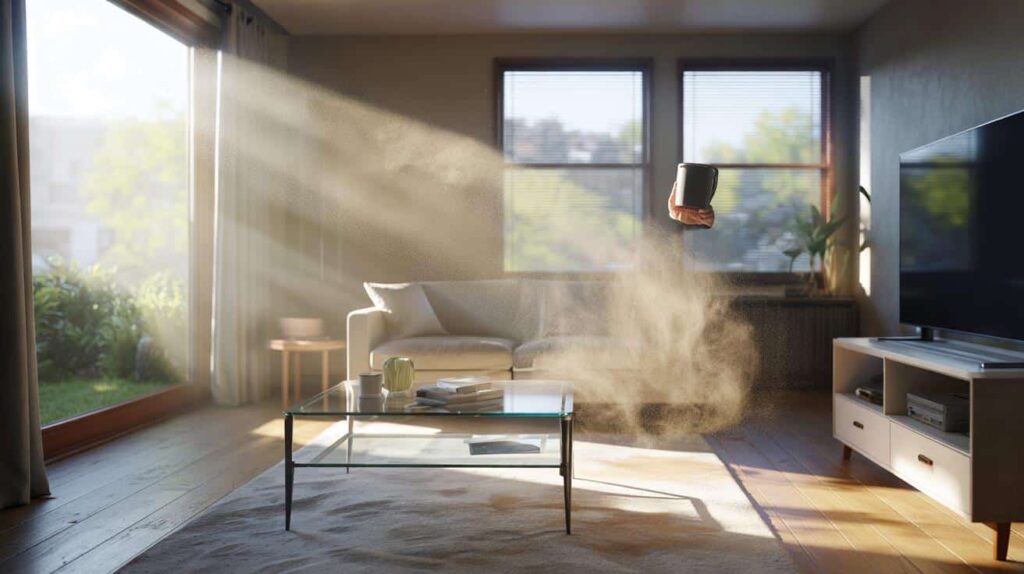
Dust. Everywhere. A pale, swirling cloud suspended in the beam of light, drifting lazily above the coffee table like it owned the place. Streaks on the windows I’d sworn I’d cleaned. A faint gray halo on the baseboards. Even my supposedly “white” sofa was, under that ruthless light, quietly beige.
The room hadn’t changed in a night. My perception had. And that’s when I realized: my home was only clean in the shadows.

What sunlight really reveals about your “clean” home
There’s a special cruelty to midday light when it hits your living room at the right angle. It doesn’t just brighten the space, it cross-examines it. Suddenly, the television stand is outlined with a fuzzy border of dust. The glass table has fingerprints mapped out like a crime scene. The floor, which looked perfectly fine at 8 p.m., now shows a faint trail of crumbs leading from the sofa to the kitchen.

You stand there, blinking in the bright, thinking: “Was this always there?” Spoiler: yes.
One friend told me she had the same shock in her “minimalist” apartment. She works night shifts, so she usually cleans under artificial light. One rare sunny afternoon off, she opened her curtains and froze. The white blinds were striped with grime. Her matte black shelves were wearing a soft gray coat. And on her dark wood floor, the sunlight revealed a constellation of pet hair dancing in mid-air every time she walked past.
She’d always thought people on Instagram were exaggerating with their “deep clean” routines. After that, she bought a microfiber cloth, a good vacuum, and swears the sunlight bullied her into becoming a grown-up.
What’s going on is simple: electric light is forgiving, daylight is not. Artificial light hits from above, softens edges, hides texture. Sunlight slices across surfaces at low angles and suddenly every tiny particle throws a shadow. Your brain reads those shadows as “dirt”. It’s the same room, same objects, different honesty level.
*The sun is basically that brutally honest friend who says what everyone else politely ignores.*
Once you notice it, you can’t unsee it. And that’s where the weird mix of shame, motivation, and slight obsession begins.
How to clean in “sunlight mode” (without losing your mind)
The easiest trick is also the most uncomfortable: clean in the harshest light your home ever gets. Open every curtain, pull up every blind, and let the sun roast your illusions. Then, instead of trying to clean the whole world, follow the beam.
Walk into each room and stand where the light hits hardest. Look at what jumps out first: dusty TV screen, smeared mirror, crumbled edge of the rug. Tackle only those “sunlight zones”. Use a slightly damp microfiber cloth on shiny surfaces. Use the vacuum’s brush head sliding along baseboards and under furniture where the dust halo glows.

Fifteen focused minutes in that brutal light does more than an hour of half-blind night cleaning. You’re suddenly seeing what you usually miss, and your effort matches reality, not guesswork.
The trap is going from “I didn’t know my place was this dirty” to “my home must be spotless at all times”. That’s how you end up wiping skirting boards at midnight and resenting your own living room. Let’s be honest: nobody really does this every single day.
You don’t need a perfect house. You need a house that feels honestly clean enough when the sun barges in. Start with small, repeatable habits: a quick daily wipe of the most reflective surfaces, a weekly “sunlight check” in the room that embarrasses you the most, a habit of dealing with clutter before dust.
If you miss a week, you’re not a failure with a disgusting home. You’re a person who lives and works and forgets. The goal isn’t to impress a hypothetical guest with white gloves. It’s to not be personally attacked by your own windows at 10 a.m.
“Sunlight is the most honest houseguest you’ll ever have. It walks in uninvited, points at everything you’ve ignored, and never apologizes for being right.”
Here’s a simple “sunlight clean” checklist you can keep in mind when the rays hit hardest:
- Windows and mirrors – Wipe with a microfiber cloth and a bit of vinegar-water mix to erase streaks the light amplifies.
- TVs and screens – Gently dust, then buff; they’re dust magnets in side light.
- Baseboards and corners – Run a vacuum brush or cloth where dust piles in shadows until the sun exposes it.
- Glass and chrome – Taps, shower doors, glass tables: quick polish to remove water spots and fingerprints.
- Floors in sunny areas – One fast sweep or vacuum line where the light shows crumbs and pet hair the most.
Living with the truth that sunlight brings
Once you’ve seen your home in raw midday honesty, something shifts. You start planning your cleaning around light, not just around time. Maybe you crack the curtains before leaving for work, just to check if yesterday’s “good enough” is still enough. Maybe you stop feeling guilty about that one dusty bookshelf you never notice at night, because you know exactly when to deal with it.
You also begin to relax a little. That cloud of dust dancing in the beam? Everyone has it. The difference is some people notice, some don’t, and some quietly grabbed a cloth, did a quick pass, and went back to their life. The point isn’t a sterile, magazine-perfect space. It’s a home that doesn’t surprise you in the worst way the moment the sun decides to be brutally clear.

Next time a ray of light slices across your living room and highlights something you’d rather not see, you might feel that familiar flush of “how did I miss this?” Then you take ten minutes, wipe, sweep, breathe. And maybe you’ll catch yourself doing something new: standing in that same sunlight afterward, actually proud of what you see.

| Key point | Detail | Value for the reader |
|---|---|---|
| Sunlight exposes hidden dirt | Low-angle natural light shows dust, streaks, and texture that artificial light hides | Helps readers understand why their home looks “dirtier” during the day |
| Clean in the harshest light | Open blinds and focus cleaning on the areas the sun highlights first | Maximizes cleaning effort where it actually shows |
| Create simple “sunlight habits” | Short, regular routines for reflective surfaces and sunny zones | Reduces stress and keeps the home feeling honestly clean without perfectionism |
FAQ:
- Question 1Why does my house look so much dirtier during the day than at night?
- Question 2What’s the best time of day to spot hidden dirt?
- Question 3How often should I do a “sunlight clean”?
- Question 4Are there surfaces I should always check in direct sunlight?
- Question 5How do I stop feeling embarrassed when sunlight shows my mess?
