
The basil plant looked heroic for the first three days. Lush, bright green, posing next to the sink like a little Mediterranean forest. Then the leaves started drooping, one stem turned black at the base, and by the end of the week it had become what most supermarket basil becomes: a guilty, fragrant corpse headed for the compost. If you’ve ever walked past those glossy pots in the grocery store and thought “this time I’ll keep it alive,” you know the sting. You water, you talk to it, you slide it closer to the window. Still, it fades.
One tiny daily pinch and a mug of water can quietly change that fate.
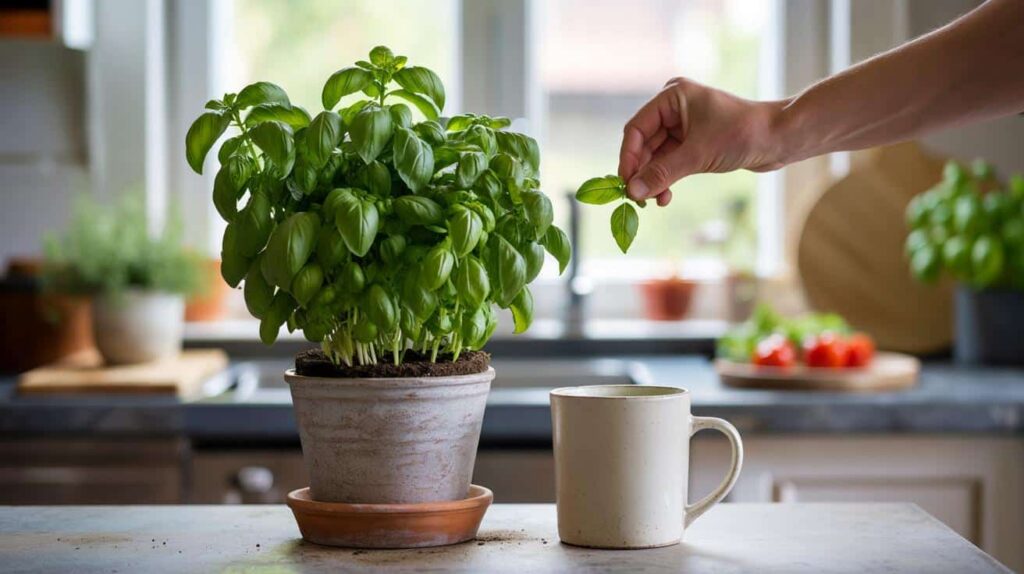
Why your basil keeps dying on the kitchen counter
Most basil doesn’t die from “bad vibes” or a lack of green thumb. It crashes because of shock. The plant has gone from a warm greenhouse, with perfect humidity and light, to your dry apartment with drafts, heat from the stove, and wildly irregular watering. That bright pot from the store also hides a nasty secret: dozens of seedlings crammed together, all fighting for too little soil.
So from day one, your basil is stressed, thirsty in the wrong way, and suffocating at the roots. No wonder the leaves yellow and drop.

Picture this: Laura, who swears she kills every plant, buys basil for homemade pesto. She waters the pot generously once, sets it right on a sunny windowsill, and forgets about it for four days. The top soil dries to dust, the inner root ball stays soggy, fungus starts working quietly underneath.
When she finally remembers, she panics and drenches it again. Two days later, the stems at the base are brown and collapsing. She blames herself. In reality, she just followed what most of us instinctively do with herbs: water hard, then wait, then water hard again.
Basil hates that rollercoaster. The roots want constant, even moisture, not floods and droughts. They also need air. When the original plastic pot sits in a decorative cachepot, water pools at the bottom and the roots sit in a swamp. Then comes root rot, then the leaves start to hang like wet laundry.
And on top of that, basil is a sun addict. It expects 5–6 hours of light and stable temperatures. A dark corner of the worktop or a window ledge above a cold draft doesn’t cut it. *From the plant’s point of view, your kitchen is basically a wild climate experiment.*
The double pot water mug trick: a tiny indoor irrigation system
The “double pot water mug” trick sounds fancy, but it’s almost embarrassingly simple. You keep your basil in its nursery pot or a clay pot with holes, then slide it into a slightly larger outer pot or a deep mug that can hold a little water at the bottom. This outer pot becomes a tiny reservoir.
You pour water not on the leaves, not in a saucer you forget to empty, but in the bottom mug. The roots then sip what they need by capillarity, instead of being drowned from the top. It’s like switching your plant from binge drinking to sipping from a straw.
A real-life setup looks like this: a standard basil from the store stays in its flimsy plastic pot for the first week. You place that pot inside a tall ceramic mug or a simple yogurt jar that’s slightly wider and deeper. At the bottom of the mug, there’s always about one centimeter of water, no more.
You top up that tiny water layer once a day or every other day, just enough so it never fully dries out and never rises past the base of the inner pot. The soil stays gently moist, the roots explore downward, and you avoid that swampy, funky smell that means decay. Emma, a self-proclaimed plant killer, went from replacing basil twice a month to keeping the same plant alive for 10 weeks with only this change.

What happens inside is almost invisible but very real. The roots grow toward the water at the bottom, thickening and strengthening the plant. The upper soil doesn’t crust over or crack because it’s constantly fed from beneath. Evaporation inside the mug adds a touch more humidity around the foliage too.
Let’s be honest: nobody really does this every single day with perfect discipline. You’ll forget sometimes, you’ll skip a morning, you’ll add too much water once. But this system is forgiving. As long as the plant can drink from below more often than not, it survives the minor human errors. That’s the quiet power of this “double pot” trick.
One daily pinch: the small ritual that keeps basil young and bushy
The second half of the secret is not water, it’s scissors. Or fingers. Basil doesn’t want you to “save it” by barely touching it. It wants to be harvested, and not randomly from the sides, but with one specific gesture: a daily pinch of the growing tip. Every day, you look for the highest pair of leaves on a stem and pinch just above a set of little leaves forming in the crotch.
That tiny pinch tells the plant: stop going up, grow sideways. Two new stems appear from that point, then four, then eight. The plant stays compact, dense, and full of usable leaves instead of shooting one tall, fragile stalk that collapses at the first draft.
Most people do the opposite. They wait for a recipe, grab a handful of the biggest leaves from the bottom, and leave a tall, bare, shy-looking stem with just a tuft on top. The plant loses its “solar panels” and has less energy to bounce back. Then it flowers too early, spends its energy on seeds, and the leaves turn bitter.
There’s also the emotional hurdle: people are afraid to “hurt” the plant. They baby it, avoid cutting the top, watch it stretch, then declare they’re just not plant people. You’re not alone in this; that hesitation is incredibly common. A gentle daily pinch feels destructive the first time, then surprisingly satisfying when you see two new shoots appear right where you snipped.
“Once I started pinching it every morning while the coffee machine warmed up, the basil stopped dying and started acting like a tiny tree,” laughs Marco, who runs a tiny city balcony garden. “I used to think not touching it would protect it. Turns out, the more I harvested, the happier it got.”
- Pinch the top, not the bottom: Always cut just above a pair of small leaves, never strip the plant from the base up.
- Use clean fingers or scissors: Avoid tearing or crushing the stems, which opens the door to disease.
- Take a little, but often: A few leaves every day is better than a brutal haircut once a week.
- Remove flower buds early: If you see a tiny flower cluster, snip it off to keep flavor and leaf production high.
- Pair the pinch with watering: Turn it into a mini-ritual: check the water in the mug, pinch one tip, then walk away.
Living with a basil plant that actually lasts
Once the double pot and the daily pinch become part of the kitchen routine, the basil plant stops being a disposable ingredient and starts behaving like a roommate. You’ll notice how fast new leaves appear after a good sunny day. You’ll catch yourself sniffing the foliage while waiting for the pasta water to boil. You might even feel slightly proud when guests ask how on earth your basil is still alive in October.

There’s a subtle mindset shift behind this. You move from guilt (“I always kill plants”) to observation (“Today the leaves are a bit limp, maybe the mug is dry”). You don’t need botanical Latin or expensive grow lights. You just need light, a bit of regular water from below, and the courage for that one little pinch.

| Key point | Detail | Value for the reader |
|---|---|---|
| Double pot water mug | Inner pot with drainage holes sits in a slightly larger mug with 1 cm of water | Gives basil steady, gentle hydration and reduces risk of root rot |
| Daily pinch of the tip | Pinch above a pair of small leaves to force branching and prevent legginess | Creates a bushy plant that produces more usable leaves for longer |
| Light and placement | Bright spot with several hours of light, away from cold drafts or hot appliances | Keeps basil vigorous, flavorful, and less prone to sudden collapse |
FAQ:
- Question 1How much water should I actually put in the mug?
- Answer 1Keep roughly 1 cm of water at the bottom of the outer pot or mug, so the base of the inner pot almost touches it without being submerged. Top it up when it’s nearly gone instead of letting it flood past the drainage holes.
- Question 2Can I still keep basil alive if my kitchen doesn’t get much sun?
- Answer 2You can, but growth will be slower and leggier. Put it in the brightest window you have, even if that means moving it away from the stove, or add a small LED grow light above it for a few hours each day.
- Question 3My basil keeps flowering. What should I do?
- Answer 3Just pinch off every flower bud as soon as you see it. That redirects the plant’s energy back into leaf production and improves flavor, which often fades once flowering gets going.
- Question 4Should I repot supermarket basil or leave it as it is?
- Answer 4If you want it to last more than a few weeks, gently split the crowded seedlings into two or three small pots with fresh potting mix. Then use the double pot water mug method with each new pot.
- Question 5How often can I harvest without weakening the plant?
- Answer 5You can take a few leaves every day as long as you always leave enough foliage for the plant to photosynthesize. Regular light harvesting from the tips is actually what keeps basil bushy and productive.
