
The cold hits different this year. Not like the thick, dry winters your grandparents describe, where the snow stayed and the ice moaned under your boots. Step outside on an early February morning in much of the Northern Hemisphere and the air feels confused, swinging from biting frost to wet, mild drizzle in a single week.
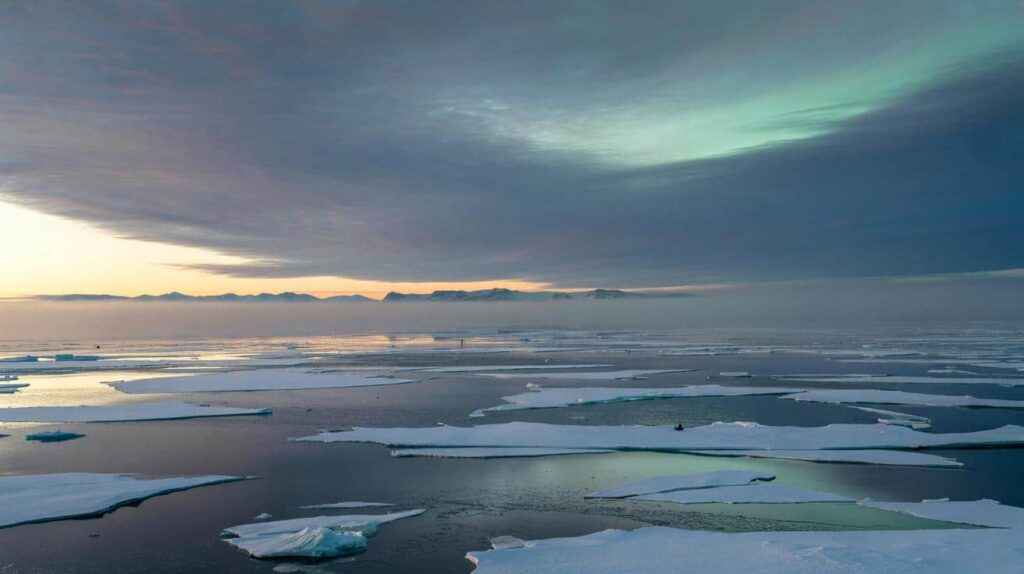
On satellite screens in quiet forecasting rooms, that confusion looks like something else entirely: a bruised, wobbling cap of white at the top of the planet, thinner and patchier than most living meteorologists have ever seen.
They’re starting to say it out loud now, sometimes with a sigh before the microphone goes live: this February could expose an Arctic so fragile, it barely resembles the one they trained on in school.

And what happens up there never stays there.

February’s strange skies are telling a story from the Arctic
Ask a forecaster in Europe or North America how this winter feels, and many will use the same word: unstable. One week, a brutal cold snap that shocks the energy grid, the next, a thaw that has ski resorts trucking in artificial snow. These mood swings in the weather are a surface symptom of something quieter and more dramatic happening far to the north.
High above the pole, the stratospheric polar vortex — that tight, icy belt of wind that usually keeps Arctic air locked away — has been flirting with breakdown. When that belt weakens or splits, the Arctic’s boundaries blur and the rest of us feel the spillover.
In January, several models used by national weather services started showing aggressive “warm air intrusions” into the Arctic. Think of tongues of milder air pushing north, punching holes into the usual winter chill. At the same time, sea-ice maps revealed large areas of thin, first-year ice where thick, multi-year ice used to dominate.
Meteorologists in Norway, Canada and the U.S. quietly compared notes. The numbers pointed to an early February setup we simply haven’t measured on this kind of global, instrumented scale. One veteran forecaster in Tromsø told colleagues that the last time the Arctic seemed this vulnerable so early in the year was “in the stories my grandfather told, not in the data I’ve seen in my lifetime.”
The logic is cruelly simple. A warmer planet means a warmer Arctic, and a warmer Arctic means weaker contrasts between polar and mid-latitude air. That contrast is the engine that keeps the jet stream racing along in a relatively straight path. So when the difference shrinks, the jet stream slows and meanders, letting lobes of polar air dive south and bulges of warm air surge north.
Each of those warm bulges eats at the ice from above and from below, warming both the air and the ocean. The Arctic used to be a fortress of cold by February; this year, parts of it look more like a breached wall.
How a “fragile Arctic” shows up in your daily weather
If you want to feel the Arctic’s fragility in a practical way, look at your local five-day forecast and circle every wild swing. A 15-degree jump between Wednesday and Friday. Snow, then rain on top of snow, then flash-freeze. These are classic fingerprints of a wobbly jet stream and loosened polar air masses.
One simple habit that forecasters quietly recommend now: treat February like a month of ambushes. Plan as if your weather could flip by midweek. Check updates morning and evening, not just on Sunday night. It sounds basic, almost boring, but when Arctic patterns are this unstable, the “set and forget” approach to winter plans is a fast way to get caught out.
We’ve all been there, that moment when you leave the house under soft, wet snow and come home through a razor-sharp wind that feels imported from Siberia. In early February, these whiplash days become more common when the Arctic is exposed and the polar vortex is disrupted. Municipal services feel it first. Road crews must shuffle salt deliveries, power companies refresh their blackout protocols, and schools debate last‑minute closures not once or twice a season, but over and over.
In Germany this winter, one regional grid operator reported that sudden cold snaps after mild spells squeezed demand forecasts so tightly they had to dip into expensive standby capacity multiple times in a single fortnight. That kind of stress begins with a jet stream that has lost its old, disciplined rhythm.

From a scientific angle, calling the Arctic “fragile” isn’t just emotional language. It describes a system that has lost its buffers. Thicker sea ice used to act as a kind of memory, storing cold between years and resisting every warm pulse that tried to melt it. Now, with more thin ice and open water in February, a single warm storm can do damage that would have taken weeks decades ago.
When meteorologists warn that early February could reveal an Arctic state “unseen for generations”, they mean this: the combination of low ice extent, unusual warmth aloft, and a strained polar vortex may line up in ways we’ve simply never recorded with modern instruments. That makes the whole chain — from ice floe to city street — more twitchy, more reactive, quicker to swing.
What you can actually do when the Arctic’s mood swings hit home
For most of us, “fragile Arctic” sounds far away, almost abstract. The trick is to turn that distant phrase into small, grounded actions. Start with your own winter routine. Instead of assuming February is locked into deep-winter mode, think of it as open-ended. Keep both snow boots and rain gear by the door. Keep a basic blackout kit ready, not as doomer prep, but as grown‑up pragmatism.
One precise method used by people in weather‑sensitive jobs is the “48‑hour lens.” They don’t obsess over month‑ahead projections; they zoom in on the next two days. Twice a day, they ask: “What changed since yesterday’s forecast?” That tiny habit catches the kind of last‑minute Arctic-driven swings that ruin commutes and outdoor workdays.
If your instinct is to ignore the weather app because it “always changes”, you’re not alone. These days, the forecast does change, and that’s the whole point. A fragile Arctic feeds unpredictability into the system, and short‑range updates are where those shifts show up first.
The common mistake is clinging to a single early forecast like a promise. We book trips, plan work, schedule deliveries, then feel betrayed when a sudden Arctic plunge cancels everything. Let’s be honest: nobody really checks the forecast every single day. Yet in winters like this, moving from a weekly glance to a quick daily check can be the difference between calm adjustments and last‑minute panic.
This winter, the Arctic is less a distant backdrop and more an unseen character, quietly rewriting our local scripts from thousands of kilometers away.
- Watch the jet stream news
When you see headlines about a “polar vortex disruption” or “sudden stratospheric warming,” translate that as: expect odd, persistent weather patterns over the next couple of weeks. - Upgrade your “winter default”
Instead of betting on either deep cold or early spring, plan for both. Layer clothing, keep your car ready for ice and heavy rain, and leave margin in your schedule when big pattern shifts are forecast. - Connect Arctic news to local choices
*When you read about record‑low sea ice or unusual warmth at the pole, treat it as context for why your February feels off — not as distant trivia. That mental link can nudge more realistic expectations, and less frustration, when plans shift.
The Arctic is changing fast — and we’re living through the plot twist
Some winters fade into memory as a blur of grey days and damp coats. This one is different. Meteorologists will replay the early February charts from this year for a long time, trying to understand how an Arctic once wrapped in layers of reliable cold ended up looking so exposed, so early, on their screens.
For people far from the ice, the story lands not in satellite images but in daily life: the cancelled train when rails freeze after a mild spell, the flooded street where rain chews through old snowbanks, the anxious text threads when the power flickers under a sudden deep freeze. None of these moments scream “Arctic climate signal” on their own, yet together they sketch out a new kind of winter.
A plain-truth thought sits underneath all this: the line between “up there” and “down here” is much thinner than we were raised to believe. The Arctic used to be taught in school as a remote, almost mythical cap on the globe; now its mood leaks into gardening plans, airline schedules and the price of heating your home.

Meteorologists, by training, prefer caution. When they start talking about a fragile Arctic state unseen for generations, they’re not chasing drama. They’re reading the same patterns over and over and finding fewer solid anchors to hold onto. That uncertainty can feel unnerving, but it also invites a kind of clear‑eyed attention — to the sky, to the news, and to the choices we keep making that shape the winters still to come.

| Key point | Detail | Value for the reader |
|---|---|---|
| Arctic fragility is real | Record‑thin sea ice, warm intrusions, and a stressed polar vortex are converging in early February | Helps explain why local winter weather feels more chaotic and less predictable |
| Weather whiplash will intensify | Wobbling jet streams send sharp cold snaps and sudden thaws in rapid succession | Encourages smarter planning for travel, work, and home safety |
| Small habits matter | Using a 48‑hour forecast lens, checking updates, and prepping for both cold and mild spells | Reduces stress, last‑minute surprises, and practical risks during volatile winters |
FAQ:
- Is this winter’s Arctic state really “unseen for generations” or just media hype?
Meteorologists base that phrase on data: unusually low February sea‑ice thickness, repeated warm air intrusions, and signs of polar vortex stress that don’t line up with mid‑20th‑century records. While the Arctic has always varied, the current combination of extremes is rare in modern measurements.- Does a fragile Arctic automatically mean more snow where I live?
Not automatically. A weakened polar vortex can send cold air south, which sometimes boosts snow, but it can also bring mild, stormy spells or dry cold depending on where the jet stream sets up. The key impact is more volatility, not just “more snow everywhere.”- How does sea‑ice loss change my local February weather?
Less and thinner ice means the Arctic ocean releases more heat and moisture into the atmosphere. That warmth can disrupt the usual pressure patterns, nudging the jet stream into new shapes. Those shifts then steer storms and temperature swings that you feel in your town.- Should I trust long‑range winter forecasts in years like this?
Seasonal outlooks are useful for broad tendencies — milder, colder, wetter, drier — but a fragile Arctic increases the odds of surprises. Use them as background, not as a promise. For actual decisions, short‑range (2–5 day) forecasts stay your most reliable guide.- Is there anything personal I can do about what’s happening in the Arctic?
On the big scale, cutting emissions, voting for climate‑aware policies, and supporting clean energy all feed into slowing Arctic warming. On the personal, practical level, adapting your habits to more erratic winters — from home efficiency to smarter travel — is how you live with the changes already here while pushing, collectively, for fewer down the line.
