
The first time you feel it, it’s not the snow. It’s the sound. That strange, heavy quiet that swallows the usual city noise, as if someone put a lid over the sky. Streetlights glow in a weird halo, your breath hangs thicker in the air, and every gust of wind has a sharp edge that wasn’t there last week.
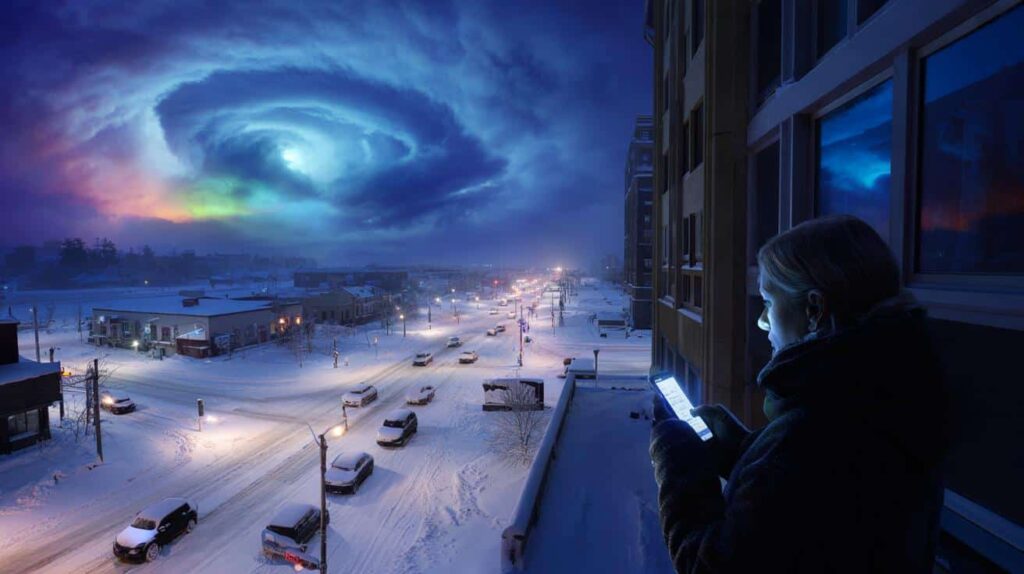
You scroll your phone at the window and there it is: maps painted in violent purple and blue, meteorologists warning of “extreme anomalies”, a term you half-recognize from some headline last winter. The phrase “polar vortex” pops up again, that ominous swirl of Arctic air that seems to have adopted a personality of its own.
Some experts say February could be a month we remember for a long time.
Nobody’s quite ready for what that might mean.

The polar vortex is wobbling — and February could get wild
On weather models tonight, the Arctic looks like it’s having a mood swing. The tight ring of icy air that usually spins neatly above the North Pole is starting to stretch, warp and tilt — a process known as a sudden stratospheric warming, or SSW.
When that happens, the polar vortex can weaken or even split, sending blobs of frigid air spilling south into North America, Europe and Asia. That’s when you suddenly get minus double digits in places that were just jogging in hoodies a week earlier.
This isn’t sci‑fi. It’s the same pattern behind some of the most brutal late‑winter cold snaps of the past decade.
Back in February 2021, Texas learned the hard way what a misbehaving polar vortex can do. A major breakdown high above the Arctic set off a chain reaction, steering dangerously cold air deep into the American South. Millions lost power, pipes burst in homes never meant for that kind of freeze, and at least 200 people died.
Meteorologists are seeing early signs of a similar disruption building again this winter. It doesn’t mean a copy‑paste of 2021, but the echoes are loud enough that forecasters are raising their voices earlier than usual. For Europe, that same kind of vortex wobble has previously meant Siberian blasts, frozen rail lines, and schoolyards turned into ice rinks overnight.
Weather rarely repeats itself perfectly. It does like to rhyme.
So what’s actually happening above our heads? About 30 kilometers up, in the stratosphere, the polar vortex is a spinning band of westerly winds that usually keeps Arctic air locked in place. When that band suddenly warms and weakens, the jet stream below it can twist into odd, wavy shapes.
Those wavy bends act like conveyor belts, dragging air from the Arctic into mid‑latitudes, while pulling milder air north somewhere else. That’s why you can have one region buried under snow and another weirdly mild at the exact same time. *It’s not the planet going “crazy”; it’s the atmosphere redistributing its chaos.*
Scientists are tracking this winter’s shift day by day. The signals aren’t subtle anymore.
 Meteorologists warn early February may expose a fragile Arctic state unseen for generations
How to get ready for an “upside‑down” February
Preparation for an unstable polar vortex winter isn’t about bunker‑style panic. It’s more like quietly rewiring your routine before the worst hits. Think in short, practical moves: check exposed pipes, clear gutters, know where your blankets actually are.
If you drive, topping up windshield fluid, checking your battery, and throwing a shovel and sand in the trunk sound boring, until you’re stuck on a side street at 11 p.m. with spinning tires. For renters or people in small apartments, a simple draft stopper under doors and an extra thermal curtain can shift the feel of a room by a couple of degrees.
Nobody gets bonus points for suffering through the cold unprepared.
We’ve all been there, that moment when the cold snap arrives and you realize your only “winter gear” is a thin fashion coat and one lonely glove. There’s a quiet shame in that, like you somehow failed an adulting test.
But this winter’s setup is different because the risk isn’t just “a bit chilly”. A destabilized polar vortex can flip a mild week into a dangerous one, especially for older people, kids, and anyone who can’t afford to crank the heating. That means planning isn’t overreacting, it’s basic self‑respect.
Let’s be honest: nobody really does this every single day. Yet a few hours of prep now can save you from scrambling later, when stores are sold out of heaters and salt.
“Right now the atmosphere is loaded like a spring,” says one climatologist I spoke to. “If the polar vortex breaks down fully, the impacts could be abrupt. That doesn’t mean panic. It means using the warning as a head start.”
- Watch the 10–15 day forecasts
Not just the daily app icon. Look at trend arrows, not just exact temperatures. - Layer your defenses, not just your clothes
Curtains, rugs, window film, and a backup heat source can stack up small comforts. - Think about your people
Check in with neighbors, relatives, or friends who live alone or in drafty places. - Plan for power bumps
Have candles, power banks, and a low‑tech way to stay warm in one easy‑to‑find spot. - Keep some flexibility
If you can work from home on the harshest days, decide that now, not when roads are icy.
Living with a future of stranger winters
This winter’s polar vortex drama isn’t a one‑off plot twist. It’s a glimpse of the new rulebook, where climate change doesn’t just mean “warmer” but “weirder” — sharper swings, wilder contrasts, and seasons that no longer behave like the ones we grew up with.
Scientists are still debating how much human‑driven warming is nudging the vortex into more frequent breakdowns, yet most agree the background conditions have changed. The Arctic is warming faster than the rest of the planet, and that alone shifts the balance of the whole system.

For ordinary people, the question becomes less “Will it snow?” and more “Can my life bend when the weather does?” That might look like cities redesigning power grids, schools rethinking closure rules, employers accepting that remote work is a resilience tool, not a perk. It might look like you, texting a neighbor before the next cold wave rolls in, just to say: “You good if this gets rough?”
Those small human links are their own kind of climate adaptation.

| Key point | Detail | Value for the reader |
|---|---|---|
| Polar vortex shift | Unusual warming in the stratosphere is weakening the Arctic wind belt and could send extreme cold south in February | Helps you understand why forecasts are suddenly turning dramatic |
| Real‑world impacts | Past vortex disruptions brought deadly cold snaps, grid failures, and transport chaos far from the Arctic | Shows what kinds of disruptions to anticipate in daily life |
| Personal preparation | Small, concrete steps at home, on the road, and in your social circle increase your resilience | Turns alarming headlines into actions you can actually take |
FAQ:
- Is this polar vortex shift guaranteed to bring extreme cold where I live?
No. A weakened vortex raises the odds of cold outbreaks, but the exact regions hit depend on how the jet stream bends. Some areas may get harsh snow and ice, others may stay relatively mild.- How long do polar vortex disruptions usually last?
The initial breakdown happens over days, yet the surface impacts can linger for several weeks. Cold spells often come in waves rather than one continuous freeze.- Is climate change causing more polar vortex events?
Research is ongoing. Some studies link a warming Arctic to more frequent vortex disruptions, while others find weaker connections. Most experts agree that a warmer background climate is making extremes of all kinds more likely.- What’s the fastest way to prepare my home?
Focus on drafts and essentials: seal windows and doors, protect exposed pipes, stock basic food and meds, and have blankets and a backup light source ready in one place.- Should I be worried about power outages?
Grid operators are more alert since 2021, yet heavy demand plus ice and wind can still trigger outages. Treat them as a realistic possibility, not a certainty, and prepare for at least 24–48 hours without power if you live in a vulnerable region.
