
The first sign isn’t the darkness.
It’s the silence.
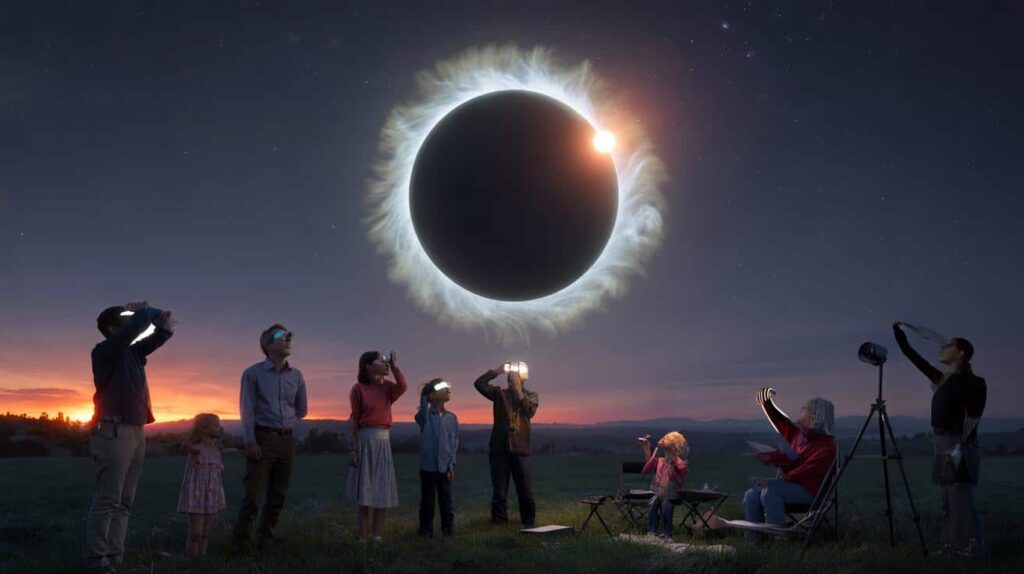
You’re standing in a field, or on a rooftop, or on a crowded beach, and the usual soundtrack of the day starts to fade. Birds grow restless. Dogs tilt their heads toward the sky. The light turns a strange metallic color, like the world has slipped under a tinted glass dome.
Someone near you stops talking mid-sentence. Another person starts recording on their phone, hands shaking a little. Shadows go razor-sharp, then begin to twist into eerie crescent shapes on the ground.

Then, right in the middle of the day, the Sun is eaten.
And for a few breathless minutes, day turns to night.
The longest blackout of the Sun in our lifetime
We’ve all seen sunsets, storms, sudden blackouts.
But the longest total solar eclipse of this century will be something else entirely.
Astronomers are already calling it a once-in-many-lifetimes alignment: the Moon sliding exactly in front of the Sun, holding it there in a perfect, trembling balance. In some parts of the world, the Sun’s face will be completely swallowed for several unforgettable minutes, stretching long enough for your brain to say, “This can’t be real,” again and again.
For people under the path of totality, it won’t just dim.
It will genuinely feel like the world has skipped a beat.
If you’ve never witnessed totality, it’s hard to imagine how physical the experience feels.
Eclipse veterans talk about the way the air cools fast, a wind rises from nowhere, streetlights snap on late and confused.
In small towns along the path, hotels sell out a year in advance. Farmers rent out fields as temporary campgrounds. Kids who barely care about science beg to stay up late planning their viewing spot. In 2017, during another great eclipse, traffic jams stretched for hours after totality as people tried to drive home, stunned and sunburned, with smudged phone photos that didn’t come close to what their eyes had seen.
This time, the shadow will linger even longer.
Enough time for emotions to really land.
What actually happens is pure celestial geometry.
The Moon, though 400 times smaller than the Sun, is 400 times closer to Earth, so from here they look almost exactly the same size.
On this particular alignment, the Moon will be relatively close to Earth in its orbit, which makes its apparent size in the sky just a bit larger. That tiny difference is what stretches totality toward record-breaking duration. The path where day will become night is a narrow band, barely a couple of hundred kilometers wide, racing across the globe at supersonic speed. Either you’re in the shadow, or you aren’t.
*Miss the path of totality by just a few dozen kilometers, and you’ll only get a partial, no matter how fancy your camera is.*
How to actually experience this eclipse — not just scroll past it
The first practical step is brutally simple: find the line.
Astronomers call it the path of totality, and every map you’ll see online will highlight it like a dark river slicing across countries and oceans.
Pick a city or town squarely under that path.
Not “near it”, not “kind of close”. Directly under it. Then check historical weather for that region on the same date: some areas are notorious for stubborn cloud cover, others offer much clearer skies. Once you have your target, book early — transport, a bed, even a patch of ground you’re allowed to stand on.
Watching a total eclipse is a bit like a concert with no replay button.
If you’re late, it’s over forever.

There’s another layer nobody talks about enough: your own attention.
Between cameras, filters, kids, friends, and social media, it’s absurdly easy to spend totality staring at a screen instead of the sky.
People who’ve chased multiple eclipses often say their biggest regret from the first one was trying to “capture” it instead of simply standing there. Let’s be honest: nobody really does this every single day. We don’t often give ourselves full permission to just watch something without documenting it.
So plan your photos and videos for the partial phases, before and after.
When totality hits, drop the tech, look up, and let your nervous system burn the memory in.
During the 2017 eclipse, astrophotographer Angela Brooks told me, “I brought three cameras, two lenses, and a tripod.
When the shadow finally rolled in, I forgot every setting I’d rehearsed for months and just stood there with my mouth open.
That’s when I understood: the eclipse isn’t a shot, it’s a shock.”
- Protect your eyes
Use ISO-certified eclipse glasses during all partial phases.
Only remove them in totality, when the Sun is completely covered. - Arrive early
Traffic, parking, and confusion spike fast.
Give yourself at least a couple of extra hours to settle and look around. - Have a simple plan
Choose one spot, one group, one main goal.
Overcomplicated setups are the first thing to collapse under the excitement. - Expect strange emotions
People cry, laugh, or go completely quiet.
Let whatever happens, happen. - Think about the kids
Ear defenders for noise, snacks, and a simple explanation of what’s going on.
This may be the story they tell their whole lives.
When the sky goes dark, what does that do to us?
There’s a reason ancient cultures carved eclipses into stone.
When the Sun disappears in the middle of the day, your body reacts before your brain has time to give a rational speech about orbital mechanics.
Some people describe a deep, animal-level fear as the light drains away. Others feel an almost spiritual awe, like the universe is suddenly far more visible than usual. Street sounds lower, conversations slip into whispers, and for a few stolen minutes, thousands of strangers share the same stunned expression, faces all turned in the same direction.
An eclipse doesn’t just change the light.
It rearranges the social gravity of a place.
For communities along the path, the coming of the longest total solar eclipse of the century is already reshaping daily life.
Local councils debate crowd control. Teachers write last-minute lesson plans. Small businesses prepare pop-up stands stocked with water, coffee, cereal bars, and cheap eclipse glasses.
In some towns, older residents remember a shorter eclipse decades ago. They talk about how farm animals panicked, how roosters crowed at the wrong time, how kids went strangely quiet in playgrounds as the sky dimmed. This time, they expect tens of thousands more visitors. Parking lots become makeshift camps. Families host friends who fly in “just for the shadow.”
It’s not just an astronomical event.
It’s a social experiment, playing out in real time.
Scientists are excited for other reasons.
Each long eclipse offers a rare chance to study the Sun’s corona — that ghostly white crown that only appears when the blinding disk is blocked.
With the extended totality, research teams can gather more detailed data on solar wind, magnetic fields, and temperature changes across the atmosphere. Ecologists plan to track bird movements, plant behavior, and insect activity as the light drops and returns. Meteorologists will watch how quickly the temperature falls and how tiny local winds shift in the shadow’s wake.
Behind the crowds with cardboard glasses and folding chairs, a quiet army of researchers will be working flat out.
For them, this sudden daytime night is a goldmine.
| Key point | Detail | Value for the reader |
|---|---|---|
| Path of totality matters | Only within the narrow shadow band will day fully turn to night | Helps you choose the right location instead of missing totality by a few kilometers |
| Prepare like it’s a one-off concert | Book travel, lodging, and have your viewing spot and timing figured out early | Reduces stress on the day and raises your chances of a clear, memorable experience |
| Experience over recording | Use devices during partial phases, then mostly watch with your own eyes in totality | Gives you an emotional, embodied memory rather than just another shaky video |
FAQ:
- Question 1How long will this total solar eclipse actually last at maximum?
- Question 2Is it safe to look at the eclipse without glasses during any part of it?
- Question 3What if I’m not in the path of totality — is it still worth watching?
- Question 4Do animals really change their behavior when day turns to night?
- Question 5What’s the best simple setup if I want at least one good photo?
