
The salon was buzzing that Tuesday morning when she dropped into my chair with a sigh and a sentence I’ve heard a thousand times: “I’m over 50, so I guess it’s time for short hair, right?”
She said it like a dental appointment. I smiled, grabbed my comb, and asked my favorite question: “Do you actually want short hair, or do you just think you’re supposed to?”
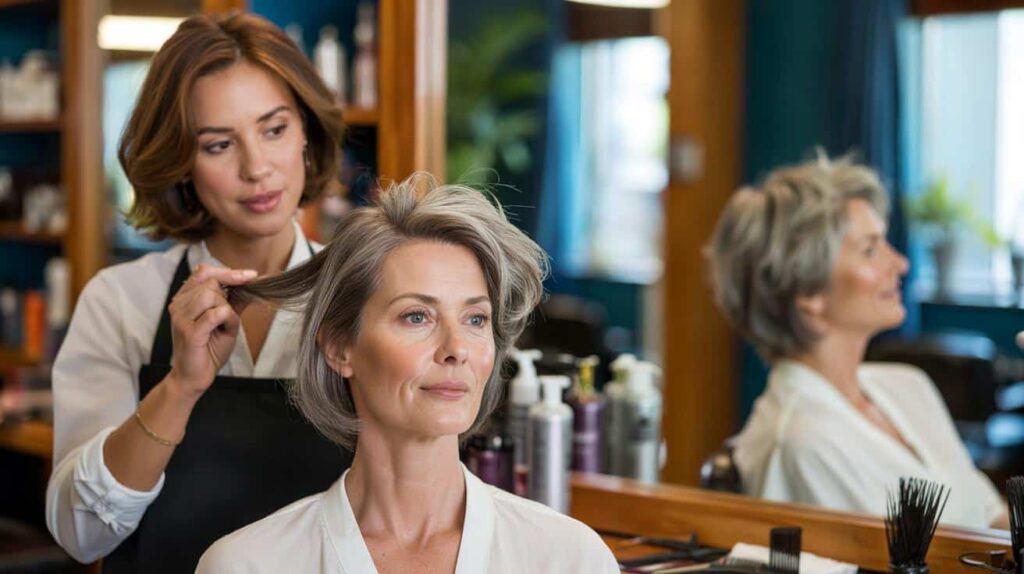
She stared at herself in the mirror, fingers tracing the ends of her shoulder-length bob. A little tired, a little flat, still carrying the ghost of the style she’d worn at 35.
On the shelf behind us, color bowls clinked, blow-dryers hummed, and a woman with a cropped silver pixie laughed like she’d just gotten younger on the spot.
The truth is, the short hair decision at 50 isn’t just about hair.
It’s about who you’re ready to be next.

The real question: do you want short hair or a fresh identity?
When women sit down and whisper, “I’m thinking of going short,” they’re rarely talking only about inches.
They’re talking about hot flashes, thicker waists, thinning ends, teenage kids leaving home, a face that’s familiar but somehow different.

Short hair becomes this symbol of a pivot point.
A line in the sand between the woman who was juggling toddlers and deadlines, and the one who wants to sleep through the night and say no more often.
The mirror doesn’t lie, but it also doesn’t have to be cruel.
What I see, standing behind that chair, is not age.
I see bone structure, eye color, how someone laughs, how they move their hands when they talk.
That’s what short hair should respond to.
Not a date on your passport.
Last month, a woman named Claire sat down and pulled out a photo of a celebrity pixie.
On the screen, this actress had a razor-sharp jawline, huge eyes, and a full-time glam team.
Claire, on the other hand, had fine hair, a softer jaw, and a job that started at 7 a.m.
We talked for ten minutes before I even picked up my scissors.
Where did her hair part naturally? How much time did she spend styling? Was she bothered more by flatness at the crown or heaviness at the nape?
She admitted she only blow-dried when it was absolutely necessary.
We ended up with a textured, cheekbone-length crop that hugged the back of her neck but left softness around her face.
Three weeks later, she came back for a fringe trim and told me strangers had been complimenting her in the supermarket aisle.
Not because she “looked younger,” but because she looked like herself again.
The logic behind this is simple: short hair amplifies what’s already there.
When you cut away length, you reveal your facial architecture, your posture, your expression.
That’s liberating when a cut is chosen for your real features and lifestyle.
It’s punishing when it’s chosen from a random Pinterest board called “Flattering cuts for women over 50.”
Hair thins, texture changes, hormones shift, yes.
But your style shouldn’t shrink as a response to those changes.
It should adapt.
Short hair that truly works at 50 and beyond is less about chasing youth and more about framing your lived-in beauty with intention.
How to choose a short cut that actually loves your face
Here’s the method I use in the salon when a woman over 50 tells me she’s ready for short hair.
We don’t start with trends, we start with the mirror.
First, I look at face shape: oval, round, long, square, heart, diamond.
Round faces tend to glow with a bit of volume at the crown and softness around the cheeks.
Square jaws are incredible with textured, piecey layers that break up strong angles.

Next comes hair texture: fine, coarse, straight, wavy, coily.
Fine hair often loves a structured bob or a crop with internal layers.
Waves or curls usually look better when they’re not cut too blunt or too short at the crown.
Only then do we talk length: pixie, ear-length, jaw-length, or classic short bob.
Short hair should be a custom suit, not a one-size-fits-all T‑shirt.
The biggest mistake I see women over 50 make with short hair is cutting out of frustration.
They’re fed up with their blow-dryer, tired of battling frizz or flatness, and they just say, “Chop it all off.”
That usually leads to a cut that’s technically short but emotionally wrong.
Too severe. Too boyish for her taste. Or too “helmet-like” because everything is the same length.
Then she spends months trying to grow it out, hating every photo in the meantime.
The kinder path is to go shorter in stages.
Maybe a collarbone bob first, then jaw-length, then a softer crop.
Each step teaches you how your face feels with less hair, what products you actually reach for, and how much styling you can live with.
Let’s be honest: nobody really does this every single day.
There’s another trap I see all the time: the “polite” short cut that ages you more than your wrinkles.
Perfectly rounded, stiff, with bangs like a visor.
No movement, no personality, just compliance.
*Hair at 50 doesn’t have to mean behaving yourself.*
It can mean more mischief, more air, more texture.
That’s where personalization comes in: a feathery fringe, an uneven part, a little undone wave.
As I often tell my clients, “Short hair isn’t about taking something away. It’s about showing the world what you’ve decided to keep.”
- Choose softness around the face if you’re worried about looking “hard” or severe.
- Ask for invisible layers or point-cut ends to avoid the classic round “helmet.”
- Keep some length at the top if you like volume or want to balance a round or fuller face.
- Use your glasses as a guide: your cut should harmonize with the frame shape, not fight it.
- Plan your maintenance: trims every 5–8 weeks keep short hair looking intentional, not accidental.
Living with short hair after 50: the quiet confidence shift
There’s a moment that often happens about three days after a big cut.
You catch yourself in a shop window or a Zoom meeting and do a double take.
At first, it can be unsettling.
You see more of your neck, more of your jaw, the slope of your nose, the sparkle or tiredness in your eyes.
Nothing is hidden behind a curtain of hair anymore.
Then, for many women, something else kicks in.
A small, private sense of ownership.
You chose this. You didn’t default to it because “someone my age should.”

That quiet click of alignment between how you feel inside and what you’re showing outside is the real transformation.
Hair is just the delivery system.

| Key point | Detail | Value for the reader |
|---|---|---|
| Face and texture first | Choose short cuts based on bone structure and natural hair texture, not age rules or trends. | Reduces regret and gives a style that feels genuinely “you.” |
| Go shorter in stages | Transition from longer to short via intermediate lengths like a bob or lob. | Makes the change less shocking and easier to adapt your routine. |
| Soft structure, not helmets | Add texture, invisible layers, and movement instead of uniform, rounded shapes. | Creates a modern, flattering look that energizes rather than ages. |
FAQ:
- Question 1Will cutting my hair short automatically make me look younger?
- Answer 1No. A random short cut can actually harden your features. What creates a fresher look is the right balance of length, volume, and softness for your specific face and hair texture.
- Question 2My hair is thinning. Is short hair really better after 50?
- Answer 2Often, yes. Strategic layers and a shorter length can make thin hair look fuller at the roots. The trick is not to go so short that the scalp shows, and to avoid heavy, blunt lines that collapse.
- Question 3How often do I need to get trims with a short cut?
- Answer 3Plan on every 5–8 weeks. Pixies and ultra-short crops sit closer to 4–6 weeks, while short bobs can stretch to 6–8 without losing their shape too much.
- Question 4Can I wear short hair if I have a round face and a fuller neck?
- Answer 4Yes, as long as the cut adds a bit of height at the crown and doesn’t hug the widest part of your cheeks. Leaving length slightly below the jaw can visually elongate the face and neck.
- Question 5Do I need to change my makeup if I go short?
- Answer 5Not necessarily, but many women like a touch more definition: slightly stronger brows, a bit of mascara, or a brighter lip. Short hair exposes your features more, so small tweaks can help you feel balanced.
