
You’re standing in front of the mirror, hair still damp, and that familiar thought creeps in again: “Why does my hair just… lie there?”
You’ve tried mousses, powders, blowouts that promise “runway volume”, yet your fine, short hair keeps slipping back into its flat comfort zone by lunchtime.
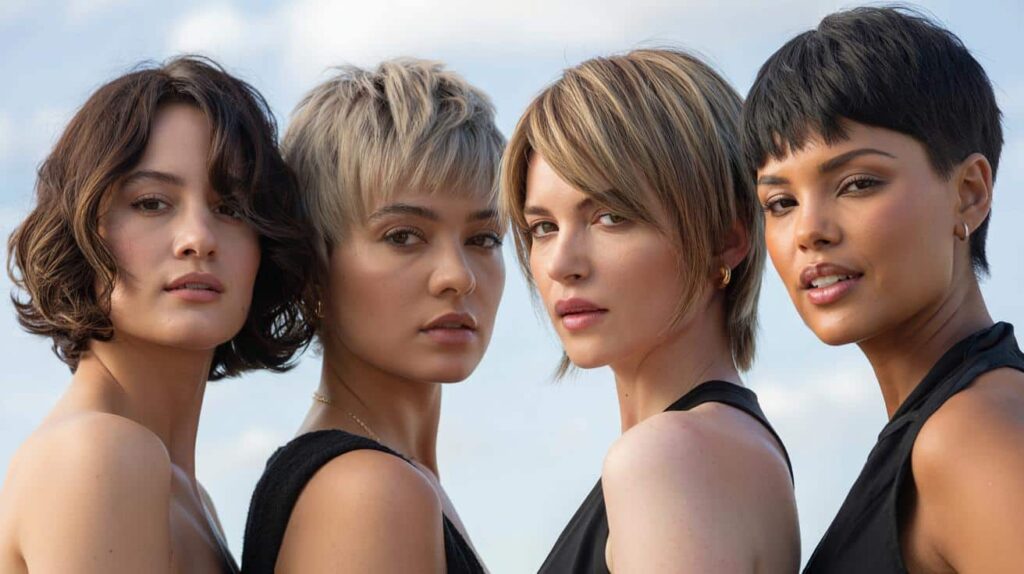
The truth is, it’s not you. It’s the cut.
On fine hair, the wrong short haircut can instantly betray every gap and weakness. The right one, on the other hand, suddenly gives the illusion of twice as much hair and half as much effort.

One snip, one angle, one tiny layer can change how your whole face looks.

And that’s exactly where these four short hairstyles come in.
1. The textured bob: the easiest cheat for instant volume
The textured bob is that friend who always photographs well, even on bad days.
Cut roughly between the jaw and just below the chin, it keeps enough length to play with, while the ends are lightly deconstructed to avoid the “helmet” effect.
On fine hair, that broken-up edge is everything.
Instead of lying in one sad, perfect sheet, each small section moves on its own, catching the light and creating natural shadows.
From the side, it looks fuller.
From the back, it looks like there’s more density than you actually have.
Picture Léa, 34, who walked into a salon after years of “micro-bobs” that always looked too neat.
Her hair was baby-fine, shoulder-skimming, and so flat at the roots she had started wearing headbands just to hide it.
The stylist cut her hair just below the jaw, added invisible layers only in the interior, then scrunched in a bit of salt spray.
Suddenly, her bob wasn’t flat anymore, it was alive.
She texted a picture to a friend.
The reply came back instantly: “Wow, did your hair grow? It looks so thick.”
Same amount of hair, completely different illusion.
The magic of the textured bob lies in how it breaks up straight “lines” of hair.
Fine hair tends to clump into smooth, sleek panels that reflect light in one big surface, which exaggerates flatness.
By adding micro-layers and point-cut ends, you introduce small irregularities that scatter the light.
Your eye perceives those ripples as depth, and depth reads as volume.
*This is where a good conversation with your stylist matters more than any spray.*
Ask specifically for a bob with texture at the ends and soft internal layers, not a blunt cut that can weigh your hair down and reveal every gap near the scalp.
2. The layered pixie: light, airy, and secretly structured
The layered pixie is the cut that scares many women… until they try it.
Done right on fine hair, it’s like cutting away all the dead weight and keeping only the flattering parts.
The key lies in short, feathered layers at the crown that lift away from the head.
Nape and sides stay slightly closer to the scalp, creating contrast.
This difference in length between the top and the sides makes the hair seem instantly fuller on top.
Your cheekbones pop, your neck looks longer, and the face opens up.
Take Sara, 28, who used to gather her fine hair in a tiny, sad ponytail every single day.
She thought she “didn’t have the face” for a pixie because her hairline was low and her forehead small.
Her stylist suggested a layered pixie with a soft, side-swept fringe.
The top was cut slightly choppy, crown hair lifted and thinned out just enough to move, not to lie flat.
When they dried it with the fingers, directing the hair forward and up, she saw something new in the mirror: texture.
No heavy products, no twenty-minute blow-dry.
Just light hair, standing up on its own like it finally had a purpose.
There’s a structural logic behind the layered pixie.
When fine hair is very short, weight is no longer the enemy: gravity has less grip.
So the cut relies on graduation and strategic layers to control where the volume sits.
Shorter hair at the sides and back pushes the visual weight to the top, where we want it.
Let’s be honest: nobody really spends half an hour styling a pixie every single day.
That’s why the architecture of the cut needs to do 80% of the work, with just a pea-sized dab of texturising paste emulsified between your fingers for definition and controlled “mess.”

3. The rounded bob with curtain bangs: soft volume around the face
If you’re not ready for ultra-short, the rounded bob with curtain bangs is a comforting middle ground.
The base of the cut usually hits around the lips or top of the neck, and the perimeter is slightly curved inward.
The curtain bangs, cut to skim the cheekbones or the bridge of the nose, are gently parted in the center.
They frame the face and give the illusion of thickness right where the eye lands first.
Styling is simple: blow-dry with a round brush pointing the ends slightly under, then let the curtain fringe split naturally.
A light spray of dry shampoo at the roots finishes the job.
Maude, 42, had convinced herself bangs were “too much work” for someone with fine hair.
Her biggest fear: that dreaded stringy fringe that separates into three thin strands by noon.
Her hairdresser proposed long, airy curtain bangs, heavily point-cut for softness and blended into a rounded bob that followed the jawline.
Instead of a dense, straight fringe, the hair was lighter, mobile, and intentionally imperfect.
Two weeks later, she realized something unexpected.
On video calls, people kept telling her she looked “rested” and “different,” even if they couldn’t pinpoint why.
The gentle volume around her eyes and temples subtly lifted her whole expression.
The rounded bob with curtain bangs plays with proportions.
By adding movement at the front, the cut distracts from flatness on the crown and creates a visual “halo” of volume around the face.
The soft curve at the ends closes in slightly, which gives a sense of fullness along the jaw.
It’s especially flattering if your hair tends to separate in the back or if your ends are naturally wispy.
On fine hair, this cut thrives on lightness.
Choose airy, non-greasy products and blow-dry the fringe away from the face, not plastered against the forehead.
Your goal is a gentle curtain, not a heavy wall of hair.
4. The cropped shag: controlled chaos for ultra-fine hair
The modern cropped shag is the rebel of short cuts for fine hair.
Choppy layers, a bit of rock’n’roll fringe, no perfect lines… and yet, it can be surprisingly wearable.
The shape usually hovers between the ears and the jaw, with lots of internal layers and a fringe that breaks up into piecey bits.
On very fine hair, those small, irregular sections create permanent movement, even when the hair is straight.
To style it, flip your head down, rough-dry with your hands, then pinch a tiny amount of wax into the ends.
You’re not chasing perfection. You’re chasing attitude.
Many women arrive at the salon with screenshots of 70s icons or ultra-cool French shags.
Then they whisper, “My hair is way too thin for this, right?” with a mix of hope and resignation.
What usually happens is this: the stylist adapts the shag to the hair’s reality.
Less layering at the crown if the scalp tends to show, more length left in the fringe to avoid a “plucked” effect, softer graduation at the back.
The result isn’t an exact copy of the inspiration photo.
It’s a gentler, airier version that still carries the same spirit: messy, laid-back volume.
One that still looks good when you wake up slightly late on a Wednesday.
“Fine hair needs structure, not weight,” says one Paris salon owner. “The shag gives structure through layers and direction, not through loads of product or heavy blow-drying.”
- Ask for softened layers, not ultra-thin razor cuts, to avoid scraggly ends.
- Keep a bit more density around the hairline so the scalp never feels exposed.
- Use dry texture spray on the mid-lengths, not at the roots, to stop the style collapsing.
- Book micro-trims every 6–8 weeks so the shape doesn’t lose its edge.
- Accept that a shag is meant to look a bit wild; that’s where its charm – and volume – comes from.
Living with fine, short hair: learning to work with, not against, your texture
Once you’ve tried one of these cuts, something shifts.
You stop fighting your hair to behave like someone else’s and start noticing what it actually wants to do.
A textured bob that falls perfectly after air-drying.
A pixie that still holds volume after you’ve pulled a beanie off.
A rounded bob that frames your face even on day-three hair.
A cropped shag that looks better when you barely touch it.
We’ve all been there, that moment when you leave the salon feeling like a different person… then wonder how you’ll ever recreate it at home.
The secret is not to chase a magazine finish every morning, but to choose a haircut whose natural shape flatters your fine hair even on rushed days.

Fine, short hair will probably never become a giant, bouncy mane.
But with the right cut, it can gain presence, texture, and that quiet confidence that comes from looking like yourself — only a little more amplified.

| Key point | Detail | Value for the reader |
|---|---|---|
| Choose structured cuts | Textured bobs, layered pixies, rounded bobs, and cropped shags build volume through shape | Helps select hairstyles that visually thicken fine hair |
| Play with light layering | Soft internal layers and deconstructed ends create movement without thinning out the hair | Prevents flat, “sheet-like” hair while keeping density |
| Let the cut do the work | Minimal styling, light products, and finger-drying support the architecture of the haircut | Saves time daily while maintaining natural-looking volume |
FAQ:
- Which short haircut adds the most volume to very fine hair?The layered pixie usually creates the strongest visual volume, because short sides and back push all the attention and fullness to the top and crown.
- Are layers bad for fine hair?Too many or too harsh layers can make fine hair look thinner, but soft, internal layering is one of the best tricks to add movement and apparent density.
- How often should I trim a short cut on fine hair?Every 6–8 weeks is ideal to keep the structure intact; beyond that, the shape collapses and the hair looks flatter.
- Which products work best for short, fine hair?Light texturising sprays, volumising mousses, and dry shampoos are better than heavy waxes or oils that can weigh the hair down.
- Can I have bangs if my hair is very fine?Yes, as long as they’re airy and slightly layered, like curtain bangs or a soft, piecey fringe, instead of a thick, blunt, straight-across bang.
