
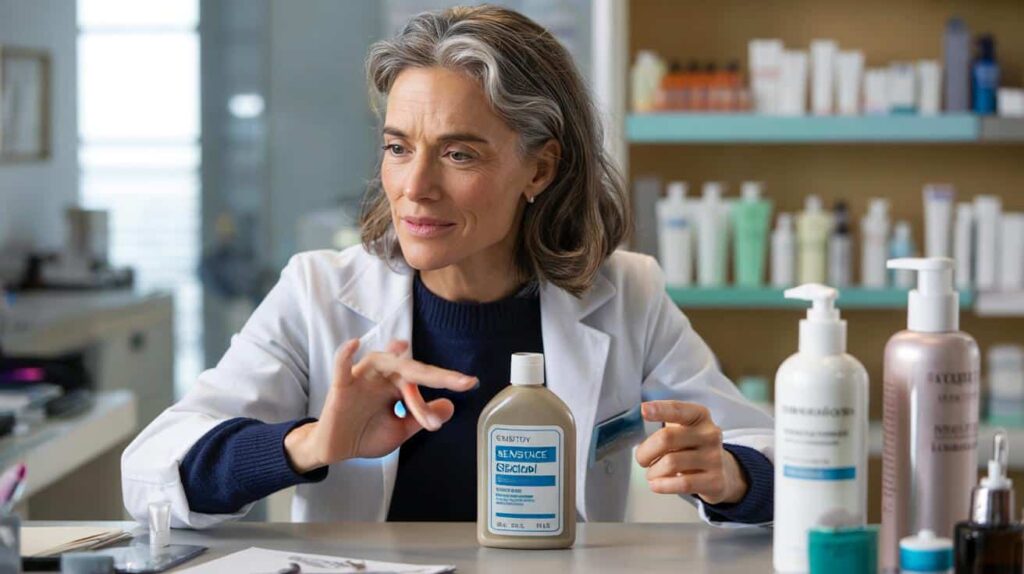
The dermatologist arrives late, hair still a little damp, white coat thrown over a navy sweater. She drops her tote on the chair, pulls out her lunch box, and then, almost as an afterthought, a squat plastic bottle with a supermarket label. “This,” she says, waving it in the air like a guilty secret, “I’ll buy it until I’m 90.” The interns lean in, expecting some 40-euro, Latin-name miracle. Instead, it’s a drugstore classic, the kind you walk past on autopilot, hunting for something fancier.
There’s a faint smell of clean laundry and pharmacy aisles.
The kind of smell that quietly earns your trust.

The supermarket shampoo a dermatologist actually trusts
Her name is Dr. Clémence, 46, Paris-based dermatologist, and she spends her days treating angry scalps and exhausted hairlines. She has shelves of samples in her office, PR packages piling up under her desk, glossy bottles with gold caps and promises that shimmer.

Yet the product she returns to, the one she buys with her own money at the supermarket, is painfully simple: a gentle, fragrance-light shampoo from the “sensitive scalp” aisle, the kind you’d hardly glance at. No “liquid silk”, no cactus flower, no celebrity claim. Just a clear formula, short ingredient list, and the quiet confidence of someone who’s been through hundreds of shampoos and seen what they do to real people.
That’s the one she says she’ll be buying when her hair is silver.
A few weeks before her confession, a patient walked into her office with a blender of a routine. Three shampoos on rotation, a scalp scrub, a purple toner, an oil, a leave-in, and a weekly “detox” with apple cider vinegar she’d seen on TikTok. Her hair looked glossy from a distance. Up close, her scalp was inflamed, red in patches, and constantly itchy.
She was convinced she needed something “stronger”. A more intense treatment, a more complicated routine, another step. Instead, Dr. Clémence stripped everything back. One supermarket shampoo: soothing, sulfate-mild, no harsh perfumes. That was it for a month. No scrubs, no oils on the roots, no miracles in a bottle.
By the third week, the redness had calmed down. By the fourth, the patient whispered, “My scalp finally feels quiet.”
Dermatologists see the same story on repeat: people obsessed with hair length, volume, and shine… while the scalp, which is literally skin, is treated like a plastic mannequin. Hair is dead fiber; the scalp is living tissue. It reacts, inflames, overproduces sebum, flakes, tightens. The more aggressive you are with it, the more it fights back.
That’s why gentle, balanced supermarket shampoos keep winning in their offices. They don’t have the sexy marketing, but they tend to avoid heavy perfumes, trendy irritants, and overcomplicated formulas. They focus on cleansing without stripping, respecting the barrier function of the scalp, keeping the microbiome more or less stable.
The logic is simple: calm scalp, better hair over time. Angry scalp, pretty blow-dry that never lasts.
How dermatologists really use a “simple” shampoo
The method is not glamorous, but it works. When she washes her own hair, Dr. Clémence doesn’t squeeze half the bottle into her palm. She uses a small, coin-sized amount, rubs it between her hands until it foams lightly, and applies it only to the scalp and roots. Never the lengths.
 Forget curtain bangs, the “shattered fringe” is the 2026 hairstyle trend you absolutely have to try
She massages with her fingertips, not her nails, for about one minute. Not a frantic scrub, more like a firm, mini face massage for the head. She lets the foam slide down the lengths when rinsing, which is usually enough to clean them. Then she repeats once if she’s had a heavy styling week, once only if her scalp feels normal.
Her rule: cleanse the skin, respect the hair fiber. The supermarket shampoo is the base. Everything else is optional.
A lot of people feel guilty about their hair routine. They think they should be double-cleansing on Mondays, masking on Wednesdays, oiling on Sundays. Let’s be honest: nobody really does this every single day. Life is messy. You come home late, your hair is in a bun, and the best you can do is a quick rinse and bed.
That’s exactly why she likes a reliable, no-drama supermarket shampoo. It forgives rushed showers and imperfect habits. It doesn’t punish you with irritation if you accidentally wash two days in a row. The real mistake she keeps seeing is not “using cheap shampoo”; it’s combining an aggressive shampoo with hot water, frantic scrubbing, constant styling products, and zero rest days for the scalp.
We’ve all been there, that moment when you realise your hair smells like dry shampoo more often than like actual hair.
During a consultation, she once told a patient, “I don’t care if your shampoo is 4 euros or 40. I care if your scalp can live with it every week for the next 20 years.” The room went quiet, because that’s not how beauty is usually sold to us. We’re trained to chase instant before/after images, not long-term tolerance.
Her favorite shampoo isn’t sold as a miracle. It’s sold as “gentle daily cleansing for sensitive scalps”. Clear bottle, blue and white label, tucked between anti-dandruff giants and kids’ formulas at the supermarket. “I test everything,” she smiled, “but this one always comes back into my shower.”
- A gentle base shampoo you can use all year long
- A second shampoo only if your scalp has a specific issue (dandruff, seborrheic dermatitis)
- One lightweight conditioner or mask on lengths only, once or twice a week
Why a “boring” shampoo can quietly change everything
There’s a strange relief in hearing a skin doctor say she buys the same shampoo as everyone else, in the same fluorescent aisle, under the same tired supermarket lighting. It breaks the spell a little. You start to question why you felt guilty for not owning a glass bottle with botanical illustrations and a triple-digit price tag.
The truth is, your hair doesn’t know how expensive your shampoo is. Your scalp only “knows” if it’s being respected. A formula that doesn’t sting, doesn’t leave you with tightness near the hairline, doesn’t trigger flakes two days later… that’s value. Over years, that calm baseline could mean fewer emergency appointments, fewer panicked searches for “scalp burning after dye”, less fear of washing your hair before a big day.

And that’s quietly powerful.

| Key point | Detail | Value for the reader |
|---|---|---|
| Scalp-first mindset | Treat shampoo as skincare for the scalp, not just soap for the hair | Helps reduce irritation, itching, and chronic discomfort |
| Simple, gentle formula | Short ingredient list, mild surfactants, light fragrance or fragrance-free | Better tolerance for long-term, weekly use on sensitive skin |
| Consistent routine | One reliable supermarket shampoo used correctly, with minimal overload | Saves money, time, and prevents “trial-and-error” damage over years |
FAQ:
- Question 1Can a cheap supermarket shampoo really be as good as a salon one?
- Question 2How do I know if a shampoo is gentle enough for my scalp?
- Question 3Should I avoid sulfates completely?
- Question 4How often should I wash my hair with this kind of shampoo?
- Question 5Can I use the same shampoo on my kids?
