<strong>Far below the Greenland Sea, scientists have stumbled on something strange: shimmering plumes, icy crystals and life thriving in the dark.
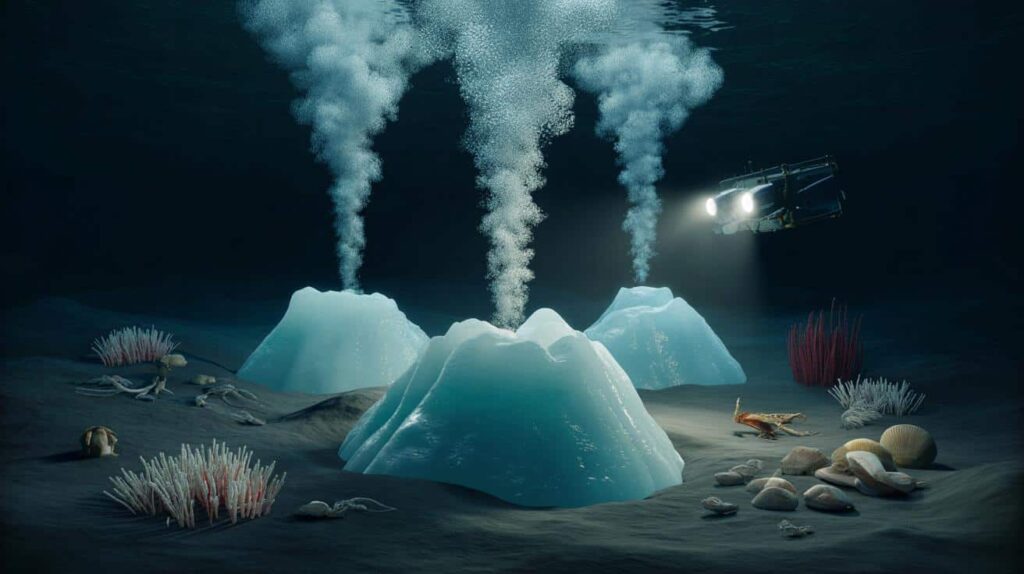
During a recent Arctic research expedition, an international team located the deepest known emission of gas hydrates on the planet, more than three and a half kilometres beneath the ocean surface. What they found there is forcing researchers to rethink both future energy plans and climate risks locked into the seabed.
A hidden hotspot on the Molloy Ridge
The finding comes from the Ocean Census Arctic Deep – EXTREME24 expedition, which targeted the Molloy Ridge, a deep, tectonic ridge in the Greenland Sea between Svalbard and Greenland. While mapping the seafloor, instruments picked up two towering columns of gas rising from the depths.

These plumes, made up of methane bubbles, reach astonishing heights: one stretches around 1,770 metres above the seabed, the other about 3,355 metres. Both start at roughly 3,640 metres depth, in a zone now named the Freya Hydrate Mounds.
 Why Do Crocodiles Not Eat Capybaras?
At around 3,640 metres below sea level, the Freya Hydrate Mounds host the deepest known methane hydrate emissions so far recorded on Earth.
To understand what was happening on the seafloor, researchers deployed a remotely operated vehicle (ROV). Cameras and sensors revealed conical mounds made of gas hydrates – solid, ice-like crystals where water molecules trap gas, mainly methane, inside their structure.
These mounds sit in what scientists call a “cold seep” area: places where cold, hydrocarbon-rich fluids slowly seep out of the seabed through fractures, feeding both chemical reactions and unusual ecosystems.
An extreme ecosystem that shouldn’t exist, but does
Cold seeps at such depths are rare. Until now, methane seeps and hydrate deposits have mostly been documented on continental slopes, usually shallower than 2,000 metres. The Freya site lies almost twice as deep, in the middle of an oceanic ridge, far from typical continental margins.
Against expectations, the site is teeming with life adapted to an environment without sunlight. Here, energy does not come from photosynthesis but from chemiosynthesis, where microbes convert inorganic compounds into food.
Among the organisms recorded on the Freya Hydrate Mounds are:
- tubeworms living in tight clusters on the seafloor
- bivalves such as clams and mussels hosting symbiotic bacteria
- gastropods, including specialised deep-sea snails
- crustaceans scavenging around the hydrate mounds
The fauna looks strikingly similar to that seen at Arctic hydrothermal vents, where hot fluids gush from volcanic chimneys. Yet Freya is a cold system, driven by methane and other hydrocarbons rather than superheated water.
The Freya Hydrate Mounds support a chemosynthetic community comparable to Arctic hydrothermal vent fields, but rooted in cold methane seepage instead of volcanic heat.
Another key point: these hydrate deposits are not frozen in time. Seafloor imaging suggests that the mounds form, destabilise and collapse. Tectonic movements, heat flow from the Earth’s interior and changing environmental conditions all shape this cycle.
What gas hydrates actually are
Gas hydrates are often nicknamed “flammable ice”. Under the right conditions of low temperature and high pressure, water molecules freeze into a crystalline cage that traps gas molecules such as methane.
Most marine hydrates form in the pores of sediments along continental slopes, where organic matter buried in the seabed slowly breaks down and releases methane. There, the combination of cold waters, heavy overlying pressure and abundant carbon creates a stable hydrate zone.
| Key conditions for methane hydrate formation | Role |
|---|---|
| Low temperature | Helps water form solid cages around gas molecules |
| High pressure | Pushes gas into the crystalline structure and keeps it stable |
| Organic-rich sediments | Provide the source of methane during decomposition |
If temperature rises or pressure falls, this precarious structure fails. The hydrate melts and methane escapes as bubbles that grow and expand as they travel upward through the water column.
An enormous energy cache with tricky downsides
Scientists estimate that more than 100,000 trillion cubic metres of methane may be stored as gas hydrates in seafloor sediments and in permafrost on land. That volume rivals, and possibly exceeds, known conventional gas reserves.
Gas hydrates likely represent the planet’s largest single store of natural gas, yet they remain one of the least accessible and riskiest to tap.

Methane burns more cleanly than coal or oil, releasing less carbon dioxide per unit of energy produced. That makes it attractive as a potential “bridge fuel” in energy transitions. On paper, hydrate deposits such as Freya might look like future targets for extraction.
But several obstacles stand in the way:
- Current technology cannot reliably extract methane from hydrates without destabilising the seafloor.
- Melting hydrates could unleash sudden methane releases, with safety and environmental risks.
- Remote deep-sea locations are expensive and logistically difficult to reach.
- Unique ecosystems could be destroyed before they are properly studied.
On top of this, methane is a potent greenhouse gas. Over a 20-year period, it traps far more heat per molecule than carbon dioxide. If large amounts escape to the atmosphere, they amplify warming.
A climate feedback hidden under the waves
The Freya Hydrate Mounds bring fresh attention to a worrying feedback loop. As ocean temperatures rise, even deep waters in polar regions may slowly warm. That shift can weaken the stability of methane hydrates.
Once hydrates start to melt, methane bubbles rise. Some methane dissolves in the ocean and can be consumed by microbes. Yet a fraction may still reach the atmosphere, particularly in shallower seas or in regions with intense upwelling.
Warming seas threaten to destabilise methane hydrates, release additional greenhouse gas and sharpen the very warming that triggered the process.
Researchers are now asking whether deep Arctic sites like Freya are already experiencing subtle changes, or if they remain mostly unaffected for now. Long-term monitoring would help trace how much methane is released, how much is consumed in the water, and whether any escapes into the air.
Balancing energy ambitions with deep-sea protection
The Freya find also adds weight to debates about what should be allowed in the deep ocean. On one hand, gas hydrates could be seen as a vast energy reserve for countries looking for stable supplies. On the other, untouched mounds such as these harbour specialised species and genetic resources that could hold medical or biotechnological value.
Any future move toward hydrate extraction would have to consider:
- the risk of seafloor landslides triggered by hydrate destabilisation
- the possibility of sudden, hard-to-control methane leaks
- the loss of slow-growing deep-sea communities
- uncertainties in how local disturbance might ripple through wider ocean systems
Key terms that help make sense of the finding
Several technical terms sit at the heart of this story. A “cold seep” is a place where fluids rich in methane and other hydrocarbons seep out of the seabed at or near ambient seawater temperature, rather than being heated like at hydrothermal vents.
“Chemosynthesis” describes the process where microbes use chemical energy from those fluids to build organic matter. In darkness, this acts as the base of a food web, just as plants fuel most surface ecosystems through photosynthesis.
“Gas hydrates” are not a single mineral but a family of structures. Their stability zone depends strongly on temperature, pressure and gas composition. Even small changes in one of these factors can push a deposit across the boundary between stable and unstable states.
What future research might look like
Scientists are already sketching out next steps for the Freya Hydrate Mounds. Future missions could use repeat ROV surveys, seafloor observatories and chemical sensors anchored near the vents to measure bubble flux, sediment temperatures and small shifts in the mounds.
Computer simulations may model different scenarios: ocean warming by a fraction of a degree, increased tectonic activity, or human disturbance from potential drilling. Each scenario helps estimate how quickly such a site might change, how much methane could be mobilised and which parts of the ecosystem are most vulnerable.
For now, the Freya site acts as both a natural laboratory and a warning signal. It shows how much energy sits frozen beneath the seafloor, and how tightly that energy is tied to delicate life forms and a climate system already under stress.