
The woman in the salon chair was fiddling with her phone, pretending not to care. She’d just turned 56, she told the hairstylist, and her usual cut “suddenly looked like it belonged to someone else.” Around her, younger clients were getting shaggy layers and curtain bangs, scrolling TikTok for inspiration. She just wanted one thing: to look fresher, lighter, less tired. Not younger exactly, just…less dated.
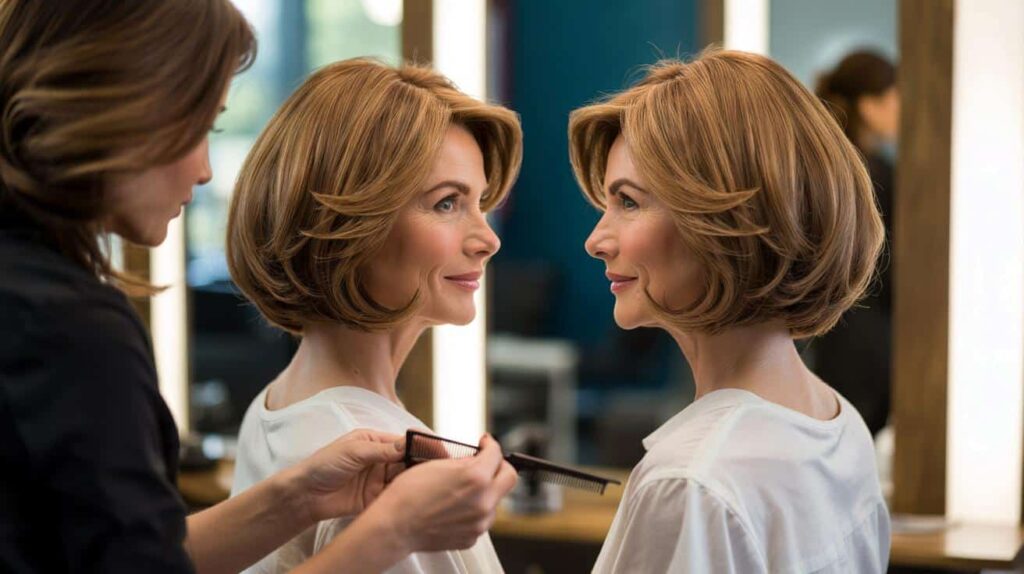
When the hairdresser suggested a bob, she rolled her eyes. “A bob? That’s so… mom at a PTA meeting.”
Five minutes later, with the cape snapped around her neck and the first lock on the floor, she whispered: “Why did I wait so long?”
There’s a reason this “boring” bob keeps coming back. And it might be the cut that quietly changes everything after 50.

The “corny” bob that secretly flatters almost every woman over 50
Say the word “bob” and half the room will picture the same thing: a stiff, rounded helmet from the 90s. Or worse, the default cut your aunt got when she said, “Just chop it off, I’m done.” No wonder plenty of women over 50 run the other way when they hear the word. It sounds safe. Predictable. A little sad.

But talk to any seasoned hairstylist and they’ll tell you a different story. The bob is the cut they recommend the most after 50 because it’s not really one haircut, it’s a whole family. Blunt, layered, French, wavy, asymmetrical, chin-length or brushing the collarbone. That supposed “corny” shape is actually one of the most powerful tools for framing the face and lifting the features.
A Paris-trained stylist I spoke with swears by what she calls the “soft bob” for clients in their fifties and sixties. “They come in with long, tired hair that they’ve been hanging onto for years,” she said, “and you can feel their shoulders drop when we cut.” She described one client, 62, who had been hiding behind a low ponytail for a decade. Her hair was thinning at the temples, flat at the roots, and taking ages to blow-dry.
They agreed on a jaw-skimming bob with invisible layers and a gentle side part. “When she stood up, everyone in the salon turned to look,” the stylist recalled. The client didn’t look younger in that artificial, filtered way. She looked sharper, more awake, like the volume had been turned back up on her face. The next week, she came back with selfies from her granddaughter’s birthday and a giant smile.
There’s a simple reason the bob works so well after 50. Hair naturally loses density, shine and elasticity with age. Long lengths can drag the face down, emphasizing jowls, deep lines and hollow cheeks. A bob cuts that weight, literally and visually. It brings the eyes, cheekbones and jaw back into focus. Shorter lengths also reflect more light, which gives the illusion of thicker, healthier hair.
On top of that, a good bob plays with geometry. A slightly longer front softens a heavier jawline. A bit of volume at the crown subtly lifts the whole expression. A grazed collarbone length can slim the neck. That’s why, for many stylists, **the bob isn’t a trend haircut, it’s a face-sculpting tool**. Especially when the goal is not perfection, but presence.
How to ask for the right bob after 50 (and avoid the dreaded “helmet”)
The magic doesn’t come from saying “I want a bob.” The magic comes from the details. The first thing a good hairstylist will look at is your neckline, your jaw, and how you move your head when you talk. If you’re over 50, they’ll also check where your hair is thinning, how strong your cowlicks are, and how much time you’re realistically willing to spend on styling.

A flattering bob after 50 usually sits somewhere between the bottom of the ear and the top of the shoulders. Chin-length gives a sharp, graphic frame. Collarbone-length, often called a “long bob” or lob, is softer and easier if you’re nervous about going shorter. The key word to use at the salon is “softness”: soft edges, soft layers, soft movement. That tiny detail shifts the cut from rigid to luminous.
There’s one trap many women fall into when they finally agree to cut their hair: they say, “Just do what you think is best,” while secretly panicking. Then they go home with a bob that feels like someone else’s head. An honest conversation matters. You can say, “I don’t want anything too round,” or “My neck is my favorite feature, let’s highlight it,” or “I need to be able to tuck it behind my ears.”
Stylists also see the same regret over and over: keeping the back too short and stacked. On a 25-year-old, that graduated bob can look edgy. Past 50, on finer hair, it can turn soccer-mom very fast. Ask instead for a slightly straighter back, with tiny, hidden layers for movement. And breathe: *you’re allowed to say no if you feel the cut is going in a direction that doesn’t feel like you*.
There are a few technical tricks that make the difference between “corny bob” and “effortless bob.” Many pros now cut the perimeter blunt, then add micro-layers on the interior, so the hair falls clean but isn’t stiff. A soft, broken line at the ends also keeps things modern. One London stylist I interviewed put it simply:
“After 50, I want the hair to look like it’s moving even when my client is standing still. That’s the secret. Stiff hair ages, movement forgives.”
To help your stylist translate that idea, you can ask specifically for:
- A length that hits between the jaw and collarbone, depending on your comfort level
- Light, invisible layers inside the cut for movement, not volume towers
- A slightly elongated front to frame the face and soften the jaw
- Texture at the ends instead of a hard, round “bowl” effect
- A parting that respects your natural fall, not a forced, high-maintenance line
Living with your bob: confidence, care and quiet revolution
Once the first shock of shorter hair passes, something curious often happens. Women report feeling strangely lighter, not just on their heads, but in their day. The morning routine shrinks. Drying time cuts in half. That resigned little bun you used to twist up “just to run to the store” might quietly disappear. You catch your reflection in a shop window and, for a second, you don’t see “your age”, you just see your face again.

Let’s be honest: nobody really does this every single day — the perfect blow-dry, the round brush, the serum, the spray. A good bob accepts that reality. It’s cut to fall decently when you air-dry it, to work with your natural texture, to still look intentional on the days you only have three minutes and a paddle brush. That’s probably why so many hairstylists recommend it after 50: it respects real life.

| Key point | Detail | Value for the reader |
|---|---|---|
| Personalized length | Choose between chin and collarbone based on face shape and comfort | Maximizes facial lift and confidence without feeling “too short” |
| Soft movement | Invisible layers and textured ends instead of heavy stacking | Avoids the helmet effect and keeps the look modern, not dated |
| Low-maintenance styling | Cut adapted to natural texture and realistic daily habits | Helps you look polished without needing salon-level skills |
FAQ:
- Does a bob really suit all face shapes after 50?Not the exact same bob, but some version of it usually does. Round faces benefit from a slightly longer, collarbone-grazing bob with a side part. Square or stronger jaws are softened by a front that’s a touch longer than the back. Heart-shaped faces often look great with a chin-length, lightly layered bob.
- Will cutting my hair into a bob make it look thicker?Often, yes. Removing weight and damaged ends allows the hair to bounce and reflect more light. A blunt or softly blunt perimeter can create the illusion of density, especially on fine or thinning hair, which is common after 50.
- How often should I trim a bob?Every 6 to 8 weeks keeps the shape crisp without being high-maintenance. If your hair grows quickly or you like a very precise line, every 5 to 6 weeks works better. Stretching it to 10–12 weeks usually makes the cut collapse and lose its flattering structure.
- Can I wear a bob if I have curls or waves?Yes, and it can be stunning. The key is cutting on dry or nearly dry hair, so the stylist can see how each curl springs. You’ll usually want a slightly longer length to allow the curl to form, and gentle layering to avoid a triangle shape. Define curls with a cream or light gel and avoid heavy serums.
- What if I regret going shorter?Start with a longer bob (lob) that brushes the shoulders or collarbone. Live with it for a few weeks. If you like the feeling, you can gradually go shorter. Hair grows back, and a good stylist can soften any cut that feels too severe by adding texture and movement.
