
The physio asked her to squat. “Just a little,” he said, watching her face tense before her knees even moved. The woman, mid‑40s, leggings rolled up, clutched the back of a plastic chair like a life raft. On the wall behind her, posters praised swimming, cycling, Pilates. All the “safe” heroes of bad knees. None of them had stopped her from waking up at 3 a.m. with that stabbing pain climbing up her joints.
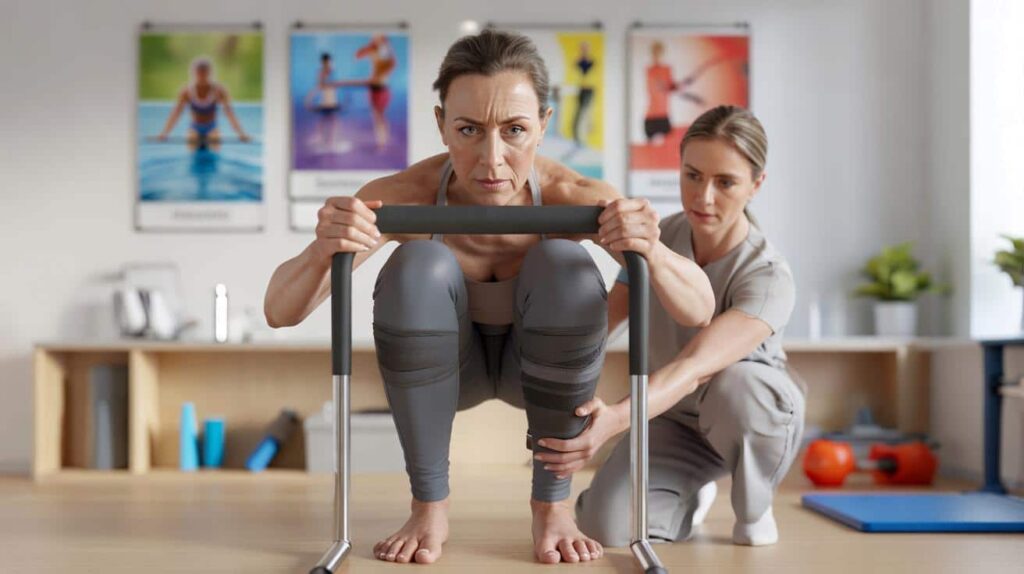
Then he showed her something that looked… wrong. A deep, deliberate squat. The kind that usually earns a “never do this with bad knees” comment thread online.
She tried it. Winced. Paused. Breathed.

This is where the story starts to split the medical world in two.

Why these “forbidden” squats are suddenly on every expert’s lips
Ask ten knee specialists what to do about chronic pain and nine will say the same thing: swim, cycle, maybe some Pilates. Gentle. Controlled. Low impact. That familiar prescription has been the safe bet for years.
Yet a growing group of sports doctors and physios now quietly swear by a more provocative solution: targeted, progressive squats that would have been unthinkable for knee patients a decade ago. Not the sloppy, ego‑fueled squats of gym fail videos, but technically strict moves designed to stress the knee – just enough.
They argue that without that controlled stress, the joint never truly adapts. The pain just… moves around.
Scroll any social feed and you’ll see the backlash. One viral clip showed a 60‑year‑old runner performing slow, almost hypnotic single‑leg squats while her physio guided her knee over her toes. The caption read: “Rehab, not ruin.” The comments exploded.
Hundreds thanked the creator, sharing how similar exercises had finally let them climb stairs without gripping the rail. Others were furious, calling it “reckless” and “a lawsuit waiting to happen.” One orthopedist chimed in to call it “borderline dangerous advice for the general public.”
Lost in the shouting was a simple fact: that same squat protocol had been tested in controlled settings for years, mainly with athletes. Just not with people who call their workout “getting out of the car without swearing.”
So why this split? Partly because knee pain is rarely just “the knee.” Weak quads, stiff hips, collapsed arches, lost confidence – they all land their weight on the same joint. Squats, when carefully coached, load the muscles that protect the knee and retrain the brain to trust the movement again.
Many traditional programs stop at “don’t hurt it,” focusing on short‑term relief. The pro‑squat camp chases something else: durable, adaptable strength. They talk in terms of tendon load, joint nutrition, neuromuscular control. Their critics worry about people copying these moves alone in their living room, with no guidance and a history of meniscus tears.
Let’s be honest: nobody really does this every single day the way the research protocols describe it.
How these controversial squats actually work (and what not to copy)
The version most experts praise isn’t the classic gym squat with a barbell thrown on your back. It often starts with something almost embarrassingly small: a squat holding a kitchen counter, or sitting back to a high chair and standing up again. Movement first, depth later. Load comes last.
The key detail is how the knee travels. Instead of obsessively keeping it behind the toes, physios now guide the knee slightly forward, tracking over the second toe as you bend. The descent is slow, three to four seconds, a pause at the bottom, then a steady push back up. Two sets of 8–10 reps, three or four times a week, is a common baseline.
*It feels too simple until your thighs start shaking halfway through the second set.*
Where people get into trouble is speed and ego. They feel one good day and jump straight to weighted squats, or try to sink “ass to grass” because some fitness influencer said it’s the only real squat. The knee, still adapting, answers with a sharp, sulky ache that lasts two days.
Experts also warn about “ghost pain from the brain.” If you’ve been told for years that squats are poison for your joints, your body tenses before you even move. That tension changes the way you load the knee, feeding the very pain you fear. The physios pushing these squats spend half their time coaching breathing, foot placement, and that tiny moment of trust at the bottom of the movement.
They know most of us aren’t scared of exercise. We’re scared of making things worse and losing the little mobility we still have.
One sports physician summed it up in a way that stuck with me:
“Squats aren’t the enemy of your knees. Bad squats, at the wrong time, with the wrong story in your head, are the enemy of your knees.”
From the pro‑squat side, a few simple rules keep coming back:
- Start with bodyweight and support (chair, rail, counter) before anything else.
- Let the knee go slightly over the toes, but keep it tracking straight, not collapsing inward.
- Use a slow tempo and stop one or two reps before sharp pain, not after.
- Progress depth or load, not both together.
- If pain spikes for more than 24–48 hours, you’ve done too much, too soon.
Between fear and progress: where do your knees belong?
The medical community may be split, but your knees don’t live in a study. They live in cramped stairwells, crowded buses, sticky gym floors, and those mornings when the first step to the bathroom feels like stepping onto gravel. That’s where this debate becomes real.
For some, swimming and Pilates will always be the sweet spot. Gentle motion, minimal risk, enough strength to get through the week. For others, especially those whose pain lingers despite all the “safe” options, these controversial squats might be the missing piece. Not a miracle, not a hack, just a structured way of telling the joint: “You can handle this now.”
We’ve all been there, that moment when you hover at the top of a chair, halfway between sitting and standing, wondering how long your legs will hold. That’s basically a squat. The question is whether you choose to train that moment, or tiptoe around it and hope time is kind.

There’s no universal answer, and maybe that’s the real shift: the idea that knee rehab isn’t a one‑size‑fits‑all sheet of exercises stapled to a prescription, but a negotiated truce between pain, fear, and the life you still want to move through. Some will sign that truce with laps in a pool. Others, increasingly, will sign it one shaky, deliberate squat at a time.

| Key point | Detail | Value for the reader |
|---|---|---|
| Progressive squats, not heavy lifting | Start with supported, bodyweight squats and slow tempo | Offers a realistic path to stronger knees without jumping into risky loads |
| Knees over toes is not always “wrong” | Controlled forward travel of the knee can strengthen protective structures | Helps readers unlearn outdated rules that may be holding back their rehab |
| Pain response is a guide, not a verdict | Short‑lived discomfort is different from lingering, sharp pain after exercise | Gives a simple filter to judge whether squats are helping or aggravating the joint |
FAQ:
- Are squats safe if I already have knee osteoarthritis?Often yes, if they’re introduced gradually and supervised at first. Research shows strengthening around the joint can reduce pain, but the exact squat depth and frequency need to be tailored to your stage of arthritis.
- Should my knees ever go past my toes during a squat?They can, as long as the movement is controlled and your knee tracks in line with your toes. For many rehab protocols, a slight “knees over toes” position is deliberately used to strengthen tendons and improve tolerance.
- What kind of pain means I should stop immediately?Sharp, stabbing pain inside the joint, sudden swelling, or discomfort that spikes and doesn’t calm down within 24–48 hours are red flags. That’s when you pause and get a professional opinion.
- How many times a week should I do these squats?Most expert programs use three to four sessions per week, with rest days in between. Quality of movement matters far more than squeezing them in every single day.
- Do I need a physio to start, or can I learn from videos?Videos can be helpful to understand the idea, but an initial check‑in with a physio or sports doctor is highly recommended, especially if you’ve had surgery, major injuries, or long‑term knee pain.
