
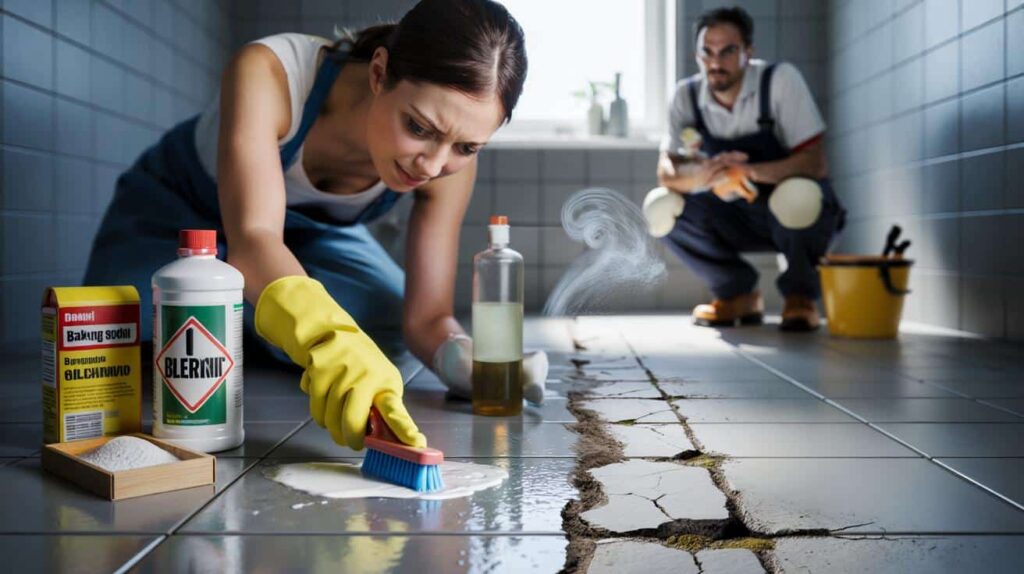
The woman in the video smiles, leans over her bathroom floor and sprinkles three powders into the stained grout like she’s seasoning a steak. A few lazy scrubs with a toothbrush, a quick wipe, and suddenly the dark, tired lines between the tiles turn ice white. The caption flashes: “3 CHEAP INGREDIENTS – GROUT LIKE NEW IN 5 MINUTES!” Comments explode. “Omg, game changer.” “Where has this been my whole life?” “Just did this, works 100%.”
You watch this on your phone, half fascinated, half suspicious, thinking of your own kitchen floor and that one yellowed strip in the shower. Five minutes. Three ingredients. Under five dollars.
Then you talk to a real tiler, and they call it something else entirely.

Why the “3 cheap ingredients” grout hack went viral
There’s a reason those grout-cleaning reels rack up millions of views. Dirty grout is like a permanent grey underline on your floor, reminding you that life is messier than the catalog photos. A quick, magical shortcut that promises to erase years of grime with three pantry staples feels like a small miracle.

Most of the viral recipes look almost the same. A spoon of baking soda. A splash of bleach. A hit of hydrogen peroxide or dish soap or white vinegar. Mix into a paste, smear, wait, wipe. That’s the script.
A Paris-based cleaning influencer I spoke to admitted she tested one of these “miracle mixes” on the grout in her rented bathroom. She filmed the whole thing, ring light on, audio crisp. At first, it was amazing: the grey joints came up bright, almost too white, under her brush. She posted a 15-second cut, and the views climbed and climbed. Her landlord was less impressed.
Three weeks later, hairline cracks started to appear along the shower floor. The grout, which had been slightly flexible, now looked chalky, brittle. Small chunks began flaking off near the drain. Moisture seeped under the tiles, and a musty smell settled in. Her “hack” turned into a €900 repair.
Professionals say that kind of story is not rare. Tile installers and building inspectors are suddenly seeing the consequences of home users mixing high-pH powders with strong oxidizers or acids directly on old grout. The cocktail may look gentle because it’s “homemade” and uses cheap ingredients, but chemically it can be far more aggressive than a regulated cleaner.
Grout is porous, often already weakened by age, humidity, and microcracks you can’t see. When you add harsh DIY blends, you’re not just lifting surface dirt. You can be opening the structure like a sponge and bleaching it to death. The joint looks younger for a few days, then starts aging in fast forward.
What professionals really think of the viral grout cocktail
Ask a real tiler about mixing random kitchen chemicals on grout, and many will drop the polite tone. One Spanish contractor I contacted called it straight: a “dangerous fraud” sold as a life hack. Not dangerous in the sense that your house will explode, but dangerous for your tiles, for your lungs, and for your wallet later on.
The fraud part? You’re shown a five-minute after shot, not the six-month aftermath. Porous grout can’t shout on TikTok when it starts crumbling under your feet.
One common viral combo is baking soda, bleach, and vinegar. Alone, each has a purpose. Together, things get dicey. Vinegar is acidic, bleach is highly alkaline and reactive, and baking soda is a mild base. People pour, fizz, and scrub, thrilled by the foam. A chemist from a building materials lab told me that this fizzing looks like “cleaning power” to the untrained eye.

In reality, part of what you’re seeing is the neutralization of active ingredients. Bleach and acid don’t play well together. At best you cancel out cleaning efficiency, at worst you release irritating fumes. Meanwhile, the joint between your tiles is being soaked in a strong solution that no manufacturer ever tested on a real floor.
Grout is essentially a thin band of cement-based material between ceramic or stone tiles. It’s not painted plastic. It’s mineral, porous, and often only a few millimeters deep. When you repeatedly attack it with strong oxidizers or mix-and-guess chemistry, you risk leaching out fine particles and drying the joint from the inside. The surface goes from compact to powdery.
Professionals use acids or alkalis too, but diluted, standardized, and for specific tasks like removing cement haze or mold. They rinse, they neutralize, they ventilate. Let’s be honest: nobody really does this every single day in a small bathroom with no window. That gap between pro practice and internet hacks is exactly where the problems grow.
A safer way to get grout “like new” without wrecking it
If you’re staring at your dingy grout and feeling tempted by the three-ingredient promise, there’s a calmer path. It starts less glamorously: with a bucket of warm water, a mild, pH-neutral cleaner, and a stiff nylon brush. Work systematically, one square meter at a time, wiping away dirty water before it dries back into the joints. It’s not magic, it’s elbow grease.
Then, for stubborn stains, pick one targeted product, not a cocktail. Either a diluted oxygen bleach designed for laundry, or a commercial grout cleaner labeled for your type of tile. Test a small hidden area, wait 24 hours, and only then move on.
There’s also the long game nobody shows in viral videos: protecting grout once it’s clean. When the joints are dry, a grout sealer or impregnator forms a kind of invisible shield that slows down future staining. We’ve all been there, that moment when you realize you scrubbed for an hour just because you skipped ten minutes months ago.
*One boring session of sealing can save entire weekends of scrubbing later.* Yet many of us prefer the thrill of a hack to the quiet discipline of maintenance. Professionals say that’s the real trap: chasing miracles instead of building habits that actually preserve your surfaces.
A French tiler with 25 years on building sites told me, “People call me after the hack, not before. They show me the video and ask why their grout now falls apart. I tell them: the video was for clicks, my work is for twenty years.”
- Skip the risky mixes
If a recipe tells you to blend bleach with vinegar, ammonia, or “whatever you have under the sink,” that’s a red flag, not a tip. - Use one active cleaner at a time
Choose either a mild alkali, a specialized grout product, or oxygen bleach. Rinse well before switching to something different. - Think repair, not miracles
Sometimes grout is simply too far gone. Regrouting or using a grout recoloring sealer is safer than trying to resurrect crumbling joints with aggressive chemistry.
When “cheap and fast” on grout ends up costing more
Once you start talking to building pros, a pattern emerges. Many of them have at least one story about a client who “fixed” their grout with a viral trick, then faced hidden damage months later: loose tiles in the shower, black mold spreading under a bright white surface, or joints that turned sandy under bare feet. The cheap hack quietly morphed into an expensive renovation.

The awkward truth is that grout is often the most fragile line in a room that holds water and daily life. Treat it roughly, and the consequences spread far beyond those little grey stripes. Treat it with a bit of respect, and it will quietly do its job for years: sealing, stabilizing, aging with you in the background.

| Key point | Detail | Value for the reader |
|---|---|---|
| Hidden risks of DIY mixes | Uncontrolled reactions between bleach, acids, and powders can weaken grout and irritate lungs. | Avoid damage and health issues from “innocent” homemade cocktails. |
| Pro-approved routine | Neutral cleaner, targeted product, thorough rinsing, then sealing once dry. | Clear, realistic method to get cleaner grout without hacking it to pieces. |
| When to stop scrubbing | Old, cracked, or hollow grout often needs regrouting or recoloring, not stronger chemicals. | Saves time and money by switching to repair instead of forcing a bad surface to look new. |
FAQ:
- Question 1Is it really dangerous to mix vinegar and bleach on grout?
Yes. Mixing bleach with acidic products like vinegar can release chlorine-based fumes that irritate eyes and lungs. On top of that, you’re not cleaning better, you’re just creating a harsh, unstable solution over fragile grout.- Question 2What three “cheap ingredients” are usually promoted in these hacks?
Most viral recipes use some combination of baking soda, bleach, hydrogen peroxide, dish soap, or vinegar. Each on its own has uses, but mixed randomly, they can cancel each other out or become too aggressive for grout.- Question 3Can baking soda alone damage grout?
Used gently and not too often, baking soda is generally safe as a mild abrasive. Problems start when it’s combined with strong oxidizers or scrubbed too hard on already weakened joints, which can accelerate wear.- Question 4How often should I deep-clean my grout?
For most homes, a light scrub every few weeks and a deeper clean every few months is enough, especially if you sealed the grout. High-traffic kitchens or showers may need more frequent attention, but consistency matters more than intensity.- Question 5What if my grout still looks terrible after cleaning?
That’s usually a sign that the surface is stained or degraded, not just dirty. At that point, regrouting, applying a grout colorant, or calling a tiler is smarter than escalating DIY chemistry. You may spend a bit more once, but you avoid quietly destroying the base of your tiles.
