
You’re lying in bed, the glow of your phone finally fading on the nightstand. The house is quiet, the day is done. And then the tiny decision appears in your mind, as mundane as brushing your teeth and yet oddly loaded: bedroom door open, or closed? You hesitate, hand on the handle, listening to the faint hum of the hallway.
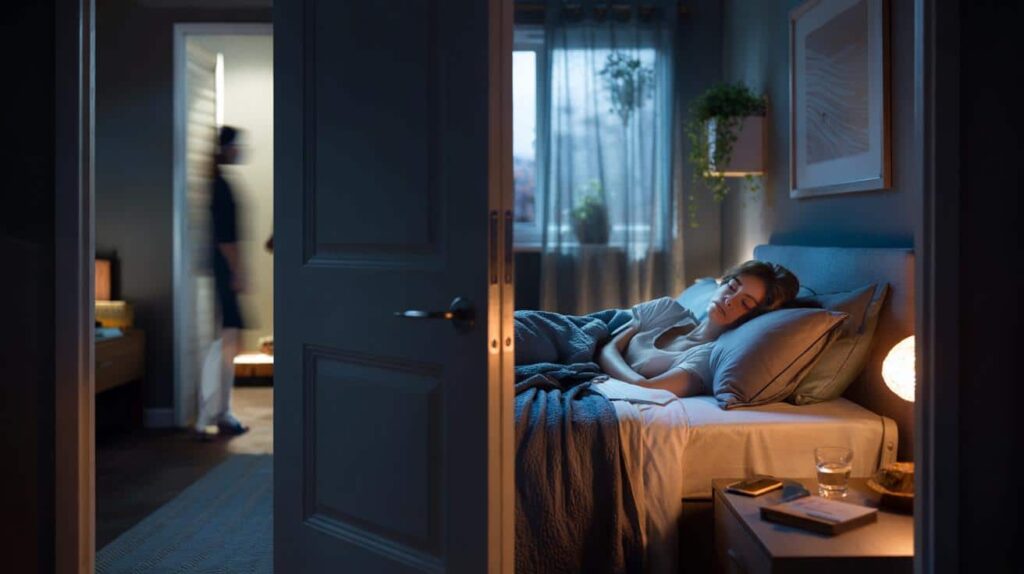
Some people say cracking the door just a bit helps them breathe easier and sleep deeper. Others swear that a closed door is the only way they feel safe enough to let go.
The air feels different depending on what you choose.

When fresh air fights with your fear of the dark
Spend a night paying attention, and you’ll feel it. In a closed bedroom, the air gradually turns thicker, warmer, just a little more stale by 3 a.m. Your breathing gets heavier, you wake up for a sip of water, and you might blame stress or bad dreams.

Yet quite often, it’s the invisible build-up of carbon dioxide from your own breathing that quietly nudges you out of deep sleep. Open the door, even slightly, and that heavy feeling softens. The room “breathes” with the rest of the home.
Dutch researchers once measured overnight CO₂ levels in bedrooms and found that a closed door and windows could send concentrations soaring above 2,000 parts per million. With a door open, levels dropped dramatically and people slipped into deeper, more restorative sleep stages.
Think about nights in a small guest room at your in-laws’ place, or in a sealed hotel room. You wake up groggy, headachey, almost hungover, even without a single drink. Then you crack the door or window the next night, and the difference is almost shocking. A simple handle turn turns into an act of self-care you didn’t know you needed.
There’s a basic reason. Your lungs pull oxygen from the air and push out CO₂. In a closed, not-so-well-ventilated bedroom, that CO₂ concentrates and changes how your body regulates breathing and sleep depth.
Open the door and air from larger, cooler spaces flows in. CO₂ levels drop, and your brain stops getting those tiny “micro-alarms” that fragment deep sleep. The science is clear: better airflow can help you sleep better. **But the story doesn’t end there.**
The open-door trap: lighter air, louder nights
If opening the bedroom door was just about cleaner air, the choice would be easy. The trouble starts with the things that come along for the ride. Sound, light, footsteps, the flick of a bathroom switch at 2 a.m.
Parents know this too well. Leave the door open and every whisper from the hallway, every fridge door closing, every late-night scroll from a teenager’s room travels straight into your sleep. The result isn’t always dramatic; often it’s dozens of tiny awakenings you don’t recall the next morning. You just feel tired and a bit frayed around the edges.
Take the classic apartment scenario. Thin walls, shared hallways, a neighbor who loves late-night TV. With your door open, you’re not only inviting in fresher air, you’re inviting in every laugh track and argument. One woman in her thirties I spoke to tried sleeping with her door open for a week after reading about CO₂ levels.
By day three she was a zombie. The hallway light flicked on every time her partner went to the bathroom. A cat wandered in at 4 a.m. knocking things off shelves. She measured her sleep with a smartwatch and saw more interruptions, not fewer. The air felt fresher, yes. Her brain, less so.

There’s also the quiet topic many people don’t voice out loud: safety. Firefighters tend to recommend sleeping with doors closed, because a solid door slows down flames and smoke. Psychologists know that a sense of control over your space is a basic ingredient in falling asleep.
For some, a firmly closed door is non-negotiable. It’s the thin line between feeling vulnerable and feeling secure enough to drift off. *Fresh air doesn’t always win against the primal need to feel protected in the dark.* When experts talk about airflow and CO₂, they usually add a big “it depends” for that reason. You’re not just a body in a box; you’re a person, in a world that doesn’t always feel safe.
Finding the sweet spot between oxygen and peace of mind
The real trick isn’t choosing between open or closed, it’s adjusting the dial in between. Instead of flinging the door fully open, experiment with a small gap. Two fingers wide, maybe three. Enough for air to move, not enough for light and noise to blast through.
You can also work on airflow in ways that don’t touch the door at all. A cracked window when the weather allows, a quiet fan that moves air without creating a draft, or even shifting heavy furniture away from vents so air circulates more freely. Tiny physical tweaks can change how your whole bedroom feels at 3 a.m.
One thing many sleep experts repeat: don’t chase perfection. Don’t torture yourself with CO₂ graphs and noise charts if you’re already sleeping fairly well. Start with the basics. Go to bed at roughly the same time, dim the screens, lower the temperature a little.
Then, play with the door for a week. Three nights fully closed, three nights slightly open, one night with a fan or window in the mix. Notice how your body responds, not just what the guidelines say. Let’s be honest: nobody really does this every single day. Yet even one small, deliberate change can show you what your nervous system prefers.
Some specialists take a middle line. As one sleep physician put it in a recent interview: “If an open door helps your breathing but wrecks your sense of safety, that’s not a good trade. The best sleep environment is the one you can actually relax in, not the one that looks perfect on a chart.”
- Crack the door slightly rather than fully opening it to balance air and privacy.
- Use a white noise machine or fan to drown out hallway sounds if you sleep with the door ajar.
- Block stray light with a thick curtain or sleep mask when the door can’t be fully closed.
- Keep clutter away from vents and windows so existing airflow actually reaches your bed.
- Talk with housemates or family about “quiet hours” so an open door doesn’t mean constant disruption.
The small nighttime choice that says a lot about you
Once you start noticing it, this little door habit says quite a lot. Some of us grew up in homes where every bedroom door stayed open, so parents could listen for cries or sneaked midnight snacks. Others learned early that a closed door meant respect, privacy, and survival.
Your body carries those lessons into adulthood. That’s why the same open door that deepens sleep for one person can spike anxiety for another. It isn’t just physics. It’s biography. It’s neighborhood. It’s who else is, or isn’t, in your home at night.
You might find your own best answer lives in a compromise that no expert can fully design for you. A half-open door, a simple door-stop, a lock that clicks softly, the faint rush of a fan making the room feel less trapped. Or you may realize that you sleep best with the door sealed and a window cracked, and that the peace of mind is worth every percentage point of extra CO₂.
 A solar belt around the Moon by 2035?
Some nights, you’ll forget and fall asleep with the door whichever way it landed. Other nights, you’ll pause with your hand on the handle and listen to your own gut. Between airflow, light, noise, and safety, that tiny moment of choice is almost like a quiet conversation with yourself.
 Africa splitting apart isn’t sudden, but one visible change is already happening beneath the surface
| Key point | Detail | Value for the reader |
|---|---|---|
| Door position affects CO₂ | An open or slightly open door lets fresh air in and reduces carbon dioxide build-up | Helps you understand why you might feel groggy or refreshed in the morning |
| Noise, light and safety matter | Open doors invite sound, light and potential security concerns into the bedroom | Shows why better air doesn’t automatically mean better sleep |
| Personalized middle ground | Using a small gap, white noise, or a fan can balance airflow with comfort and security | Gives you practical ways to experiment and find your own ideal setup |
FAQ:
- Question 1Does sleeping with the bedroom door open really lower carbon dioxide levels?
- Question 2Is it safer in case of fire to sleep with the door open or closed?
- Question 3How can I reduce noise if I prefer to sleep with the door slightly open?
- Question 4What if I feel anxious with the door open even though the air feels better?
- Question 5Is there a simple way to test whether door position changes my sleep quality?
