
The saucepan is hissing, the pasta water is about to boil over, and with one hand you’re stirring the sauce while the other is already wiping a tiny splash from the counter.
Across the room, someone else is cooking the same meal… and leaving a glorious mess. Peels piling in the sink, spoons abandoned, flour drifting across the stove like fresh snow.
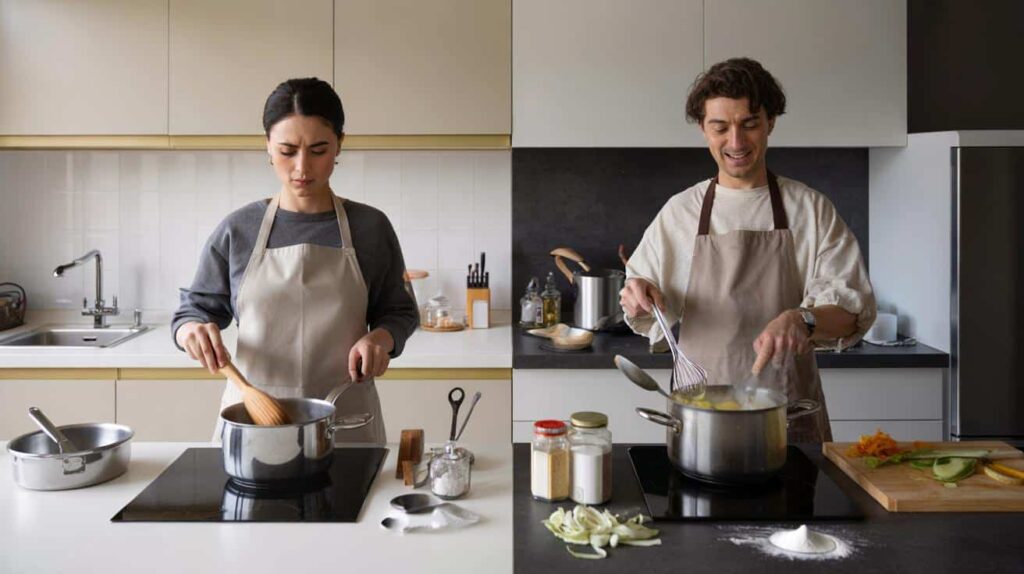
Two ways of cooking, same small kitchen.
New psychology research says this difference may be more than a matter of habit.
People who clean as they cook are being tagged as more judgmental, more emotionally rigid.
The messy cooks fire back: “At least I’m relaxed.”

So what is really going on between the cutting board and the garbage bin?

Are tidy cooks secretly controlling — or just less anxious?
Watch any shared kitchen long enough and you can almost draw a personality map from the way people handle a cutting board.
Some bodies are tightly coiled, eyes scanning for crumbs, hands darting to rinse, fold, put away before the onions are even translucent.
Others cook like they’re in a jazz bar.
They improvise, reach for spices without looking, toss garlic skins aside, promising their future self a big clean-up.
Psychologists are suddenly very interested in this dance.
A cluster of new studies links “clean-as-you-go” habits to traits like high conscientiousness, lower tolerance for ambiguity and a taste for structure.
And that’s where the controversy begins.
In one recent experiment doing the rounds in academic circles, volunteers watched short videos of different home cooks.
Same recipe, same kitchen, same camera angle — the only variable was behavior: one person wiped surfaces and stacked bowls throughout, the other left everything until the very end.
Viewers consistently rated the clean-as-you-go cook as more responsible and competent.
At the same time, they also saw this person as more likely to “judge others” and “get upset when plans change.”
The messy cook was labeled creative, relaxed… and also a bit chaotic.
None of these people actually existed.
They were actors following a script, which means what changed was not the person, but the story we tell ourselves when we watch them.
That quiet story is what the research is really poking at.
The simplest reading is tempting: “tidy equals controlling, messy equals free.”
Yet personality science almost never fits cleanly into a TikTok caption.
Researchers suggest that cleaning-while-cooking often overlaps with a high need for cognitive closure — a preference for clarity and finished tasks over open loops.
If every dirty spoon feels like an unresolved tab in your brain, of course you’ll rinse as you go.
Some experts argue this mental style can slide into rigidity or moral judgment, the classic “If I can keep things in order, why can’t you?” vibe.
Others push back, pointing out that many people tidy to reduce sensory overload, trauma-related anxiety or simple executive load.
Two cooks, same spotless countertop, completely different inner worlds.
How to read your own kitchen habits without shaming yourself
One practical exercise from therapists studying everyday behavior is almost embarrassingly simple.
Next time you cook, don’t change anything — just notice.
 Understanding body language: what it means when someone doesn’t look you in the eye while talking
Where does your attention go first: the food, the people, or the mess?
Do you feel tension in your chest when the cutting board is crowded, or does that only show up when someone else is watching you?
After the meal, jot down three quick notes: “What stressed me? What calmed me? What did I judge?”
You’re not trying to score yourself as “good” or “bad.”
You’re tracing the link between your cleaning style and your emotional landscape.
*The kitchen is just the stage where your patterns become visible.*
Psychologists who work with couples see the same fight replayed thousands of times: one partner feels abandoned in the mess, the other feels micromanaged by the sponge.
Underneath the dishes is often a deeper script about care, safety and respect.
If you’re the cleaner, you might genuinely feel loved when your partner wipes the counter before sitting down.
If you’re the “I’ll clean later” person, you might feel more loved when nobody barks instructions while you’re trying not to burn the onions.
Let’s be honest: nobody really does this every single day.
Nobody is consistently the Zen artist or the drill sergeant.
On Monday you might be scrubbing like your mother is coming over; on Friday you’re eating cereal from a mug over the sink.
Tuning into those swings can tell you more than any personality test.
Some of the researchers behind this wave of studies are surprisingly cautious about turning cooks into diagnoses.
One social psychologist I interviewed put it bluntly:
“Cooking habits are weak signals. They can hint at traits like perfectionism or flexibility, but they don’t define anyone.
The danger is when we turn a sponge into a moral weapon.”
When you feel that urge to label someone “rigid” or “lazy” based on their kitchen, pause for a second.
Ask what story you’re attaching to the behavior.
Is it really about the sponge… or about old rules you grew up with?
Here’s a quick way to reframe the scene:
- Instead of “They’re judging me”, try: “They might feel safer with surfaces clear.”
- Instead of “They’re irresponsible”, try: “They may prioritize presence over order right now.”
- Instead of “My way is the only sane way”, try: “My way works for my nervous system — not everyone else’s.”
When cleaning styles collide, relationships tell the real story
Once you start paying attention, you might notice that your kitchen persona changes depending on who’s around.
With friends, you may let pans soak and laugh at the chaos.
With a critical parent at the table, your inner cleaning drill sergeant suddenly appears, lining up spoons like soldiers.
This shifting identity is what many clinicians find more revealing than the behavior itself.
If you only scrub wildly when someone might judge you, the cleaning is about social survival, not personality rigidity.
If you clean just as intensely alone, it may be about soothing your own nervous system.

The emotionally risky part is when you start ranking those strategies as morally superior.
“Real adults tidy as they go” versus “Real free spirits don’t obsess about crumbs.”
Those quiet slogans shape how harshly you talk to yourself — and to the person you love who dares to leave a knife in the sink.

| Key point | Detail | Value for the reader |
|---|---|---|
| Kitchen habits are emotional clues | Cleaning-while-cooking often reflects needs for control, safety or clarity, not just “being neat.” | Helps you interpret your own behavior with curiosity instead of shame. |
| Others read your cleaning as judgment | Studies show tidy cooks are perceived as more competent but also more critical and rigid. | Lets you adjust your behavior or communication so loved ones feel less judged. |
| Reframing beats blaming | Changing the inner story around mess and order softens conflict in shared kitchens. | Gives you practical language to defuse everyday tension at home. |
FAQ:
- Question 1Does cleaning while cooking mean I have a rigid personality?
- Question 2Why do I feel so anxious when the kitchen is messy?
- Question 3My partner says I’m “judgy” about their mess. What can I do?
- Question 4Can I be creative in the kitchen and still be a tidy cook?
- Question 5How can we stop arguing about dishes and focus on enjoying meals together?
