
The woman in front of me at the supermarket has perfect silver hair. Not salon-blonde, not ash-brown. Just unapologetically, gloriously grey. She’s wearing red lipstick, black jeans, and a leather jacket that probably has a longer story than my entire wardrobe. A teenage girl behind her stares for a second, then whispers to her friend, “Her hair is actually so cool.” No irony, no mockery. Pure admiration.
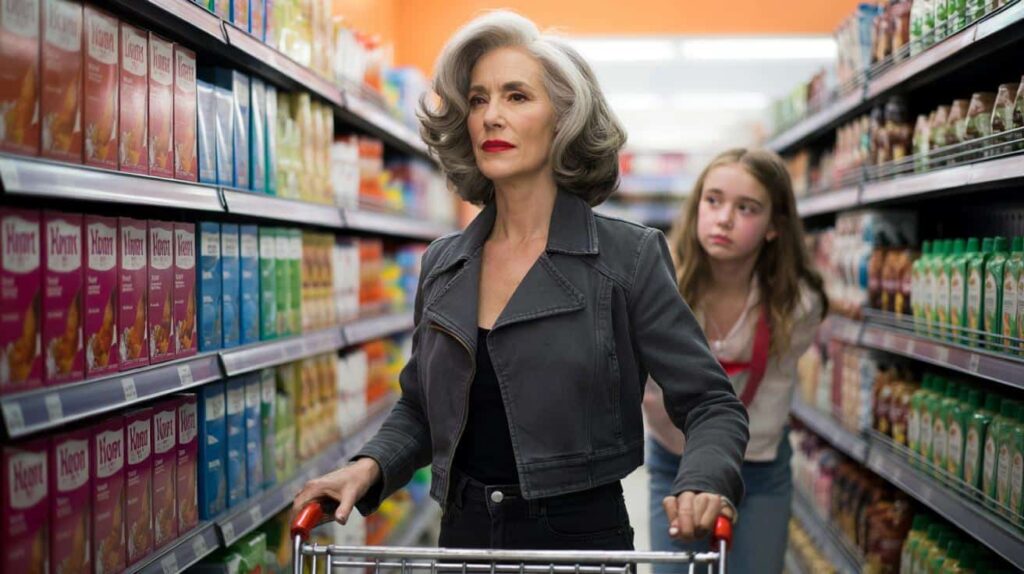
Three years ago, that same hair might have been boxed in with “Light Chestnut 6.3” and a prayer. Today, it looks like quiet rebellion in aisle five.
Something is shifting, strand by strand.

When grey hair stops being a secret
Walk through any big city right now and you can feel it. On the subway, in cafés, at school gates, more and more women are letting those silver strands stay. Not as a temporary lapse between dye appointments. As a deliberate choice.

The old whisper — “She’s let herself go” — is getting drowned out by a different comment: “She looks kind of… powerful.” That’s new. That’s not how we were trained to see grey hair, especially on women. For decades, grey meant “careless”, “tired”, “past your prime”.
Now, slowly, it’s starting to read like a statement.
Scroll through Instagram or TikTok and the numbers tell their own story. The hashtag #grombre, a mashup of “grey” and “ombre”, has become a sort of digital protest wall, filled with women documenting their grow-out, roots and all. Some of them have millions of views on simple transition videos: one photo dyed, the next with a bold streak of silver front and center.
There’s the French lawyer who went viral after showing her boardroom-ready silver bob. The Brazilian yoga teacher whose white streak has become her brand logo. The American nurse in her fifties posting side-by-side selfies: one with 20 years of dye, one with one year of natural growth. The comments under that second picture? Way more supportive, way more engaged.
You can almost see the algorithm realizing that grey is no longer bad for business.
What’s really happening goes far beyond hair. For a long time, ageing was treated like a PR crisis you had to manage with products, angles, and good lighting. Dye was part of that emergency kit. You weren’t colouring hair; you were erasing evidence.
Once you see that, it’s hard to unsee. The pressure to “cover up” came less from personal preference and more from a culture that equates youth with value, especially for women. When a 55-year-old man with silver temples is called “distinguished”, and a 55-year-old woman with the same hair is told she looks “tired”, the double standard is not subtle.
Let’s be honest: the ugly truth isn’t the grey. It’s our fear of being visibly, unapologetically alive at every age.
How to break up with hair dye without losing your mind
The first thing women who go grey naturally will tell you: this is not just about letting roots grow. It starts way before that, in a quiet, uncomfortable decision. You look at the dye appointment on your calendar, or that box on your bathroom shelf, and you simply… don’t.
A lot of women experiment with the “soft exit”. They stretch out appointments. They add lowlights or highlights instead of full coverage, to blend the line where grey meets colour. Some cut their hair shorter to speed up the transition. Others go for one last intentional dye: a lighter, cooler shade that makes the demarcation less brutal as silver comes in.
It’s less like flipping a switch and more like slowly changing the lighting in a room.
The messy part isn’t the hair, it’s the gaze. Your own, and other people’s. People will say clumsy things. “Are you… done with dye?” “You’re brave.” Or that passive-aggressive classic: “I could never do that.” It stings, especially in the in-between phase where you don’t feel chic yet, just patchy.
This is where most people give up: month three to six. That’s when roots are obvious, the old colour is dull, and every mirror feels like a test you’re failing. *We’ve all been there, that moment when you catch your reflection in a shop window and don’t quite recognize the person looking back.*
Here’s the quiet trick that helps: decide in advance which comments you’ll ignore and which ones you’ll treat as data, not judgment.

“Going grey was less about my hair and more about stopping the performance,” says Lila, 49, who quit dye after two decades of three-week appointments. “I realised I was spending hundreds of euros and hours of my life just to look like a slightly blurrier version of my 35-year-old self. For who? Not for me.”
- Accept the awkward stage: Plan 6–12 months where your hair looks “in transition”, not “finished”.
- Change the cut, not just the colour: A sharper shape often makes grey look intentional, not accidental.
- Upgrade the small things: Better haircut, nice lipstick, clear skin routine. Tiny details, big psychological effect.
- Pick your answer line: One sentence you’ll use when people comment, so you’re not caught off guard.
- Allow a backup plan: Knowing you can always dye again weirdly makes it easier to stick with the choice.
The ugly truth about beauty standards, seen in a strand of hair
Once you start paying attention to how people react to grey hair, you see the deeper script at play. The compliment “You don’t look your age” sounds nice, but hidden inside is a message: your actual age isn’t good enough. The praise always points you away from reality.
Grey hair doesn’t magically fix that, of course. But it drags the conversation into the light. It asks: what if the goal isn’t to look thirty forever, but to look like yourself at forty, fifty, sixty, with clarity and style? What if the real luxury is not pretending you are something you’re not?
One plain-truth sentence sits under all of this: beauty standards are made up, but the anxiety they create is very, very real.
The money side of this story is brutal. Global hair colourants represent a multi-billion-dollar industry. Those “one quick root touch-up” appointments add up to thousands over a lifetime, not even counting the emotional tax of constantly checking your reflection, scanning for treacherous silver at the parting.
When women step away from dye, some talk not just about freedom, but about a weird, unexpected feeling: anger. They realise how early the message started, how normal it seemed that a 28-year-old “had to” cover three millimetres of grey. They think about the ads that promised “confidence in a bottle” when what they really sold was dependency.
Walking out of that loop can feel like walking out of a very pretty cage.
There’s another layer as well: who is “allowed” to age in public. For years, male actors gracefully went silver on screen while their female co-stars were quietly replaced with younger faces, or heavily dyed until their hair no longer matched their skin or energy.
Seeing more women visible with grey hair — journalists, influencers, CEOs, activists — slowly rewrites the script. A young girl today can scroll her feed and see that “growing older” doesn’t automatically mean “fading out”. It can look loud, stylish, sharp.
That doesn’t mean everyone must go grey. It means the choice is finally starting to feel like a choice, not an obligation dressed up as self-care.
A new way of seeing age, one head of hair at a time
Stand in front of a mirror tonight and really look at your own hair. Not the “flaws” your inner critic zooms in on. The texture, the shine, the weird cowlick you’ve had since childhood, the single silver strand that catches the light differently. It’s all data about where you’ve been and where you are now.
You don’t owe anyone eternal youth. You don’t owe the beauty industry your salary. You don’t even owe social media a “cool” transition. What you might owe yourself, though, is one honest question: if nobody judged, if no one commented, what hair would you choose to live in?
Maybe the answer is: “I still want my colour, I genuinely love it.” Fair. Maybe it’s: “I’m exhausted, I want out.” Or “Not yet, but soon.” There is no moral medal for going grey, only a different contract with your reflection.
The real revolution is not the trend itself. Trends pass. The quiet shift happens when a woman with silver hair walks into a room and people see her first, not her age. When a teenager points to that woman and thinks, “If I look like that at 50, I’ll be happy.”

That’s the moment the ugly truth about beauty standards starts to lose its grip — one unapologetic strand at a time.

| Key point | Detail | Value for the reader |
|---|---|---|
| Grey hair is becoming a statement | From #grombre to visible role models, more women reject compulsory dye | Helps you feel less alone and see your choice as part of a bigger shift |
| The transition is emotional, not just visual | Awkward phases, social comments, and internalised ageism are part of the process | Prepares you mentally for the messy middle so you’re less likely to give up |
| Ageing can be reclaimed, not hidden | Letting grey show exposes double standards and opens space for new narratives | Gives you permission to define beauty on your own terms, at any age |
FAQ:
- Question 1How long does it usually take to transition to natural grey hair?For most people, the visible transition phase lasts between 6 and 18 months, depending on how fast your hair grows and how short you’re willing to cut it. A big chop speeds things up dramatically; keeping your length means a slower, more gradual change.
- Question 2Won’t going grey make me look older?Sometimes yes, sometimes no — and that’s the point. A sharp cut, healthy texture, and confident styling often look fresher than a flat, over-dyed colour. Many women report that people say they look “more vibrant” once the grey actually matches their skin tone and energy.
- Question 3What if I start and then hate my grey hair?You can always go back to dye. This isn’t a one-way door. Some women test the waters during holidays or quieter months, then decide later whether to commit. Giving yourself that freedom can make the experiment feel less scary.
- Question 4How do I care for grey hair so it doesn’t look dull or yellow?Hydration is key: use nourishing masks, gentle shampoos, and a purple shampoo occasionally to counteract yellow tones. Sun protection and avoiding heavy heat styling also keep silver brighter and shinier.
- Question 5Is it disrespectful to women who still dye their hair if I celebrate my grey?Not at all. The real issue was never dye itself, but the idea that we had no real choice. You embracing your silver doesn’t judge anyone else’s colour; it just adds one more visible option to the spectrum — and that helps everyone.
