
The first groan starts near the treadmills. Someone mutters “oh no, not those” as the coach rolls a rack of dusty metal chairs into the middle of the gym. A few people pretend to stretch extra-long, hoping the moment passes. Others suddenly need water. Nobody wants to admit it, but the words “sit-to-stand squats” make half the room want to quit on the spot.
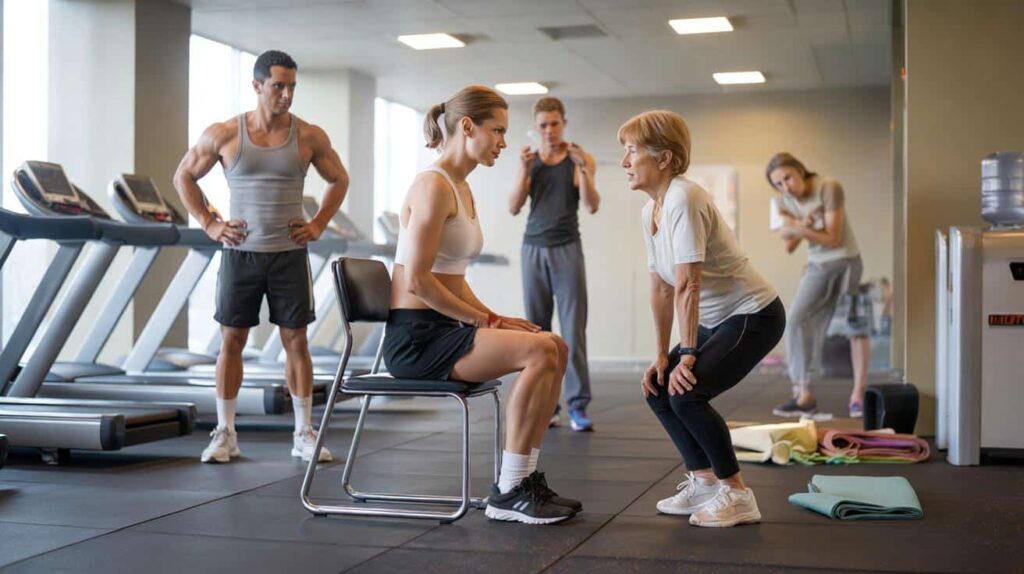
You probably know this move by a simpler name: getting up and down from a chair. The most hated “grandma exercise” of every group class. The one people skip because they think it’s too easy, too boring, or too embarrassing.
And yet, this is the exercise many physios are now calling **the single best remedy** for stubborn knee pain.

The room does not agree.

The “boring” move that refuses to go away
Ask any physiotherapist what they give almost every person who walks in with aching knees, and you’ll hear the same answer: sit-to-stand. Or its standing cousin, the wall sit. Again and again. Day after day.
While social media glorifies deep squats with chains and colorful resistance bands, the quiet star of knee rehab is this unglamorous up-and-down from a chair. No music drop, no fancy leggings, just your body and gravity.
On paper, it sounds like nothing. In real life, it can feel like a small mountain.
One evening in a suburban gym, a coach asked a mixed group to do 3 sets of 15 chair squats. A young guy in a tank top rolled his eyes and said, “This is warm-up stuff, right?” A woman in her fifties silently moved her water bottle closer and stared at the floor.
By the second set, the guy in the tank top was shaking and slowing down. The woman in her fifties had found a rhythm: sit, stand, exhale, reset. At the end, she looked surprised and said, “My knees don’t feel worse. That’s… new.”
The coach later admitted: “If I call it ‘functional strength work’, people accept it. If I say it’s rehab for your knees, they think I’m calling them old.”
The logic behind this “grandma exercise” is brutally simple. Knee pain often explodes at two key moments: when you get up from a chair and when you go down stairs. Both require your quadriceps and glutes to fire in a controlled way, while the joint handles the load.
Sit-to-stand squats train precisely that pattern: safe range of motion, vertical load, controlled descent. Wall sits load the thighs without movement, building strength without the joint shearing that many fear.

It’s not magic. It’s repetition of the one thing knees need to do all day: bend, bear weight, and straighten again without screaming.
How to do the “most hated” exercise so your knees actually thank you
Start with a simple setup: a stable chair, your feet flat on the floor, knees roughly over your ankles. Scoot a little closer to the edge of the seat. Lean your torso slightly forward, like you’re about to stand to greet someone.
Press your feet into the ground and stand up without using your hands, then sit back down slowly, almost as if the chair might vanish. Do 8–10 repetitions, resting between sets. If your knees complain sharply, raise the seat with a cushion or use a higher chair so the angle is less intense.
The goal is not depth. The goal is smooth, controlled motion with no stabbing pain.
This is where many people get discouraged. They push through pain “to be brave”, sink too low, or rush the move just to get it over with. The body stiffens, the face tightens, and the brain files the whole experience under “Never again, thanks.”
There is another way. Think of it as retraining your relationship with your own knees, not punishing them. Small range, slow repetition, and honest listening. *Progress here is often so gradual you only notice it when a staircase suddenly feels less like a threat.*
Let’s be honest: nobody really does this every single day. Yet the ones who get better are the ones who do it most days, quietly, without drama.
“People expect a magic stretch or some exotic Pilates move to fix their knees,” explains Marie, a sports physio in Lyon. “But I get the best results from sit-to-stand and wall sits. Patients hate them at first. Then one day they realize they walked a whole afternoon without pain. That’s when they stop arguing with the chair.”
- Start high, not low: Use a taller chair or add cushions so the first sessions feel almost too easy.
- Use your pain scale: Discomfort up to a 3 out of 10 is acceptable; sharp or lingering pain means adjust.
- Play with support: Put a light finger on a table or wall for balance, without leaning your weight.
- Count in breaths, not reps: Stand on an exhale, sit on an inhale, 8–12 times, 2–3 sets.
- Anchor it in daily life: Do a set before coffee, another before brushing your teeth, one more after dinner.
Why nobody agrees… and why that might be a good sign
Scroll through any fitness forum and you’ll see the split. One side swears that squats and wall sits “saved their knees”. The other blames them for every flare-up, claiming only swimming or Pilates feel “safe”. Both groups are telling their truth. Both are missing part of the picture.

Pain is personal. Two people with the same MRI can have opposite reactions to the same exercise. One feels empowered by loading the joint. The other panics at the first twinge, tightening everything around it. Somewhere between those extremes lives a quiet middle path: targeted strength, at the right level, on a joint that is gently invited back to work.

| Key point | Detail | Value for the reader |
|---|---|---|
| Simple strength beats fancy routines | Chair squats and wall sits train the exact movements that trigger daily knee pain | Understand why a “boring” move can change how your knees feel on stairs, chairs, and walks |
| Progression matters more than intensity | Height of the chair, range of motion, and frequency are adjustable levers | Customize the exercise so it helps your knees instead of aggravating them |
| Consistency rewires the joint-brain dialogue | Regular, low-drama practice reduces fear and builds trust in movement | Feel less fragile and more in control of your body over time |
FAQ:
- Question 1Are chair squats really better than swimming or Pilates for knee pain?
- Answer 1They’re not “better”, they’re more specific. Swimming and Pilates are great, low-impact options, but chair squats directly train the motion your knees use to stand up and sit down. For many people, that targeted strength makes a bigger difference to daily pain than general gentle movement alone.
- Question 2What if my knees hurt during sit-to-stand?
- Answer 2Start with a higher seat, reduce how far you stand up, and go slower. Pain that eases quickly after the set and stays below a mild level is usually acceptable. Sharp, catching, or lingering pain is a sign to decrease the intensity or get individual guidance from a physio.
- Question 3How many repetitions should I do for results?
- Answer 3A practical target is 2–3 sets of 8–12 reps, 3–4 times per week. The last 2–3 reps of each set should feel challenging but controllable. Over weeks, you can lower the seat, add a light weight, or slow the descent to keep progressing.
- Question 4Are wall sits safer than squats for sensitive knees?
- Answer 4Wall sits remove the movement part, so some people find them easier to tolerate at first. You slide your back down the wall only as far as your knees feel okay, then hold. Both exercises can be safe if adapted; many rehab plans use a mix of the two.
- Question 5How long before I notice less knee pain?
- Answer 5Most people who stick with it see changes within 4–6 weeks: stairs feel a bit easier, long standing is less exhausting, getting up from the sofa is less of a drama. Big structural changes take longer, but small functional wins often show up surprisingly fast.
