
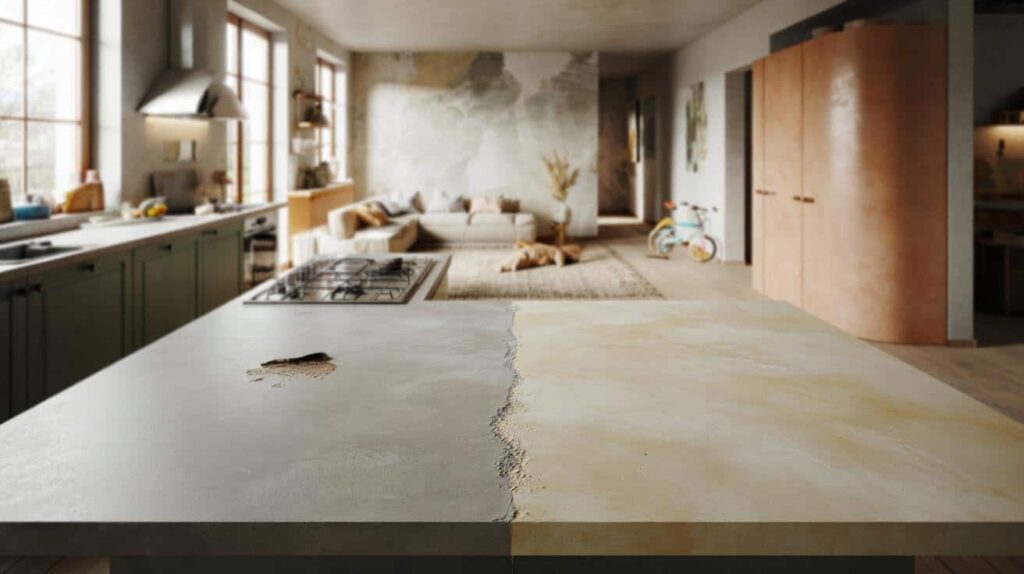
On a rainy Tuesday, I visited an apartment that could have been the set of a design catalog from 2018. Microcement on the kitchen island, microcement in the shower, microcement on the living room floor. Everything was perfectly smooth, perfectly grey… and strangely tired. The owner, Léa, laughed as she ran her hand over a chipped corner near the sink: “Two kids, one dog, and I’m constantly touching this up. I’m done.”
You can feel it in interiors right now. The silky grey coating that once screamed “architect’s project” is starting to look like yesterday’s filter on Instagram.
Designers are quietly pivoting to something warmer, softer, and frankly more forgiving.

The quiet fall of microcement in our interiors
Walk into any freshly renovated flat from the late 2010s and you’ll spot the same signature: continuous grey surfaces, from floor to splashback. It felt modern, almost gallery-like. We were seduced by that “loft in Barcelona” vibe, and microcement delivered it on a budget.

But home life has shifted. We’re cooking more, working at the dining table, kids are biking through the hallway. That hyper-minimal, all-grey shell suddenly feels hard and cold.
The aesthetic still photographs beautifully. In everyday life, it can feel a bit like living inside a design show home you’re scared to scratch.
Architects confess it off the record: requests for microcement are dropping. Clients complain about hairline cracks, marks around taps, or a floor that gets slippery when a toddler spills juice. One interior designer in London told me that out of ten bathroom projects, only one still asks for microcement, and often with hesitation.
People want surfaces that survive real life. Not just a styled photo shoot on move-in day.
We’ve all been there, that moment when you realise your “low-maintenance” choice needs a maintenance manual thicker than a phone book.
The shift isn’t just aesthetic, it’s emotional. After years of smooth, uniform materials, many of us crave texture, warmth, things that age without drama. Microcement promised a continuous, almost monolithic look. That same continuity now reads as flat and slightly anonymous.
Trends are a pendulum. When one pushes towards minimalism and industrial cool, the next swings back to something more tactile, more domestic.
Designers talk about “domestic comfort” rather than “visual purity” now. Microcement struggles in that new language.
The material taking over: lime-based plaster and mineral coatings
Step into the same type of flat today, but freshly redone, and you’ll see a different skin on the walls and sometimes even on worktops. Lime-based plasters, clay coatings, and mineral paints with a velvety, cloudy finish are moving in. They keep the continuous, seamless look, yet feel more alive.
Instead of that uniform, slightly clinical grey, you get gentle variations. Off-whites with a chalky touch. Beige that looks like sand at dusk. Soft terracotta with a hand-rubbed sheen.
The trick is simple: thin, layered coats applied with a trowel or brush, then lightly burnished. The surface catches the light instead of just reflecting it.
Take Sam and Mathieu’s small Paris kitchen. They ripped out a microcement countertop that kept staining around the hob and replaced it with a mineral-based coating reinforced for worktops, in a creamy, almost stone-like tone. The walls were redone in limewash, with broad vertical strokes that remain visible if you look closely.
The room suddenly moved from “boutique hotel lobby” to “warm Mediterranean townhouse”. Guests ask what stone they used. It’s not stone at all, just a clever mix of lime, pigments, and a protective wax.

They joke that the small marks and irregularities now look intentional, almost artisanal, instead of like “defects”.
Why this new love affair with lime and mineral coatings? Partly because they age more gracefully. Microcement wants to stay perfect; every crack feels like a failure. These new coatings accept imperfection from the start. A tiny mark or uneven zone simply blends into the overall movement of the surface.
There’s also a sensory dimension. Walls feel slightly warm to the hand, not icy. Colours seem deeper, less “flat screen” and more like they were painted a century ago and refreshed.
*Our eyes are tired of hyper-smooth; they’re hunting for depth and nuance again.*
How to switch from microcement to the new generation coatings
If you’re looking at your microcement island or bathroom and thinking “I’m over this”, the good news is you don’t always need to smash everything out. Many lime-based and mineral systems can go over existing coats, as long as the base is sound and stable. The key step is to have a pro assess whether the microcement is still well-adhered.
Once that’s confirmed, the usual path is: light sanding, priming, then multiple thin coats of the new material. Each layer is allowed to dry, then worked again to bring out movement.
Think of it less like covering a mistake and more like giving the space a second skin, one that suits how you actually live now.
The big trap is wanting the “perfect Instagram shot” on day one. That leads to over-smoothing, over-sealing, and a result that feels as rigid as what you’re trying to escape. These coatings are at their best when they keep a bit of irregularity.
Another common mistake: treating them like plastic. Scrubbing with harsh chemicals, dragging metal stools against an unprotected corner, expecting a pale limewash behind the stove to survive spaghetti sauce night without any splashback. Let’s be honest: nobody really does this every single day.
Living with these materials means accepting that patina is part of the story, not a problem to eradicate.
“People come asking for microcement because they’ve seen it everywhere,” says interior designer Carla Mendes. “But when we show them lime-based finishes, nine times out of ten they switch on the spot. They say it feels more like a home, less like a showroom.”
- Use mineral where it makes sense
Walls, curved partitions, fireplace surrounds, vanity fronts, low-traffic worktops with good sealing. - Protect stress zones
Behind the hob, in the shower niche, right under taps: think glass, tiles, or an extra-tough sealer. - Choose colour with daylight in mind
These finishes shift with the light, so test large samples on your actual wall. - Accept movement and variation
This isn’t a print; slight tone changes are exactly what gives it character. - Work with someone who has the right touch
A good applicator is as much an artisan as a builder, and it shows on the final wall.
A new way of living with our walls and floors
The end of microcement isn’t a scandal, just the natural end of a cycle. Materials come in with a promise, then daily life exposes their limits and we quietly move on. What’s interesting now is the direction we’re heading: away from obsessive perfection, towards surfaces that accept scratches, kids’ toys, and mismatched chairs.
The rise of lime plasters and mineral coatings says something about how we see home. We no longer want our kitchens and bathrooms to look like tech stores. We want them to feel like places where stories pile up on the walls, not just grease marks.
 Polar bears in Norway’s Arctic are getting fatter and healthier, despite the climate crisis
Next time you scroll through interiors, notice what stops your thumb. Chances are it’s a wall with a soft shadow, a floor that looks like worn stone, not an endless grey slab. The trend isn’t just about materials; it’s about admitting that our homes are meant to be lived in, not curated 24/7.

| Key point | Detail | Value for the reader |
|---|---|---|
| Microcement is losing ground | Clients complain about cracks, stains and a cold, overused aesthetic | Helps you avoid investing in a material that’s already fading out |
| Lime and mineral coatings are rising | Textured, layered finishes that age better and feel warmer | Offers a stylish, long-term alternative for walls, bathrooms and some worktops |
| Application and use matter | Thin layers, good protection in key zones, acceptance of patina | Maximises durability while keeping that soft, lived-in look you’re after |
FAQ:
- Question 1Is microcement really “over”, or just less trendy?
- Answer 1It’s not disappearing overnight, but it’s clearly past its peak. Designers still use it for specific projects, yet the mainstream trend is shifting towards warmer, more textured finishes.
- Question 2What’s the main alternative to microcement for a similar seamless look?
- Answer 2Lime-based plasters, clay plasters, and mineral coatings give a continuous, joint-free effect with more depth and softer colours, especially on walls and furniture.
- Question 3Can I apply these new coatings over my existing microcement?
- Answer 3Often yes, if the microcement is stable and well-adhered. A professional will prep the surface (cleaning, sanding, priming) before applying multiple thin coats of the new material.
- Question 4Are lime and mineral finishes as resistant as microcement?
- Answer 4They can be resistant when properly sealed and used in the right areas, but they’re designed to develop a gentle patina rather than stay immaculate and “plastic” for years.
- Question 5Where should I avoid using these coatings?
- Answer 5Skip highly exposed, hard-use zones like the inside of a very busy shower floor or a rental kitchen countertop. There, tiles, stone, or compact surfaces still do a better job long term.
