
Saturday morning, small-town diner. The kind with sticky syrup bottles and a bell over the door that actually rings. At one table, four friends in their late sixties lean over porcelain mugs, laughing so loud the waitress pretends to scold them. Not a phone in sight. At the next table, three twenty-somethings silently scroll, pausing only to snap a picture of their pancakes before diving back into their feeds.
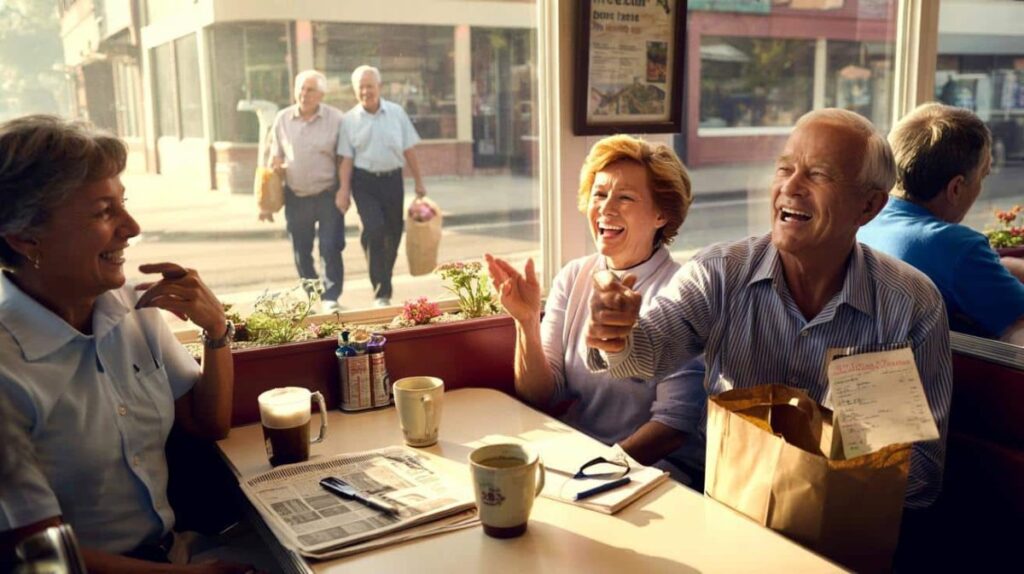
It’s like watching two different centuries share the same room. One rooted in rituals, paper, and eye contact. The other living half a step away from the moment, inside a screen. And you can almost feel it: the older group looks… lighter. Less wired, less hunted by the next notification.
They’re not anti-tech. They’ve just kept six stubborn, old-school habits that quietly protect their happiness.

1. Morning routines that don’t start with a screen
Ask people in their 60s and 70s how they start the day and you’ll often hear the same calm little sequence. Put on the kettle. Open the blinds. Maybe stretch by the window, or step outside and check the weather with your skin, not an app. The TV or phone might come on later, but it’s rarely the first thing.

Those first ten or twenty minutes set a totally different tone. No doomscrolling. No flood of emails before your brain has even woken up. Just a slow entry into the day that feels owned, not invaded. It looks boring from the outside. It feels like freedom from the inside.
One retired nurse I met, 72, has kept the same rhythm for decades. She grinds a small scoop of coffee by hand, feeds the birds, then sits with an actual newspaper, folded and creased, not swiped. She underlines a headline with a pen, tears out a recipe, and only when the mug is empty does she pick up her phone.
She told me her adult grandson tried her routine for one week. “I was less angry and didn’t know why,” he admitted. He hadn’t changed his job, his relationship, or his city. He had just delayed his first screen by 30 minutes. That tiny gap gave his nervous system a chance to arrive in the day before the world rushed in.
The logic here is simple. Your brain wakes up in a fragile state, still halfway in dream mode, and what you feed it first acts like an emotional primer. If the first hit is bad news, comparison photos, or a coworker’s urgent email, your body moves into low-level fight-or-flight before your first sip of coffee. Older generations grew up without that option, so their autopilot still leans on physical routines. That’s not nostalgia, that’s nervous system hygiene. *And quietly, it may be one of their strongest forms of emotional self-defense.*
2. Calling people instead of dropping another text bubble
Watch a sixty-something handle a complicated situation and you’ll see a reflex that feels almost rebellious today: they pick up the phone and call. Not a 30-message thread. Not a passive-aggressive emoji. A real voice, breathing on the other end, with pauses and tone and sighs you can hear. It’s messy sometimes, but it’s deeply human.
They grew up when long-distance calls were rare and expensive, so each one mattered. That habit survived. For them, “checking in” often means hearing someone say “hello”, not seeing the three little dots flicker and disappear.
A 68-year-old neighbor told me she calls her best friend every Sunday at 7 p.m., without fail. They’ve done this for 35 years. They talk about nothing and everything: a sore knee, a recipe that flopped, a memory that just popped up. Meanwhile, her granddaughter keeps a “streak” with 250 people on social media but admits she doesn’t feel truly close to many of them.
The older woman’s social life is smaller, but thicker. Less constant contact, more depth. When her husband got sick, those same friends showed up in person without needing a calendar link or a group chat to coordinate.
There’s a reason a two-minute phone call can clear up a conflict that would take 40 angry texts. Human voices carry nuance that pixels can’t. You hear someone hesitate, chuckle, soften. That texture calms the nervous system and grounds the relationship. We’ve all been there, that moment when a simple call would have saved a week of silent overthinking. Let’s be honest: nobody really does this every single day. But older folks do it more than we do, and that one habit keeps their relationships warmer, which quietly keeps their mood higher too.
3. Walking as a default, not a workout “event”
One of the most deeply old-school habits might be the simplest: they walk. Not always in neon sneakers or tracked by a watch. They walk to the store, to the mailbox, to a friend’s house. They walk after dinner “to help digestion”, like their parents told them. Movement isn’t a performance; it’s just how they move through the day.
When transport was less convenient, legs did what cars and apps do now. That muscle memory remains. For many in their 60s and 70s, sitting all day still feels stranger than walking a few extra blocks.
A retired couple in their early seventies, living in a mid-size city, told me they don’t “exercise”. What they do is walk to buy bread, walk to the park, walk the neighbor’s dog twice a week. None of it would go viral on fitness TikTok. But they average 7,000–8,000 steps a day without counting.
Their son, 34, drives to a gym to walk on a treadmill facing a TV. His phone logs every heartbeat. Yet he often complains of back pain and restless sleep. When he visits his parents, he notices something humbling: they move through their day with less stiffness than he does, and they rarely talk about “finding time to work out”. The habit is built into errands, not carved out as an extra task.
Walking like this doesn’t demand discipline, just a different default. Short distances aren’t “too small” for a car, they’re exactly right for two legs. That constant trickle of light activity keeps joints oiled, moods lifted, and sleep deeper. It also creates small chances for micro-conversations with neighbors and cashiers. That tiny social layer adds up. Physical health, emotional stability, and a sense of belonging are all sneaking into one modest habit: getting from A to B the slow way.
4. Paper, pens, and the quiet power of doing things by hand
If you peek into the bag or home office of someone in their seventies, you’ll often still find a paper diary, a shopping list curled at the edges, a notepad by the phone. They write things down. Appointments, recipes, questions for the doctor. That scratch of pen on paper is more than a quirk. It’s a mini ritual that slows the mind just enough to think clearly.
They don’t need an app to remind them of every breath. Their memory is supported by ink, not by push notifications. The pace is slower, but the feeling of control is sharper.
Of course, there are mishaps. One 70-year-old man I spoke with laughed about losing his entire week’s grocery list in the washing machine. Still, he insists on handwritten lists. “When I write it, I remember half of it anyway,” he said. There’s science behind that: writing by hand engages more of the brain than typing, reinforcing memory.
You can see the same thing with physical photo albums. While younger people scroll through thousands of images they rarely print, many older adults still curate a handful of photos into books. Turning those pages is a slow, tactile trip through their life story. It’s grounding in a way scrolling simply isn’t.
 $2,000 Direct Deposit for U.S. Citizens in February Eligibility, Payment Dates & IRS Instructions
One 69-year-old grandmother put it like this:
“On my phone, life flies. On paper, life stays.”
This isn’t about rejecting tech, it’s about keeping some anchors offline. Want to try the feeling? Start small:
- Use a cheap notebook as a “brain dump” instead of a dozen note apps.
- Write tomorrow’s three priorities on paper before bed.
- Print a few favorite photos and put them somewhere you actually see.
These tiny gestures slow down your thoughts and turn vague worries into visible words you can manage. That sense of “I’ve got this” is priceless.
5. Real hobbies that don’t need an audience
Spend an afternoon with people in their 60s and 70s and you’ll notice something quietly radical: they do things for the sheer joy of doing them, not for sharing them. Woodworking in a garage that smells like sawdust. Knitting a crooked scarf while the radio hums. Tending tomatoes in a garden nobody else will ever photograph.
The activity is the reward. No likes, no metrics, no followers. Just the satisfaction of making or growing something with your own hands and watching it change over weeks or months.
A 74-year-old widower I met spends hours repairing old radios in his basement. He doesn’t sell them. He doesn’t post before/after shots. He just finds broken things and makes them work again. “It keeps my brain and my hands busy,” he said, almost shy. On the shelf behind him, fifty silent radios wait, each with its own rescue story.
Compare that to the way younger generations often approach hobbies: as potential side hustles, content opportunities, brand-building exercises. The pressure to be visibly “productive” squeezes the simple joy out of messing up, learning slowly, or staying delightfully average at something for years.
The emotional payoff of an unmonetized hobby is bigger than it looks. It offers:
- A place where mistakes are allowed and nobody is judging.
- A feeling of progress that isn’t tied to career or income.
- Proof that your identity is more than your job or your online persona.
That quiet sense of competence is deeply stabilizing. **You can be terrible at your hobby and it can still save your week.** When you don’t need applause, a rainy afternoon with your tools or yarn or seeds becomes its own small, steady source of happiness.
6. Saying “no” without apologizing for it
There’s one last old-school habit that might be the hardest for younger, hyperconnected generations: older people say “no” a lot more easily. No to late-night events that will wreck their sleep. No to staying on a group chat that only drains them. No to doing three things at once when their body is asking for a nap.
Their calendar is still full, but it’s full of what they can actually handle. Age teaches them the cost of overcommitting, and they’re less afraid to disappoint people for the sake of their own energy.
A 67-year-old former manager told me he used to accept every invitation, then secretly hope people would cancel. Now he looks at anything new through a blunt filter: “Will this give me energy or steal it?” If it’s the second, he politely declines. No long explanation, no guilt spiral.
Younger folks, wired for constant availability, often find this selfish. Yet the same people end up ghosting, burning out, or resenting friends they said “yes” to. The older group has simply learned to disappoint a little early, rather than disappoint a lot later.
That habit creates space for rest, but also for presence. When they do say yes, they show up fully. The phone stays in the bag. The conversation isn’t half-watched through a mental to‑do list. **Boundaries, in their world, aren’t a self-help buzzword, they’re a basic survival skill.** And that single skill might be the quiet line between always-tired and genuinely content.
What these six habits quietly reveal about happiness
Put all these habits side by side and a pattern appears. None of them are glamorous. None will trend on social media. They’re small, repeatable choices that trade speed and stimulation for slowness, depth, and a sense of control. Lower-tech mornings, real conversations, walking, paper, private hobbies, unapologetic “no’s”.
Together, they create a life with fewer alerts and more moments that actually land. Not perfect, not drama‑free, but less jittery. Less like you’re constantly buffering.
You don’t have to be 70 to borrow them. You don’t have to throw your phone in a lake or move to the countryside. You can keep all your apps and still decide that your first ten minutes of the day belong to sunlight and a mug, not to a glowing rectangle. You can send texts all day and still choose one real phone call a week with someone who matters.

The plain truth is this: happiness is often hiding in choices that feel almost too small to notice. Old-school habits are just that—small, boring, repeated. Yet when you talk to people in their 60s and 70s who seem genuinely at ease in their skin, these are the things that quietly show up in the background. The question is less “Are you too attached to your phone?” and more “Which of these slow, stubborn rituals are you willing to steal for yourself?”

| Key point | Detail | Value for the reader |
|---|---|---|
| Offline mornings | Delay screens, use simple rituals like coffee, light, or stretching | Reduces anxiety and gives a calmer emotional baseline |
| Unshared hobbies | Activities done for joy, not performance or profit | Builds identity and satisfaction beyond work or social media |
| Comfortable “no” | Choosing fewer commitments and setting limits on availability | Protects energy and allows deeper presence in what you do say yes to |
FAQ:
- Do I have to quit social media to feel the benefits of these habits?You don’t. Think “add old habits” rather than “delete all apps”. Even one offline morning routine or one weekly call can shift how frazzled you feel.
- What’s the easiest old-school habit to start with?Most people find handwritten lists or a short daily walk the least intimidating. They’re quick wins that don’t demand big life changes.
- How long before I notice any change in my mood?For tiny habits like delaying your first screen, some people feel a difference within a few days. Deeper shifts in stress or sleep can take a few weeks of consistency.
- Is this just nostalgia for “simpler times”?Not really. The point isn’t that the past was perfect, it’s that some low-tech behaviors are still highly effective for emotional stability today.
- Can I mix these habits with high-tech tools?Yes. Use tech where it truly helps, and borrow older habits to bring your nervous system back down. Hybrid living is the sweet spot for most of us.
