
On a grey Tuesday morning, you step out the door, zip your jacket, and turn left. You don’t think about it. Your feet already know: past the bakery, across the same zebra crossing, under the same crooked tree that drops leaves exactly where you usually avoid them.
Every day, your phone might change, your inbox explodes with new chaos, but that 20‑minute walk? It’s on rails.
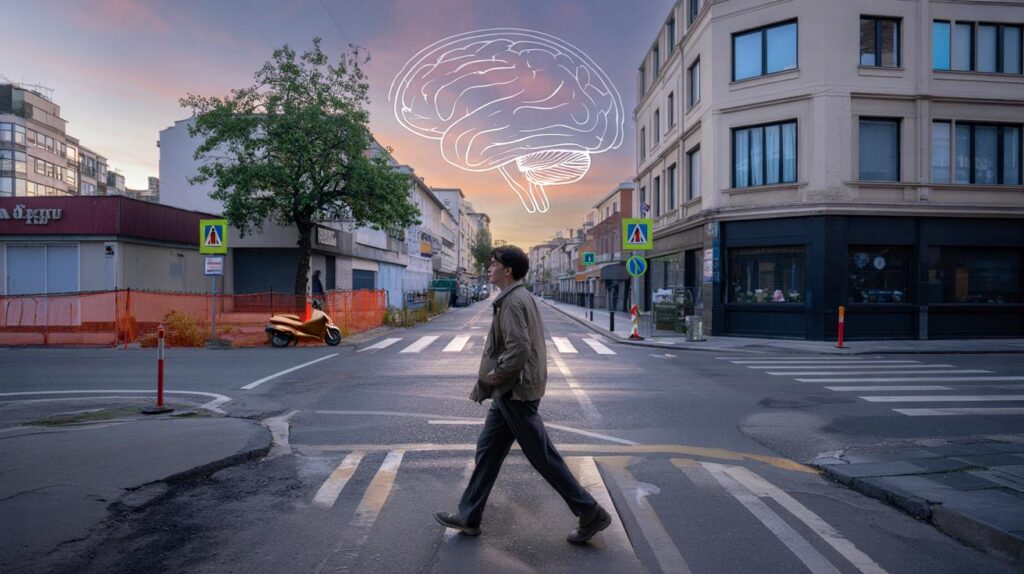
You maybe nod to the same dog walker, wait at the same light, glance at the same window with the blue curtains. It feels like nothing. A tiny blank space between real parts of your life.
Yet quietly, behind your forehead, your brain is taking notes.

And the route you always walk is teaching it what to do with uncertainty.

What your “boring” daily route really does to your brain
Neuroscientists talk a lot about two things the brain hates: pure chaos and absolute predictability. Your daily walking route sits right in the middle.
You know the turns, the timing of the lights, the spots where cars usually speed up. But you don’t know if there’ll be roadworks, a scooter on the sidewalk, or a sudden storm.
That mix of familiar structure and mild surprise acts like a training ground.
The brain learns: “Okay, the world has a pattern, but not everything is under my control.”
And that lesson leaks into the rest of your life, from how you check your notifications to how you react when plans fall apart.
Picture this. You always cut through the same narrow backstreet on your way to work. One day, a construction fence blocks the way, orange netting cutting your path in half. Your first reaction? A tiny flicker of annoyance, maybe even a spike of stress.
Then your brain does its thing. It pulls up a map, scans alternatives, adjusts, and you walk a different way.
It seems trivial, but that micro-moment is a live test of how you handle change.
Some people switch streets with a shrug. Others feel thrown off for the whole morning. The same external event, radically different internal weather.
Researchers who look at “cognitive maps” have shown that our brains don’t just store places, they store expectations. Street after street, your hippocampus builds a model of “how things normally go”.
The route becomes a script. A quiet rehearsal of: this is safe, this is known, this is where the unknown might show up.
So when the script is interrupted, the brain has two paths: fight it, or flex around it.
If your days are packed with rigid routines and very few surprises, even a small disruption can feel louder. *If your routes and habits contain tiny variations, your brain practices bending instead of breaking.*

How to walk the same route… without getting stuck in it
One simple habit shifts the whole experience of your daily walk: deliberate micro-changes. Keep the main route if you like, just tweak one detail each day. Cross the road earlier. Take the parallel sidewalk. Stop for 30 seconds and actually look up at the roofs.
You’re still inside the comfort of the familiar path, yet you’re nudging your brain to stay awake.
It starts expecting slight uncertainty rather than fearing it.
This isn’t a productivity hack. It’s more like gently reminding your nervous system, “We know where we’re going, but we’re allowed to explore.”
When people talk about routines, they often swing between two extremes. Either rigid discipline (“I never change my route, it keeps me efficient”) or total novelty (“I get bored, I change paths all the time”). The brain handles both, but the sweet spot lies somewhere in between.
We’ve all been there, that moment when a tiny change in commute feels like the last straw in an already overloaded day.
That reaction usually isn’t about the street itself. It’s about habits so tight they leave no breathing room.
Let’s be honest: nobody really does this every single day. Some mornings, you’re late, or you’re tired, or you just zombie-walk the same line. That’s fine. The goal is not perfection, it’s flexibility.
Our walks quietly teach our brain a story: “When the world shifts a little, I don’t have to panic. I can adapt, step by step.”
- Notice one new detail on your usual route each day.
- Once a week, reverse the path you normally take.
- Use small detours as practice for staying calm in mild uncertainty.
- When something blocks your way, pause, breathe, then choose an alternative on purpose.
- Treat the walk less like a tunnel and more like a low-stakes training ground for change.
Living with change, one sidewalk at a time
When you start paying attention, your daily walk stops being just background noise. The uneven paving stones, the timing of the traffic, the new graffiti on a garage door: all of it becomes a quiet dialogue between your brain and the world.
Walking the same route every day doesn’t trap you in sameness unless you move through it on autopilot. It can also be a soft, daily exposure to low-level uncertainty, the kind that teaches you, over time, that surprise isn’t always a threat. That you can meet it, adjust, and carry on.

On the days when life feels like one big construction site blocking your plans, that training suddenly matters.
What if your next walk wasn’t just about getting from A to B, but about noticing how you deal with the tiny changes along the way?
The street won’t care. Your brain will.

| Key point | Detail | Value for the reader |
|---|---|---|
| Daily routes build mental “scripts” | Repeated paths teach the brain what to expect and where surprises may appear | Helps you understand why small disruptions feel big |
| Micro-changes train flexibility | Tiny variations on a familiar route work like low-stress practice for handling change | Gives you a simple way to feel less thrown by uncertainty |
| Attention transforms routine | Noticing details turns walking from autopilot into active brain training | Turns something you already do into a quiet tool for resilience |
FAQ:
- Does walking the same route every day harm creativity?Not necessarily. A familiar route can free mental space, and adding small variations or paying attention to new details can actually support creative thinking.
- Should I force myself to change my path often?You don’t need radical changes. Gentle, occasional tweaks are enough to help your brain practice dealing with small uncertainties.
- Why do I feel anxious when my usual route is blocked?Your brain’s “script” is being interrupted. That discomfort is a natural reaction to broken expectations, not a sign that something is wrong with you.
- Can walking routines really affect how I handle bigger life changes?Yes, in a subtle way. Repeated exposure to small, manageable disruptions builds a sense of “I can adapt”, which carries over into larger situations.
- Is it better to walk new routes all the time?Constant novelty can be tiring. A balance between stable paths and occasional detours tends to support both comfort and flexibility.
