
The first warning signs didn’t come from a Hollywood disaster movie, but from a glowing screen in a quiet forecast office. Satellite images over the Arctic – usually a calm swirl of white and blue at this time of year – started showing weird shapes, warm “tongues” of air pushing into places that should be brutally frozen. Meteorologists leaned closer, double checked the scales, refreshed the models. The numbers turned red anyway.
Outside, in cities thousands of kilometers away, people zipped up thin jackets, still half-convinced winter had somehow skipped them this year. Yet above their heads, the polar engine that usually keeps seasons in line was misfiring. Something was shifting fast, and not in a subtle way.
The people paid to read the sky say we’re entering February with an Arctic they barely recognize.
And that should make the rest of us pause.
 Meteorologists warn February is approaching with signs of an Arctic disruption rarely documented
Arctic winter is breaking its own rules
Ask any veteran forecaster and they’ll tell you: February used to be predictable near the pole. Brutal cold, thick sea ice, a frozen lid on the top of the world. This year, those old patterns are slipping through their fingers.

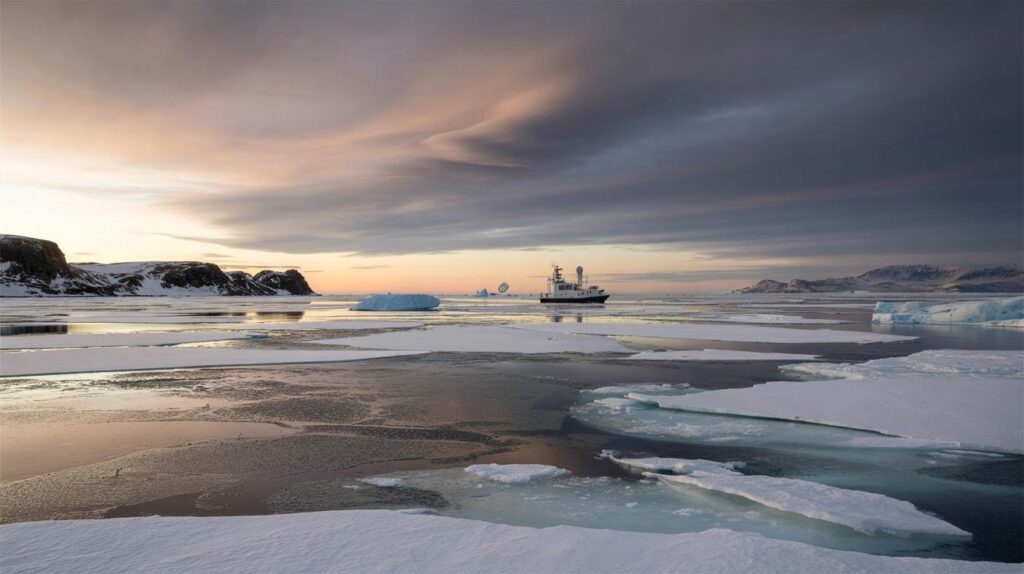
Weather stations across the Arctic are logging temperatures up to 10–20°C above seasonal norms on some days. Ice that should be hard as rock is patchy, thin, fragmented. Ocean surfaces that should be locked tight are breathing open water into the air.
The maps look wrong. The numbers feel worse.
You can see this shift in one simple snapshot: sea ice extent. Right now, satellite data is tracking near record lows for this point in winter, in some basins beating previous “worst years” by a disturbingly comfortable margin.
In Svalbard, where February used to mean relentless darkness and painful cold, locals report rain on days that should be far below freezing. Hunters talk about unreliable ice, ships push further north than they should be able to, and scientists on research stations are rewriting their safety protocols mid-season.
One glaciologist described stepping off a boat expecting solid ice and finding slush. “It felt,” she said, “like arriving in the wrong century.”
Behind this, the physics is brutally straightforward. Warmer oceans delay ice growth. Less ice means darker surfaces that soak up more sunlight, even the weak polar winter light, which then warms the water more. The Arctic’s famous “albedo” shield peels back, and the region starts amplifying its own warming.
At the same time, the temperature contrast between the Arctic and mid-latitudes is softening. That sharp gradient is what keeps the jet stream tight and relatively stable. As it weakens, the jet stream bends, loops, stalls.
What used to be a tidy conveyor belt of weather becomes a tangled hose spraying cold and heat in unexpected directions.
When the Arctic cracks, our weather follows
Meteorologists talk a lot more these days about the polar vortex, that ring of icy winds tens of kilometers above the Arctic. Right now, those winds are behaving like a spinning top that’s starting to wobble, and February could be when it tips.
Sudden stratospheric warming events – big jolts of heat entering the high atmosphere – are becoming more frequent. When they hit, the vortex can split or sag southward, sending Arctic air flooding into Europe, North America, or Asia while the pole itself warms.
If your winter has felt strangely mild so far, that doesn’t mean you’re safe. It might mean the punch hasn’t landed yet.
In February 2021, a disrupted polar vortex helped unleash Arctic air into Texas, freezing pipes, shutting down power plants, and leaving millions shivering in homes never built for deep cold. That week, sea ice near the pole was thinner than average, and parts of the Arctic were oddly warm.
This winter, the pattern isn’t identical, but meteorologists are getting déjà vu. Long-range models hint at sharp flips: spring-like spells followed by brutal cold snaps, snowstorms hitting places more used to drizzle, icing risks in infrastructure already stressed by weird freeze–thaw cycles.
We’ve all been there, that moment when you step outside dressed for “what it felt like yesterday” and the sky laughs in your face.

The chain reaction is messy but traceable. A warmer Arctic and disrupted ice cover change pressure patterns, and those patterns pull storm tracks to new places. Storms that would normally spin harmlessly over frozen seas now run into populated coasts. Rain falls where snowpack should quietly build. Floods hit when the ground is half-frozen and unable to soak up water.
Let’s be honest: nobody really builds their daily plans around stratospheric charts and sea ice anomalies. Most of us respond to what we feel at the window. Yet the atmosphere is being primed upstream in ways that sharpen extremes and stretch seasons at both ends.
February used to be a kind of climatic anchor. This year, that anchor is dragging.
How to live with a winter that won’t stay in its lane
For regular people far from the Arctic Circle, the most useful habit in the coming weeks might sound boring: zoom out from the day-to-day forecast. Look at trends, not just tomorrow’s icon on your phone.
Meteorologists are increasingly flagging “high volatility” periods, where swings of 15–20°C in a few days are on the table. In practice, that means having a flexible winter routine instead of a fixed one. Keep layered clothing in rotation, not buried in a closet. Think about your home like a system: drafts sealed, gutters cleared for sudden meltwater, backup heat sources tested before you actually need them.
A wildly changing Arctic doesn’t stay in the Arctic. It visits your front door as whiplash.
There’s a quiet kind of stress that creeps in when seasons stop behaving. People second-guess travel, worry about elderly relatives in poorly insulated homes, or feel silly carrying gloves during a 12°C afternoon that turns into freezing rain by night.
The trick is not to chase perfection, but to lower the threshold at which you say, “I’ll prepare anyway.” Charge the power bank when a cold snap and storm are in the forecast. Talk with neighbors about checking on each other if a deep freeze hits after a warm spell. Adjust your commute expectations when thawed slush can refreeze into black ice in just a few hours.
The emotional load eases a bit when weird weather is something you anticipate together, not just endure alone.
“From a forecasting standpoint, the Arctic this winter is like a warning light on the planet’s dashboard,” says Dr. Lina Gutierrez, a climate scientist tracking polar data. “We’ve entered a phase where ‘unprecedented’ is becoming a monthly word, and February 2026 is lining up to push that even further.”
- Follow trusted forecasts
Check local meteorological agencies and not just viral social media maps. - Build a small “weather buffer” kit
A flashlight, blankets, basic food, and backup phone battery can turn a bad night into a manageable one. - Watch freeze–thaw zones
Those are prime times for potholes, burst pipes, and treacherous sidewalks. - Talk about the Arctic at home
Not as distant drama, but as the engine that shapes your own winter reality. - Notice patterns, not just freak days
One warm spell is luck. A string of them inside polar night is a signal.
The Arctic’s new story is tied to ours
What’s unfolding above the Arctic Circle right now isn’t just another headline in the long scroll of climate news. It’s a live experiment we’re all taking part in, whether we signed up or not. The region once thought of as a frozen constant is turning into a restless player in our daily weather drama, nudging jet streams, tweaking storm paths, and rewriting what February feels like in places that never see polar night.
Some will experience this as a late-season blizzard, others as ankle-deep rain on snow that used to last until March. Farmers will read it in soil that never really freezes. City planners will read it in drainage systems overwhelmed by rain-on-snow events. Parents will read it in the awkward shrugs when their kids ask why there’s mud instead of sledding hills.
*The Arctic used to be a backdrop in our mental map of the world: distant, white, static.* Now it’s moving closer, not geographically, but through the nervous system of the atmosphere that wraps us all.
The question floating beneath all these meteorological warnings is simple and uncomfortable: if the region that once anchored our seasons is slipping this fast, how will we choose to adapt, locally, emotionally, politically?

And maybe more quietly: at what point do “unprecedented” Februaries stop shocking us, and start defining what winter even means?
| Key point | Detail | Value for the reader |
|---|---|---|
| Arctic conditions are warming fast | Record-low sea ice and repeated winter heat anomalies are reshaping the polar atmosphere | Helps explain why local winters feel inconsistent, with strange mixes of thaw and deep cold |
| Weather volatility will likely increase | Disrupted polar vortex and jet stream mean sharper temperature swings and unusual storms in February | Encourages readers to prepare for rapid shifts instead of relying on “normal” seasonal expectations |
| Small adaptations matter | Layered routines, better home preparation, and community awareness reduce risk during extreme events | Turns a distant climate signal into concrete steps that protect health, comfort, and daily life |
FAQ:
- Question 1Are meteorologists exaggerating the Arctic changes to get attention?
- Answer 1Most Arctic warnings are based on long-term satellite records, on-the-ground measurements, and peer-reviewed studies. Forecasters are speaking more urgently now because the trends are accelerating, not because the data is weaker.
- Question 2Does a warm Arctic mean my winter will always be mild?
- Answer 2No. A disrupted Arctic can actually send intense cold south in bursts. The overall trend is warmer, but the way you feel it locally can be through wild swings and extreme cold snaps mixed with unusual warmth.
- Question 3Can we link a single February storm directly to Arctic warming?
- Answer 3Scientists are careful here. Individual storms have many drivers, but the background conditions – like warmer seas and thinner ice – are shifting the odds, making certain patterns more likely and more intense.
- Question 4What should an ordinary household do differently this winter?
- Answer 4Stay more alert to mid-range forecasts, keep flexible clothing and basic emergency supplies handy, and prepare for power outages or icy conditions even if the previous week felt spring-like.
- Question 5Is there anything that can still slow these Arctic changes?
- Answer 5Cutting greenhouse gas emissions remains the main lever. Local actions feel small, but policies, energy choices, and collective pressure all stack up in the models that project future Arctic stability.
