
The sink is full, again. Three mugs, a plate, one greasy pan. You stand there, sponge in hand, and for some reason this tiny chore feels like climbing a mountain in flip-flops. Your head is buzzing from emails, messages, the news you half-read at lunch. The pan isn’t just a pan anymore. It’s the last straw.
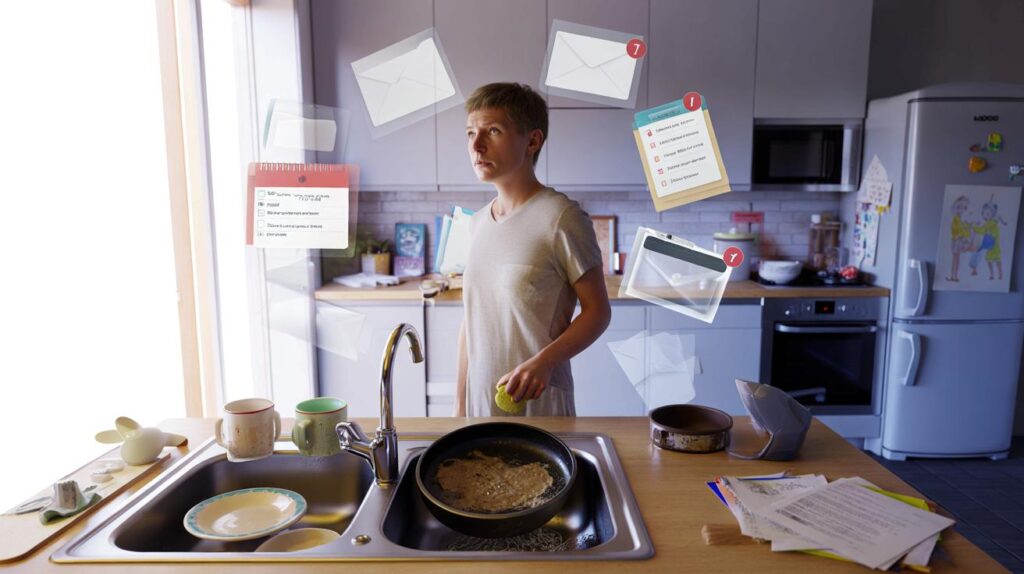
You catch yourself thinking: “Why am I like this? It’s just dishes, not a war zone.”
You’re not lazy. You’re not broken. Something else is going on in your brain.

When “tiny” tasks suddenly feel gigantic
There are days when answering one email feels harder than writing a whole college thesis once did. You open your inbox, see three unread messages, and your chest tightens. Your brain quietly whispers: “Not now. Later.” So you switch to scrolling, or pacing, or staring at the fridge for no reason at all.

On paper, these are micro-tasks. In your body, they feel heavy, sticky, oddly threatening. The gap between “This should be easy” and “This feels impossible” can be disorienting. That gap has a name: **cognitive load saturation**.
Picture Maya, 34, project manager, two kids, one aging dog. Her day is a stream of tiny requests: “Can you review this?” “Don’t forget the dentist appointment.” “We’re out of milk.” She nails a two-hour strategy presentation… then completely freezes in front of an online form that would take five minutes to fill out.
She clicks on it, stares, closes the tab. Tries again an hour later. Same thing. By bedtime, the form is still undone, and she’s calling herself “useless” in the dark. From the outside, that form is nothing. Inside her head, her mental RAM is already at 99%. One more task, even a small one, just doesn’t fit.
Cognitive load is the total mental effort your brain is using at any given moment. Every open loop, every unfinished thought, every notification takes a tiny bite out of that capacity. Once you hit saturation, the system does something sneaky: it starts flagging even small tasks as threats.
Your prefrontal cortex, the part that plans and organizes, is exhausted. So the emotional brain takes the wheel, and it hates friction. That’s why you end up avoiding that one email, that one call, the three dirty mugs. *It’s not the task that’s big; it’s your brain that’s already full.*
How to relieve a saturated brain in real life
One simple method to lower cognitive load is what psychologists call an “external brain dump.” Grab a notebook or a blank note on your phone. Write down every single thing that’s swirling in your head: the call you’re avoiding, the laundry you haven’t folded, the weird sound the car made this morning. Don’t organize it, just list it.
Then pick one task so small it feels almost silly. “Put clothes in the hamper.” “Open that email without replying yet.” Do just that, and stop. This tiny win tells your nervous system: “We’re not stuck. We can act.” It’s a hidden reset button.
Many people try to bully themselves out of overwhelm. You know the inner voice: “Just do it, everyone else manages, what’s wrong with you?” That voice doesn’t reduce cognitive load, it adds shame on top. Over time, your brain starts to associate small tasks with failure before you’ve even begun.
 Psychology explains that emotional numbness often develops as a short-term survival strategy
A kinder strategy is to lower the bar on purpose. Shrink tasks until they feel almost embarrassingly easy. Instead of “clean the kitchen”, try “throw away the trash on the counter.” Instead of “sort finances”, try “open the banking app and look at the balance.” Let’s be honest: nobody really does this every single day. But on the days you do, your brain learns that small steps are safe, not dangerous.
Sometimes the bravest thing you do all day is answer one message you’ve been avoiding for a week. That tiny act is your brain choosing engagement over paralysis.
Now, turn these small acts into a simple, visual box of options your tired brain can pick from:
- Create a “2-minute tasks” list: actions so quick you can do them without thinking.
- Keep it somewhere visible: fridge door, desk, phone home screen.
- When you feel stuck, don’t think. Just choose one item from the list.
- Celebrate mentally after each one, even if it feels ridiculous.
- Update the list weekly so it stays fresh and realistic.
Living with a full brain in a noisy world
We live in a time where your mind can be saturated before breakfast, just from notifications and background worries. No wonder a simple phone call can feel like climbing a wall with no grips. Recognizing this doesn’t magically empty the sink, but it does remove one very heavy thing: the idea that you’re “failing at life” because tiny tasks feel huge.
You start to see the pattern. The time of day when your brain crashes. The types of tasks that always trigger avoidance. The way your shoulders tense right before you “just quickly” check social media instead. That awareness is quietly radical.
From there, you can experiment. Maybe your brain handles admin only in the morning, so that’s when you answer messages. Maybe you stop pretending you can multitask nine things and accept that three is your real limit. Maybe you ask your partner or a friend to share or swap certain tasks when your mental RAM is full.
You don’t have to fix everything. You just have to notice what drains you, and shave off a little of that load where you can. One permission at a time. One tiny, doable task at a time. **Your worth is not measured by the size of the to-do list you can endure.**
There’s a quiet relief in naming what’s happening: cognitive load saturation. It gives shape to that invisible mental fog you’ve been fighting alone. It explains why you can handle a crisis at work but fall apart over a broken printer cartridge.
Once you see your brain as a system with limits, not as a stubborn enemy, the story shifts. You can design your days with more kindness, more margins, more small tasks that feel safe instead of suffocating. You can decide that when you’re staring at the dishes, maybe the next right move isn’t “try harder”, but “ask what’s already filling my head.”
 Psychology explains that hypervigilance can persist long after the original stressor has disappeared
The sink will still get cleaned. The email will still be answered. The difference is that you’ll do it from a place of understanding, not self-blame. And that changes everything, even if nobody else ever notices.

| Key point | Detail | Value for the reader |
|---|---|---|
| Recognize cognitive load saturation | Seeing overwhelm with small tasks as a sign of mental overcapacity, not laziness | Reduces guilt and self-criticism |
| Use external brain dumps | Write down every open loop and pick one tiny, concrete action | Gives a simple way to restart when stuck |
| Shrink tasks and build mini-rituals | Turn big chores into tiny steps and keep a “2-minute tasks” list | Makes daily life feel lighter and more manageable |
FAQ:
- Why do I feel exhausted by simple tasks?Cognitive load saturation means your mental resources are already used up by stress, worries, and constant stimulation, so even small chores feel heavy.
- Is this the same as being lazy or unmotivated?No. Laziness is a moral label; what you’re experiencing is a normal brain response to overload, often seen in stressed or burnt-out people.
- Can cognitive load saturation be a sign of ADHD or anxiety?Yes, it’s common in ADHD, anxiety, and depression, but it can also appear in people with none of these when life gets too crowded.
- What helps in the moment when I’m stuck?Pause, breathe slowly for 60 seconds, do a quick brain dump, then choose one task that takes two minutes or less, even if it feels “too small.”
- When should I consider getting professional help?If small tasks feel overwhelming most days for several weeks and it affects work, relationships, or sleep, talking to a therapist or doctor can bring clarity and support.
