
Your dog looks at you, head slightly tilted, eyes soft. One paw slowly lifts off the ground and rests gently on your knee. You freeze the video you were watching, smile, and instinctively shake that paw as if it were the most natural thing in the world. Maybe you even say, “Good boy!” without thinking about it. It feels like a handshake, a little joke between the two of you. Cute, simple, harmless.
Then the paw comes back. Again. And again. Harder this time. Claws scraping your jeans. Eyes more insistent. The vibe has shifted, and you suddenly sense there’s something else going on behind this gesture you thought you knew by heart.
What if this tiny paw was whispering something you’d never really listened to?
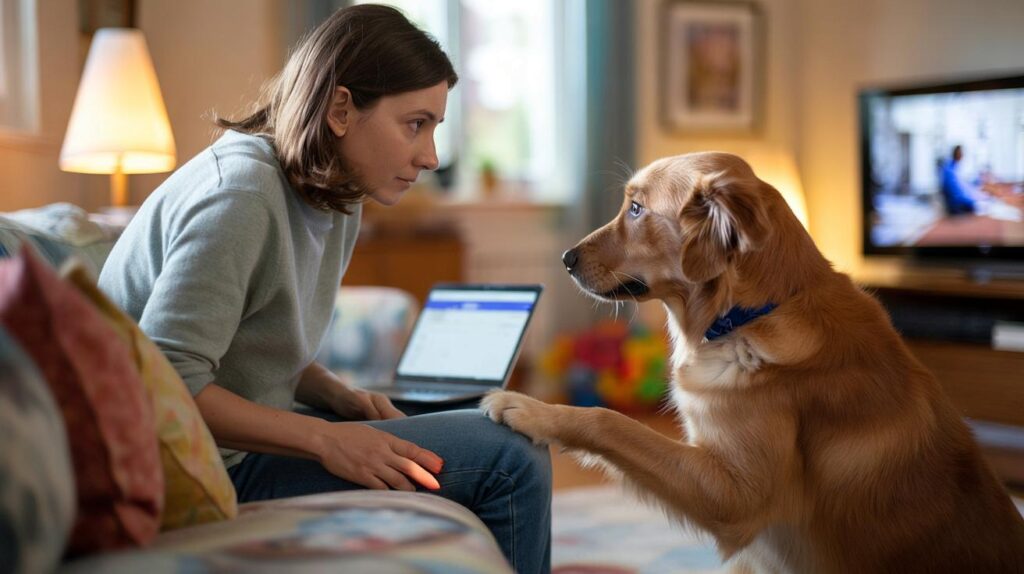
When a paw on your leg is not a game at all
Most people think “giving the paw” is just a trick, a greeting, a small performance for treats and laughs. Yet many animal behaviorists say that outside of training sessions, this movement is one of the clearest messages a dog uses with humans. Your dog isn’t trying to be polite. It’s trying to be heard.
Sometimes that paw is a discreet SOS, a sign of stress or discomfort that we read as “cute” and reward with a smile. Sometimes it’s a demand: more attention, more contact, more clarity.
Once you start looking at the whole body instead of just the paw, the scene suddenly looks very different.
Picture this. You’re working on your laptop, absorbed, barely present in the room. Your dog lies at your feet, sighs, shifts, gets up, sits in front of you. Paw on your leg. You scratch his head, eyes still on the screen. Paw again, this time with a slight whine. You respond with a half-hearted “Later, buddy” and push the paw away.
Minutes pass, and the paw returns, more insistent. Now he’s panting a little, ears pulled back, maybe licking his lips for no obvious reason. Many guardians tell trainers, “He keeps pestering me with his paw, he’s being annoying.” Yet to a professional eye, that same scene often screams: this dog is anxious, bored, or emotionally flooded.

Animal experts repeat the same thing: the paw on your leg never exists alone. It sits inside a bigger emotional picture. A relaxed dog might offer a soft paw with loose muscles, open mouth, wiggly body. A stressed dog presses a tense paw, weight forward, eyes wide, tail low or still. One gesture, completely different meaning.
We’ve all been there, that moment when we realize we’ve been misreading our own dog for months or years. It’s not about guilt. It’s about switching from “He’s being cute” to “What are you really telling me right now?”
Once you do that, the relationship changes more than any toy or treat ever could.

How experts really read that famous paw
The first step, trainers say, is to slow down. Your dog lifts a paw toward you? Pause for two seconds. Breathe. Scan the rest of the body. Look at the eyes: are they soft or fixed? The mouth: relaxed or tightly closed? The tail: neutral, tucked, wagging low and slow? This tiny mental checklist transforms that single paw tap into an actual conversation.
If your dog is calm and loose, that paw is often a gentle request: more petting, social touch, maybe a habit you’ve unconsciously reinforced 100 times before. If the body is tense, the paw might mean “I’m not okay” or “I don’t know what to do with this situation.”
A common scene seen by behaviorists: a family on the couch, TV too loud, kids moving fast, someone arguing in the kitchen. The dog crosses the room, presses a paw on the quietest person’s leg, and looks up with wide, worried eyes. Many owners say later, “He’s so clingy when we have guests.” From a behavioral point of view, that paw reads as a grounding attempt. The dog is reaching for its emotional anchor in the chaos.
On the other side of the spectrum, some dogs learn that every time they tap a leg with their paw, a human hand appears. They repeat it because it works. That’s not just affection. That’s a training loop you’ve built together without even noticing.
Experts also highlight a more subtle version: the half-raised paw that never fully lands on you or the ground. You often see it outdoors, in new or slightly tense situations. Ears alert, body still, one paw lifted and frozen mid-air. That’s not a trick; that’s a sign of uncertainty or high attention, like a question mark written in muscle.
*This is where reading context becomes more powerful than any list of “signs of stress” on the internet.*
Dogs don’t use words, but they do use sequences: gaze, posture, paw, breath. Missing those links is like trying to guess a sentence by looking at just one letter.
Turning that paw into a real two-way dialogue
One simple method behaviorists suggest is this: each time your dog offers a paw, label the moment in your own head. “You want contact.” “You’re anxious.” “You’re excited.” Even if you’re wrong at first, this mental habit forces you to notice the rest of the picture.
Then, respond with intention. Calm paw + soft body? Offer slow strokes on the chest or side, not just fast, excited pats on the head. Tense paw + worried face? Lower your own energy, reduce noise or movement, maybe guide your dog to a quieter corner with you and simply breathe together for a minute.
Many owners fall into the same trap: they treat every paw as a request for tricks or as “attention-seeking behavior” to be ignored. Let’s be honest: nobody really does this every single day. We get tired, we scroll, we half-see our animals. Yet constantly pushing the paw away, or laughing it off when the dog is actually distressed, chips away at trust.
The idea isn’t to respond perfectly every time. It’s to show your dog that when it reaches out, at least sometimes, you actually listen. That alone can lower anxiety and reduce those obsessive, repeated paw taps.
Canine behaviorist Laura Santos sums it up this way: “A dog that offers its paw a lot is rarely ‘just being cute’. It’s either repeating something that has been very rewarding… or trying hard to regulate a feeling. Our job isn’t to stop the paw. It’s to understand the feeling behind it.”
- Observe the whole body first
Eyes, tail, ears, breathing. The paw is just the entry point. - Respond at the same emotional volume
If your dog is calm, stay gentle. If it’s agitated, slow everything down instead of getting louder. - Offer an alternative outlet
If the paw is constant and pushy, redirect to a chew, a sniffing game, or a short walk so the dog can decompress. - Reinforce what you actually like
Reward calm, soft paw offers with affection. Stay neutral when the paw becomes frantic or demanding. - Ask for help when the paw feels desperate
Repeated, intense pawing with other stress signs can point to deeper anxiety or even pain.
Living with a dog that “talks” with its paw
Once you’ve seen the paw as a message, it’s hard to unsee it. Suddenly you notice patterns: your dog paws you more on stormy nights, when the kids are fighting, or right before you grab your keys. That gesture becomes a little emotional barometer of the household.
Some people feel guilty when they realize how much they’ve been missing. Others feel oddly relieved. Because if a dog is using its paw to speak, that means it trusts you enough to reach out. That trust is a starting point, not a verdict.

You might even begin to adjust tiny things: softer goodbyes before you leave the house, calmer reunions, a dedicated “quiet time” spot where your dog knows it can go, and you’ll sometimes follow. These are not grand, Instagram-perfect routines. They’re small, lived micro-choices that reshape how safe your dog feels in your presence.
The funny thing is, once you start listening better, the paw often shows up less. Or differently. Not frantic, not needy, just a gentle “Hey, you there?” between two beings who finally speak a language they both recognize.

| Key point | Detail | Value for the reader |
|---|---|---|
| Read the whole body, not just the paw | Combine paw gesture with eyes, tail, ears, and posture | Helps you distinguish between play, stress, affection, and uncertainty |
| Respond with intention | Match your reaction to your dog’s emotional state, not your schedule | Builds trust and reduces obsessive or anxious pawing over time |
| Use the paw as a conversation starter | Notice patterns and adjust environment, routines, and contact | Creates a calmer home and a deeper bond with your dog |
FAQ:
- Question 1Is my dog being dominant when it puts its paw on me?
- Answer 1Most experts say no. In everyday family life, the paw is usually about communication, habit, or emotion, not a power play.
- Question 2Why does my dog paw at me constantly in the evening?
- Answer 2Evening is when many dogs hit a wall: less stimulation, tired humans, more built-up tension. The paw can be a way to ask for contact, reassurance, or simply a little guidance on what to do with all that leftover energy.
- Question 3Should I ignore my dog when it paws too much?
- Answer 3You can ignore the behavior in the moment if it’s become pushy, then calmly reward calmer ways of asking for attention. Just don’t ignore the emotion behind it; offer walks, games, or quiet time to meet that need.
- Question 4Can pawing be a sign of pain or a health issue?
- Answer 4Yes. Sudden changes in pawing behavior, especially combined with licking joints, limping, or restlessness, deserve a vet check to rule out discomfort or medical problems.
- Question 5How can I teach my dog to “give paw” as a trick without confusing things?
- Answer 5Use clear cues and context. Train the trick in short, fun sessions with a verbal cue like “paw” and a reward. Outside those moments, focus on reading the natural paw gestures instead of treating them like part of the performance.
