
Saturday morning, small-town café, between the clink of cups and the hiss of the espresso machine. At the big table by the window, three women in their seventies are laughing so loudly the spoons vibrate. No phones on the table. Just newspapers, a shared slice of cake, and time.
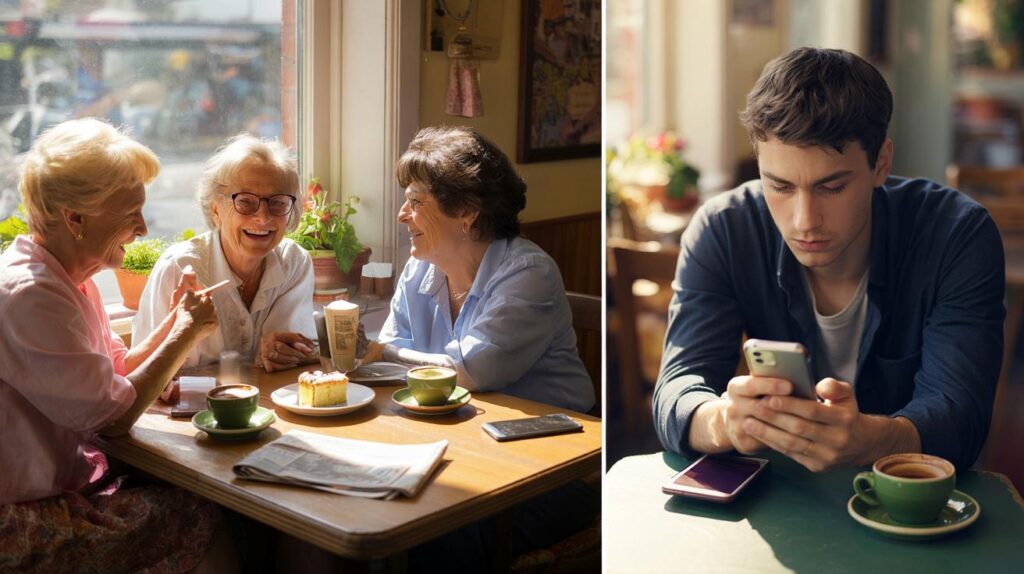
Two tables away, a young man in his twenties scrolls with his thumb like it’s a nervous tick. His coffee is cold, his eyes flick from Instagram to TikTok to some work chat that he keeps checking “just in case”. Outside, the sun is doing its quiet job. Inside, two generations are living completely different Saturdays.
One is present.
One is almost never really there.

And nobody wants to say out loud who actually looks happier.

Why the quiet joy of older people feels so unsettling
Spend an afternoon in any park and you’ll see it. Older couples on benches, just sitting. Watching dogs, watching kids, sometimes just watching the sky change color. You might call it “doing nothing”. They’d probably call it living.
A few meters away, teenagers walk in slow, zigzagging lines, heads bowed to screens, pausing only to film themselves laughing at something that didn’t seem very funny in real life. They document everything, experience almost nothing.
The weird part? The people who grew up without smartphones often look less lost than the ones who can’t imagine life without them.
Take my neighbor, 72, retired bus driver. He starts his day with a radio show, slices an orange, waters his plants, then walks to buy his bread. No smartwatch. No tracking app. He calls it “his circuit”. He’s walked it for fifteen years, always waving to the florist, always chatting with the baker.
He told me once, half-smiling, that the best thing about retirement is choosing one thing to enjoy each day. “One good coffee, one good talk, one good nap,” he said.
On the same street, a young woman with expensive headphones speed-walks past, staring at an email notification. Steps tracked. Heart rate tracked. Mood logged. Yet when you look at her face, there’s that tightness around the jaw that says: fun postponed, again.
Older people have something most tech-addicted youth rarely touch: a stable baseline. They’ve seen recessions, breakups, births, funerals. They’ve felt boredom without numbing it with a feed. Their nervous systems have had time to learn that a quiet day isn’t a failure; it’s a gift.
Youth today live inside a casino of notifications. Every buzz says, “This might matter.” Every red dot whispers, “You’re missing out.” The result is a permanent low-grade panic, disguised as productivity.
The contrast is brutal: one group is told they’re “past their peak”, yet sleeps better, laughs louder, and forgets their phone at home without collapsing.

What older people are doing differently without bragging about it
Watch the small gestures. That’s where the secret hides. A man in his sixties stirring his soup slowly, tasting it twice, adjusting the salt with care. A grandma folding laundry while humming some half-forgotten song. These aren’t “aesthetic routines” for social media. They’re rituals built over decades.
One simple method many older people use instinctively: they single-task. When they eat, they eat. When they talk, they look you in the eye. They’ll pause a story to sip their tea, not to check a notification.
Their attention isn’t scattered across five apps. It’s placed, almost ceremonially, on the moment in front of them.
Younger people often try to copy this with digital detox weekends or “mindfulness challenges”. Then real life hits: messages from work on Sunday, group chats that never sleep, that tiny itch to grab the phone during any 5-second pause.
There’s no shame in this. We’ve been trained like that. The platforms are designed to make stillness feel wrong. Yet that’s exactly the space where older people quietly thrive. They sit in waiting rooms without pulling out a phone. They stand in line and just…stand in line. We’ve all been there, that moment when you reach for your phone at a red light and feel slightly ridiculous.
They don’t expect every second to be optimized. We do, and it’s exhausting.
We rarely admit that a 68-year-old who reads a paperback on the balcony might be emotionally richer than a 23-year-old juggling three side hustles and a burnout playlist.
- They accept limitsOlder people know they can’t “do it all”, and the relief of that acceptance is enormous.
- They value offline bondsThey grew up knocking on doors, not “liking” stories, so real presence still counts more than reactions.
- They’re less hooked on metricsNo streaks, no follower counts, no daily “insights” about their productivity.
- They allow boredomIn that empty space, small ideas and quiet pleasures appear.
- *They don’t need to perform happiness to feel it*
The truth nobody wants to admit about who’s really winning
Ask most young adults who they’d rather be: themselves with energy, possibilities and tech, or a seventy-year-old with slower knees and no Instagram. Almost everyone picks youth. It sounds obvious. It also hides a strange kind of denial.

Because if you look purely at inner climate — the level of stress, the relationship with time, the capacity to enjoy a simple day — many people in their sixties and seventies are quietly ahead. They don’t brag about it; they don’t post threads about “slow living”. They just live.
Let’s be honest: nobody really does this every single day. But they do it more often than the headlines admit.

| Key point | Detail | Value for the reader |
|---|---|---|
| Slower rhythms calm the mind | Older people move, eat and decide at a human pace, not a notification pace | Gives you permission to stop treating speed as the only form of success |
| Attention is a muscle | They grew up training focus on books, conversations, manual tasks | Inspires simple practices to rebuild your own focus in a noisy world |
| Joy doesn’t need an audience | Their happiest moments usually happen far from cameras and feeds | Helps you separate real pleasure from performative “content” |
FAQ:
- Question 1Are older people really happier, or does it just look that way from the outside?Several studies show a “U-shaped” curve of happiness, often rising again after the 50s. Many older adults report less stress, more emotional stability, and better acceptance of themselves, even with health issues.
- Question 2Is technology the villain in all this?Tech itself isn’t evil. The problem comes from constant, unfiltered use. Older people simply tend to keep tech as a tool, not a lifestyle, which protects their attention and sleep.
- Question 3Can a younger person realistically live more like this without quitting their job?Yes, in small pockets. One tech-free meal a day. A ten-minute walk without earbuds. Leaving your phone in another room at night. Tiny moves change the overall feel of your days.
- Question 4What do older people think of anxious, tech-addicted youth?Most aren’t judging as much as we imagine. They’re often worried, sometimes sad, and occasionally relieved they didn’t have to grow up like this. Many would happily share what helped them if someone asked.
- Question 5How do I learn from older people without sounding patronizing or awkward?Ask specific, genuine questions: “What did you do for fun at my age?”, “What do you enjoy most about your days now?”. People in their sixties and seventies usually light up when someone cares about their story.
