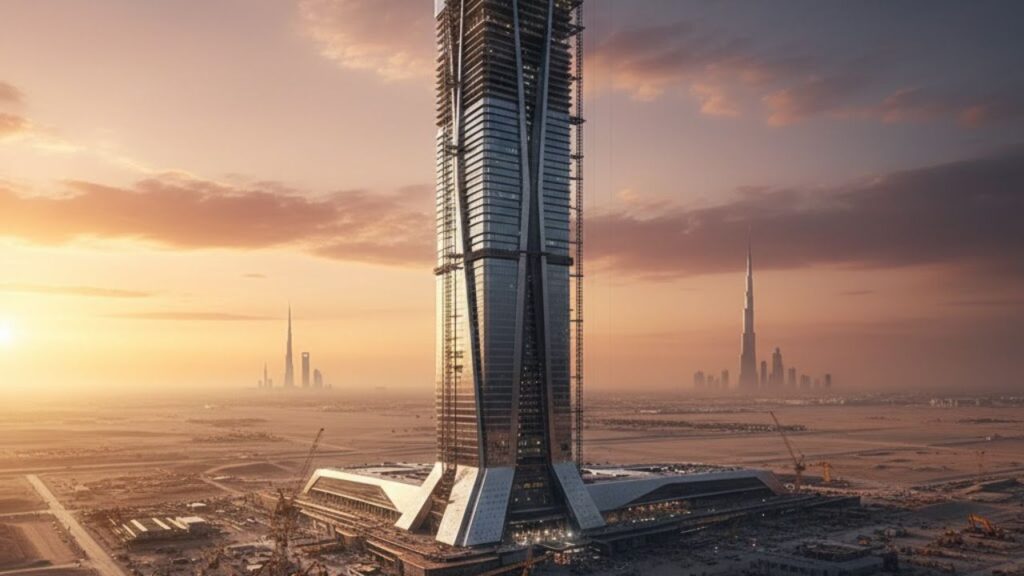
As night falls over Jeddah, the Red Sea corniche lights up, creating a glowing reflection in the water like a second city floating upside down. Beyond the palm trees and traffic, a quiet stretch of land holds the site of Jeddah Tower, a project aiming to break records and soar into the clouds at nearly one kilometer high. For years, it was just a dream, a rumor, and then a stalled construction site. But now, it’s back on track and eyeing Burj Khalifa’s crown.
The Vision Behind Jeddah Tower: More Than Just Tall
For years, cities like New York, Dubai, and Shanghai competed in a friendly race to build the tallest skyscraper. However, Saudi Arabia entered the competition with an entirely new ambition: a tower so tall, Burj Khalifa’s 828 meters start to look modest. Jeddah Tower is planned to reach 1,000 meters, surpassing Burj Khalifa and dwarfing Shanghai Tower’s 632-meter design. But it’s not just about height; it’s about symbolism, ambition, and leaving a lasting mark on the 21st century.
From Dream to Reality: The Long Journey of Jeddah Tower
Construction of Jeddah Tower began in 2013, and by 2018, it had reached 250 meters before work came to a halt due to complex challenges, including politics and construction difficulties. Locals passed the half-finished tower, accustomed to seeing cranes standing still, while rumors circulated about its future. Yet, late in 2023 and into 2024, the project was re-energized. With international firms bidding, the one-kilometer vision is back on track, promising to make its mark.

Why Height Matters: Symbolism Beyond the Skyline
Skyscrapers have always been symbols of power, from the Empire State Building to the Petronas Towers. For Saudi Arabia, Jeddah Tower isn’t just about height; it’s a statement of arrival, showing the world that the country is transitioning from oil dependence to a tourism, tech, and services hub. It’s also a bold move to outshine Dubai and draw attention to Saudi Arabia’s evolving identity in the Gulf rivalry.
The Challenges of Building a 1km Tower in the Desert
Building tall is challenging, but constructing a one-kilometer tower in the desert, on soft coastal soil, with harsh Red Sea winds, is an entirely different endeavor. Engineers have rethought everything that worked for Burj Khalifa and Shanghai Tower, including the deep foundations necessary to support such an immense structure. The tower’s triangular design narrows as it rises, cutting down wind resistance and turbulence. Concrete mixes must withstand extreme temperature variations, while elevators are being re-engineered with mid-rise “sky lobbies” to manage the building’s vertical scale.
Life at 1,000 Meters: Luxurious Views and Unique Challenges
Inside the Jeddah Tower, the vision includes luxury apartments, observation decks, and offices offering panoramic views. Imagine sipping coffee 150 floors above the ground, with views stretching across the horizon. However, such ultra-tall structures are risky, expensive, and slow to generate profit. Saudi Arabia bets that Jeddah Tower will anchor a new district, bringing in hotels, malls, businesses, and tourists eager to experience the world’s tallest building.
Questions and Criticisms: The Reality of Jeddah Tower
Despite its grand ambition, there are tough questions surrounding Jeddah Tower’s feasibility. Critics ask about the practicality of filling the immense space, the environmental impact of cooling such a massive building in a warming climate, and whether global tastes for ever-taller structures will last. These concerns are being weighed against the tower’s potential to revitalize Jeddah and boost the local economy.
Jeddah Tower’s Role in Vision 2030: Transforming the Red Sea Coast
Jeddah Tower is more than just a skyscraper; it’s a central part of Saudi Arabia’s Vision 2030 initiative. The tower is meant to catalyze a transformation of Jeddah’s waterfront, creating new public spaces, transport links, and mixed-use neighborhoods. This marks a shift from Jeddah’s old “stopover” image to a vibrant destination city. However, not everyone is excited. Some fear that luxury towers will drive up prices, pushing out everyday residents. The project also faces the legacy of other ambitious megaprojects that have faltered before.
What’s at Stake: Ambition, Risk, and Future Generations
The emotional tone of this project is not just about height but about changing the city’s identity. If Jeddah Tower becomes more than a trophy and becomes a thriving urban center, it will redefine the city. The key to success lies in creating a city that’s human-scale, with streets, parks, and transport that feel alive, not just luxury spaces. The world will need to watch the project’s evolution, from delays to redesigns, as Saudi Arabia navigates the political and financial challenges ahead.
The Future of Tall Towers: More Than Just a Skyline
Looking ten years into the future, Jeddah Tower may become an iconic symbol, standing as a testament to Saudi Arabia’s ambitions. It will be more than just the tallest building in the world; it will represent a country pivoting toward global tourism and high-tech services. Like the Eiffel Tower in 1889 and the Empire State Building in the 1930s, Jeddah Tower will symbolize an era—if it succeeds. The question remains: will the environmental cost of cooling and maintaining such a massive tower prove sustainable in the long run?
Key Insights on Jeddah Tower’s Impact
- Jeddah Tower’s ambition: The tower is designed to surpass Burj Khalifa and Shanghai Tower, changing the global skyline and regional power dynamics.
- Vision 2030 integration: The project is part of Saudi Arabia’s larger economic shift towards tourism, tech, and diversification away from oil.
- Engineering complexities: Building such a tall structure presents challenges, including complex foundations, climate concerns, and social impact.