
It might be early evening. The light outside has softened, and the house has settled into its familiar sounds. You notice how your shoulders drop when the door closes behind you. Not from exhaustion exactly, but from relief. The quiet feels like something you can breathe.
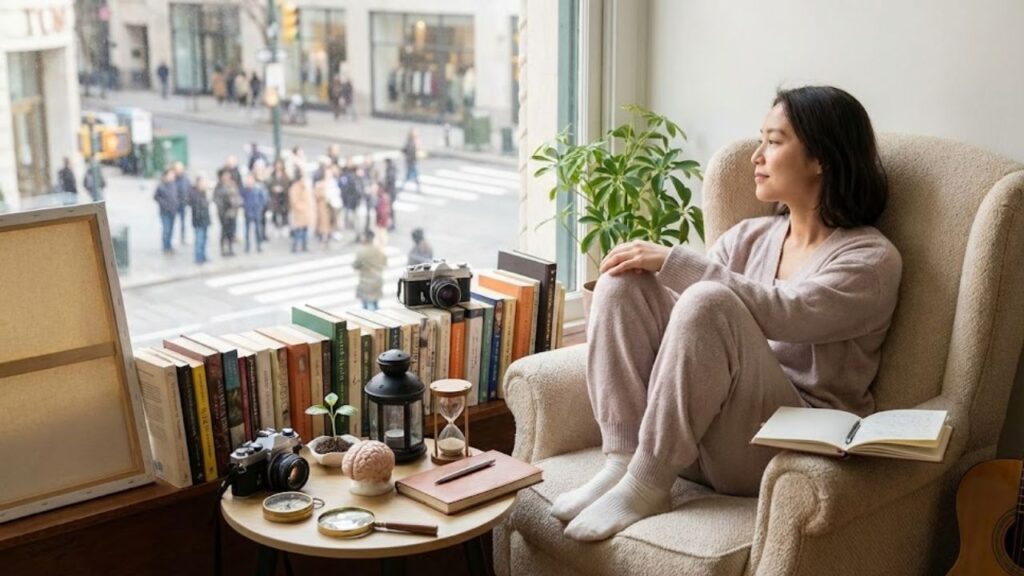
You’re not hiding from anyone. You’ve simply reached that part of life where silence feels fuller than noise. Where being alone doesn’t feel empty—it feels complete.
There was a time when this preference puzzled you, maybe even worried you. You wondered if something was wrong for not craving constant company. But slowly, without any announcement, you began to notice something else: the quiet was showing you who you really were.

The subtle feeling of being out of step
At some point, many people begin to feel slightly out of sync with the world around them. Conversations move faster than you’d like. Social calendars fill before you’ve had time to think. Even well-meant invitations can feel heavy rather than exciting.

You might still enjoy people deeply. You listen carefully. You care. But the pace of constant interaction no longer matches your inner rhythm. It can feel as though the world is speaking in a louder language than you need.
This isn’t loneliness. It’s a mismatch of tempo. And it often shows up quietly, without drama or explanation.
What solitude starts to mean with age
Psychology doesn’t frame a preference for solitude as withdrawal or avoidance. Especially later in life, it often reflects a shift toward internal clarity. Solitude becomes less about being away from others and more about being close to yourself.
As years pass, the nervous system becomes less tolerant of constant stimulation. Noise, interruptions, and surface-level chatter can feel draining rather than energising. The mind starts to value depth over volume.
This is where certain traits begin to surface—not loudly, but consistently.
Eight rare traits that often travel with a love of solitude
People who genuinely prefer solitude often carry qualities that aren’t immediately visible in social settings. They don’t announce themselves. They reveal themselves slowly.
Psychology suggests these traits are less common not because they’re superior, but because they require space to develop.
First, there is deep self-awareness. Time alone allows you to notice your own emotional weather without distraction. You recognise when you’re tired, overstimulated, or quietly content.
Second, emotional independence. You don’t rely on constant feedback to feel steady. Your sense of self isn’t built from applause or approval.
Third, heightened empathy. Solitude sharpens listening. When you do engage, you often hear what isn’t being said.
Fourth, strong inner boundaries. Preferring solitude usually means you’ve learned where your limits are. You know when to step back before resentment forms.
Fifth, creative or reflective thinking. Ideas tend to arrive in quiet moments. Your mind connects dots when it isn’t rushed.
Sixth, comfort with complexity. You can sit with mixed emotions without needing to resolve them immediately.

Seventh, selective attachment. You don’t spread yourself thin socially. You choose fewer connections, but invest more meaningfully in them.
Eighth, a grounded sense of purpose. Your life doesn’t need to look busy to feel meaningful.
A small, familiar example
Maria, 62, noticed this shift after retiring. At first, she worried she was becoming “less social.” Friends invited her out often, and she went—until she realised she felt most like herself during her quiet mornings.
She still loved her people. She simply loved her own company more than she expected. Over time, she stopped apologising for that.
What’s happening beneath the surface
There’s nothing mysterious happening in the body or mind. With age, the brain becomes more efficient at filtering what matters. It no longer wants to process everything.
Stress responses can linger longer than they once did. Recovery takes more care. Solitude gives the nervous system a chance to reset without effort.
Emotionally, there’s often less interest in performing roles. You don’t need to fill silences or explain yourself. Being alone becomes a place where nothing is demanded.
Gentle ways people naturally adjust
Those who value solitude don’t usually make dramatic lifestyle changes. Instead, they make small, respectful adjustments that honour their energy.
- Letting invitations sit for a moment before responding
- Choosing quieter settings over crowded ones
- Allowing space between social commitments
- Spending time on solitary rituals like walking or reading
- Being honest about needing rest without over-explaining
A thought that often surfaces in quiet moments
“I’m not pulling away from life. I’m finally standing close enough to hear myself.”
Reframing what solitude really is
Preferring solitude doesn’t mean you’ve become distant or disconnected. It often means you’ve become more precise about where your energy belongs.
There’s a quiet confidence that comes with this understanding. You stop measuring your life by how full your calendar is. You begin to measure it by how settled you feel.
Solitude, in this sense, isn’t an absence. It’s a presence. A space where your thoughts slow down enough to make sense.
And perhaps the most comforting part is this: nothing needs fixing. This shift isn’t a problem to solve. It’s a signal that you’re listening more closely to yourself than you once did.

That, in its own quiet way, is a rare trait.

| Key point | Detail | Value for the reader |
|---|---|---|
| Preference for solitude | Less stimulation, more internal clarity | Reduced emotional and mental fatigue |
| Rare inner traits | Self-awareness, empathy, independence | Deeper sense of identity |
| Natural adjustment | Gentle changes rather than withdrawal | Permission to live at your own pace |
