Those bright velvet-green patches can look appealing at first, until the grass beneath starts thinning and the mower fills with slimy clumps. Across the UK and the US, more home gardeners are stepping away from harsh chemicals and asking a practical question: is it possible to manage moss while staying environmentally responsible?
Why moss spreads so easily in lawns
Moss is not a weed in the usual sense. It is a bryophyte, an ancient plant group that lacks true roots, flowers, and seeds. This simple structure gives it a strong advantage in challenging environments.
It thrives in damp, compacted, and shaded areas where grass struggles to survive. Beneath trees, along fences, or at the base of slopes where moisture collects, moss quickly establishes itself. Once conditions suit it, it forms a dense mat that pushes out weakened grass.

In most cases, moss is a symptom rather than the root problem. Its presence usually signals that the lawn is under stress.

Several conditions commonly tip the balance in moss’s favour:
- Acidic soil with a low pH that limits grass growth
- Poor drainage where water lingers after rainfall
- Heavy shade from trees, hedges, or walls
- Very short mowing that weakens grass plants
- Nutrient-poor soil lacking organic matter
- Compacted ground that restricts air and root movement
Focusing only on scraping or killing moss treats the surface issue. The real solution lies below ground, in soil health and everyday lawn care.
Four natural ways to build a moss-resistant lawn
1. Adjust your mowing approach
Mowing quietly shapes the health of a lawn. Cutting grass too short, generally below 4 cm (1.5 inches), puts it under constant stress. With less leaf surface, grass struggles to photosynthesise and recover. Moss, which tolerates low growth, quickly takes advantage.
Gardeners aiming for a more resilient lawn usually follow two basic principles:
- Leave grass slightly taller, especially in shaded or dry areas
- Mow more often, removing smaller amounts each time
A sharp mower blade combined with a higher cut often does more to reduce moss than repeated chemical treatments. Clean cuts heal faster, while blunt blades tear grass, increasing stress and opening space for moss to return.
2. Nourish the soil with organic feeds
A lawn lacking nutrients quickly becomes thin and patchy, exposing bare soil that moss readily colonises. Instead of synthetic fertilisers, many gardeners now rely on organic feeding options.
Materials such as home compost, pelleted manure, and plant-based fertilisers release nutrients slowly. At the same time, they support soil life, including beneficial bacteria and fungi, which improve structure and help roots access water and minerals.
Well-fed grass grows thicker and knits together, shading the soil surface. This creates far less favourable conditions for moss, which depends on exposed, wet ground.
3. Improve airflow with aeration and better drainage
Soil compaction is one of the most common hidden causes of moss. Foot traffic, pets, play, and heavy equipment compress the soil, eliminating air spaces. Roots struggle, and water pools on the surface.
Aeration directly tackles this issue by creating channels that allow air, water, and nutrients to reach the root zone. Even a single aeration session can make a noticeable difference in spongy, moss-prone lawns.
Simple methods include:
- Wearing spike shoes while walking across the lawn
- Using a hollow-tine aerator to remove small soil plugs
- Piercing compacted areas with a garden fork
On persistently wet ground, filling the holes with a light mix of sand or compost can gradually improve drainage. Over time, earthworms and soil organisms help keep these channels open.

4. Scarifying for a controlled surface clean
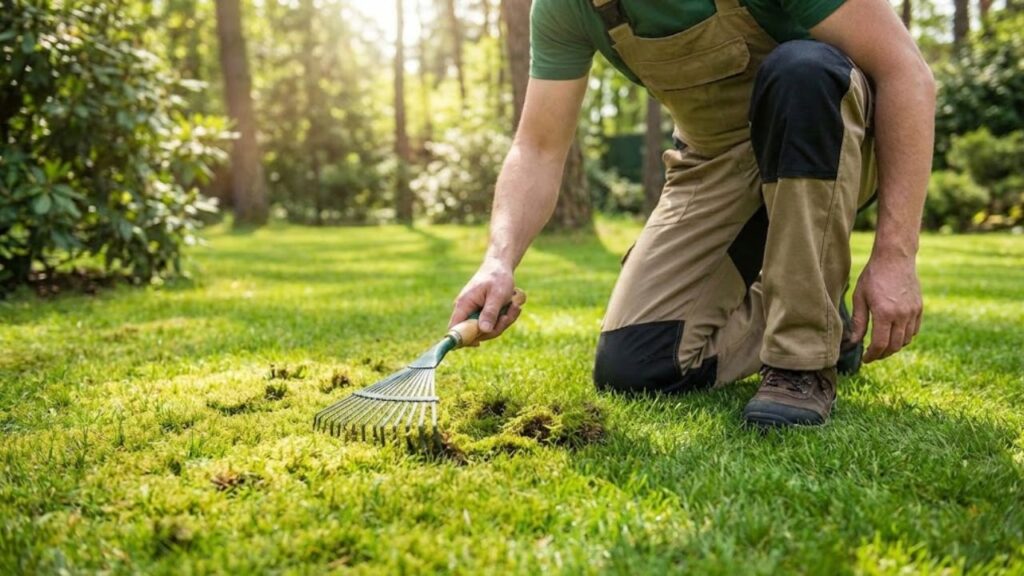
Scarifying involves lightly raking or using a scarifier to remove surface moss and thatch, the layer of dead grass and debris that builds up over time.
When done in spring or early autumn, scarifying allows light and air to reach the soil and creates small grooves where new grass seed can settle. It is best seen as removing a suffocating layer so healthy growth can return.
The lawn may look rough for a short period after scarifying. This is normal. Combined with overseeding and gentle feeding, the grass usually regrows thicker and becomes more competitive against moss.
Finding balance between tidy lawns and living gardens
Frustration with moss reflects a wider change in gardening habits. For many years, the goal was a flawless green lawn with no variation. Today, more gardeners question whether that ideal fits a changing climate and declining biodiversity.
Small amounts of moss are not harmful. Moss can shelter insects, provide nesting material for birds, and thrive in shaded areas where grass never will. In these spots, it can even serve as a low-maintenance ground cover.
A lawn with occasional moss patches is not a failure. Many gardeners now maintain a neat central area for use, while allowing more natural edges where moss, clover, and small wild plants coexist.
The benefits of avoiding chemical moss killers
Conventional moss treatments often rely on iron sulphate or similar compounds that blacken moss quickly. While effective in the short term, they do not address the conditions that allow moss to thrive. Repeated use can also affect soil structure and nearby plants.
A natural approach works more gradually but offers lasting advantages:
- Healthier soil life that supports long-term growth
- Improved water management with fewer puddles
- Lower risk for pets and children
- Greater resilience during droughts and heavy rain
Common home remedies shared online, such as vinegar or salty water, often damage soil and surrounding plants. They typically leave bare patches that moss soon recolonises. Addressing the environment, not just the moss itself, remains the most sustainable option.
Adapting strategies to different garden types
Small urban lawns with heavy shade
In city gardens surrounded by buildings or large trees, grass will always struggle. In these cases, reducing lawn size can be more effective than constant moss removal. Keeping grass in brighter areas while allowing shaded sections to support moss, ferns, or stepping stones often creates a more practical layout.
Family lawns with constant use
Where children, pets, and games dominate, compaction is unavoidable. An annual routine of aeration, compost topdressing, and overseeding helps grass recover. Raising the mowing height reduces stress, while accepting small mossy areas near fences or play equipment eases pressure on the rest of the lawn.
Clarifying common lawn care terms
Two terms are often confused: aeration and scarification. They describe different but complementary actions.
Aeration targets the soil, creating openings for air, water, and roots. Scarification focuses on the surface, removing moss and thatch to encourage new growth.

Used together with organic feeding and gentler mowing, these practices reduce moss over time. For many gardeners, the goal gradually shifts from total eradication to growing a healthy lawn that coexists with nature, bringing fewer frustrations and a more resilient garden overall.