
Off the coast of Brittany, French researchers have uncovered an astonishing stone wall submerged approximately 9 meters underwater. Dating back around 7,000 years, this structure is believed to have been constructed by coastal hunter-gatherers, suggesting a level of organization and engineering previously unexpected for such early communities.
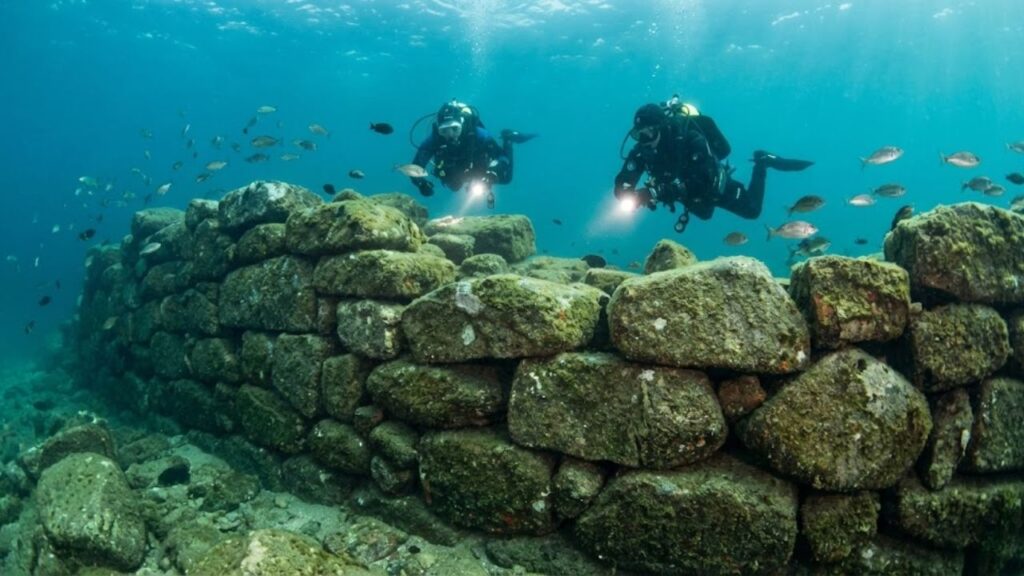
A Hidden Stone Wall Older Than Carnac, Buried Under the Atlantic
The wall was discovered near the island of Sein, off the western coast of Brittany, in an area now subjected to strong tides and turbulent waters. The first hint of the structure did not come from divers, but from detailed seafloor maps. French geologist Yves Fouquet noticed a long, straight anomaly that didn’t resemble natural rock formations.
Between 2022 and 2024, targeted dives confirmed the existence of the structure. Divers reported a linear formation stretching across the seabed, clearly arranged by human hands.

Measuring approximately 120 meters in length and standing nearly 2 meters high, the wall’s regularity and straight lines clearly indicate it was not a natural formation. The base measures about 20 meters wide, tapering as it rises. Rows of granite blocks are placed in two neat, parallel lines, with many of the stones large enough to require careful coordination for lifting and placement.

Understanding the Wall’s Construction: A Glimpse into Prehistoric Engineering
Radiocarbon dating of materials found near the wall places its construction between 5,800 and 5,300 BCE. At that time, sea levels were about 7 meters lower than they are today, meaning the structure would have stood on dry land, likely near a tidal zone or shoreline, facing the open ocean.
Unveiling the Complexity of Coastal Hunter-Gatherers
The discovery of the wall places it firmly in the Mesolithic period, the time of the last hunter-gatherers in Western Europe. This timing is significant and excites archaeologists, as it challenges long-standing views about these early communities.
For years, textbooks depicted coastal hunter-gatherers as small, mobile bands with simple camps and little social hierarchy. The discovery of a 120-meter stone wall, built from heavy granite blocks, directly contradicts this image.
The construction of such a large structure suggests careful planning, leadership, and collaboration over weeks or months, rather than a quick project by a few foragers.

Reinterpreting Early Communities: The Need for Collaboration and Planning
Researchers writing in the International Journal of Nautical Archaeology argue that such a project would have required:
- A shared goal agreed upon by a sizable community
- Knowledge of tides, fish behavior, and coastal dynamics
- Logistics for sourcing, transporting, and stacking stones
- Some form of tradition or belief strong enough to justify the labor
These factors suggest that these early communities had stable gathering spots and a sense of territorial control. Rather than drifting along the coast, they seemed to have invested significantly in particular locations, returning season after season.
What Was the Purpose of the Wall? Exploring Two Main Theories
The exact function of the wall remains uncertain, and there may never be a single definitive answer. However, two main theories dominate current discussions.
The Wall as a Giant Fish Trap
Many archaeologists believe the wall may have served as a massive fish trap. Similar, smaller structures have been discovered throughout Europe and beyond—low walls built across tidal flats to corral fish as the tide recedes.

In this scenario, the ancient wall near Sein would have functioned as follows:

- High tide: Fish would move over the wall and into the shallows, following plankton and smaller prey.
- Falling tide: As the water level dropped, fish would become trapped in depressions or channels formed by the wall.
- Low tide: Groups would walk out to collect the stranded fish using nets, spears, or baskets.
